
Healthcare IT Technician Jobs and Salary: Entry-Level Requirements in 2026
Healthcare organizations depend on computers, networks, electronic health records, mobile devices, printers, and secure user accounts throughout daily operations. When those systems fail, healthcare employees need technical support that is fast, accurate, and sensitive to the clinical environment.
For beginners and career changers, this creates opportunities in help desk, desktop support, electronic health record support, and other entry-level technical roles. The healthcare IT technician salary you can expect depends on the job title, location, employer, technical responsibilities, experience, and shift requirements.
This guide uses U.S. salary data and current job-market examples. It explains what healthcare IT technicians do, what entry-level employers may expect, which certifications can help, and how to find local or remote opportunities.

What Is a Healthcare IT Technician?
A healthcare IT technician provides technical assistance to employees working in hospitals, clinics, laboratories, insurance organizations, medical practices, and healthcare technology companies.
The role combines general IT support with an understanding of healthcare operations. A technician might solve a familiar computer problem, such as a failed login, but must do so without unnecessarily exposing patient information or disrupting clinical work.
Healthcare IT technician is not one standardized occupation. Employers may use titles such as healthcare help desk technician, hospital desktop support technician, medical IT support specialist, EHR support technician, or service desk analyst. Responsibilities can therefore vary considerably.
Common Responsibilities
Common responsibilities include:
- Troubleshooting computers, monitors, printers, scanners, and mobile devices
- Responding to support tickets by phone, chat, email, or in person
- Installing and configuring approved hardware and software
- Resetting accounts and resolving access problems
- Supporting Microsoft 365, Windows, identity systems, and remote-access tools
- Assisting users with electronic health record applications
- Diagnosing basic network connectivity problems
- Documenting incidents, solutions, and escalation steps
- Following privacy, access-control, and cybersecurity procedures
- Escalating advanced infrastructure or clinical application issues
These duties are similar to those of computer user support specialists, who provide technical help, document user problems, repair or set up equipment, and guide users through solutions. O*NET also lists titles such as desktop support technician, help desk analyst, IT support specialist, and technical support specialist within this occupational group.
Practical example: A nurse cannot access a medication-related application before a scheduled procedure. The technician confirms the nurse’s identity, checks the account status, follows the approved access procedure, documents the incident, and escalates the issue if it involves an application permission that the service desk cannot change.
Where Healthcare IT Technicians Work
Healthcare IT support professionals may work in:
- Hospitals and emergency-care facilities
- Physician offices and outpatient clinics
- Diagnostic laboratories
- Health insurance organizations
- Government or university health systems
- Healthcare software companies
- Managed service providers supporting medical clients
- Centralized or remote service desks
Some positions are primarily desk-based, while others involve walking between departments, deploying equipment, replacing workstations, or responding directly within patient-care areas.
Healthcare IT Technician Salary in 2026
A reasonable U.S. estimate for a healthcare IT technician in 2026 is approximately $38,000 to $49,000 per year, with some positions falling below or above that range.
As of June 30, 2026, ZipRecruiter estimated an average healthcare IT technician salary of $44,376 per year, or approximately $21.33 per hour. Its reported 25th-to-75th-percentile range was approximately $38,000 to $49,000.
However, broader IT support occupations can pay more. The U.S. Bureau of Labor Statistics reported a May 2024 median of $60,340 for computer user support specialists and $73,340 for computer network support specialists. These categories include workers outside healthcare and may include positions with broader responsibilities or more experience.
The figures should not be treated as contradictory. Salary websites group jobs by advertised titles, while government occupational data groups workers by duties. A “healthcare IT technician” posting may describe an entry-level support role, while another employer may advertise similar work as an IT support specialist or technical analyst.
Average Healthcare IT Technician Salary
For career-planning purposes, beginners can use the following benchmarks:
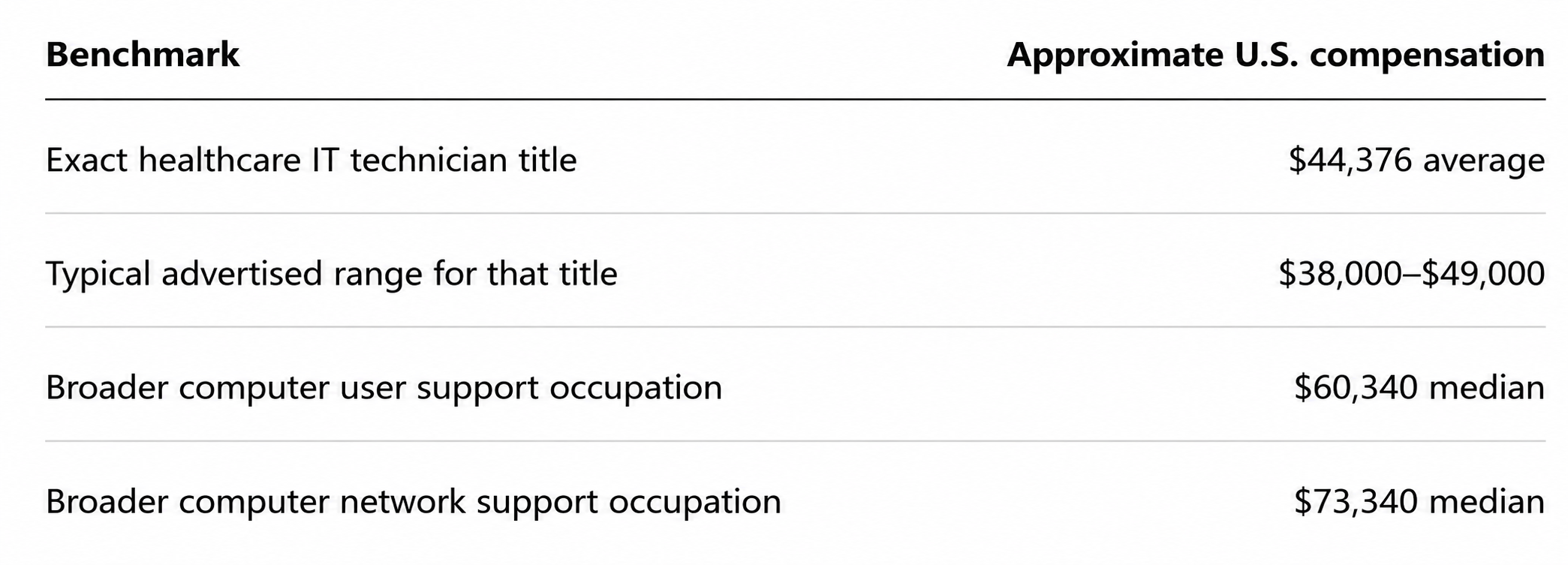
The first two figures reflect a 2026 job-title estimate. The BLS figures are May 2024 occupational medians and provide broader comparison points rather than direct healthcare technician averages.
Entry-Level Healthcare IT Salary
A realistic entry-level healthcare IT salary often begins around $38,000 to $45,000, although some employers may offer less in lower-cost markets or more for night shifts, specialized applications, previous support experience, or stronger technical skills.
A beginner with customer service experience, CompTIA A+, home-lab projects, and good troubleshooting examples may qualify for a stronger starting offer than someone with no evidence of practical ability. Previous hospital experience can also help because the candidate may already understand clinical urgency, privacy expectations, and communication with healthcare employees.
Hospital IT Technician Salary
A hospital IT technician salary may differ from the pay offered by a small clinic or general help desk. Hospitals often operate continuously and maintain large environments containing workstations, shared devices, wireless networks, clinical applications, identity systems, and specialized peripherals.
Compensation may be influenced by:
- Evening, overnight, weekend, or rotating shifts
- On-call responsibilities
- Overtime eligibility
- The number of facilities supported
- Required travel between locations
- EHR or clinical application knowledge
- Responsibility for high-priority incidents
- Benefits offered by the health system
BLS notes that support services may need to be available 24 hours a day and that some support specialists work nights or weekends. Current hospital job postings also show a mixture of weekday, rotating-weekend, and on-site support schedules.
Salary by Experience Level
The following planning ranges are a practical synthesis of the exact-title salary estimate and the wider BLS support-specialist wage distribution. They are not official employer salary bands.
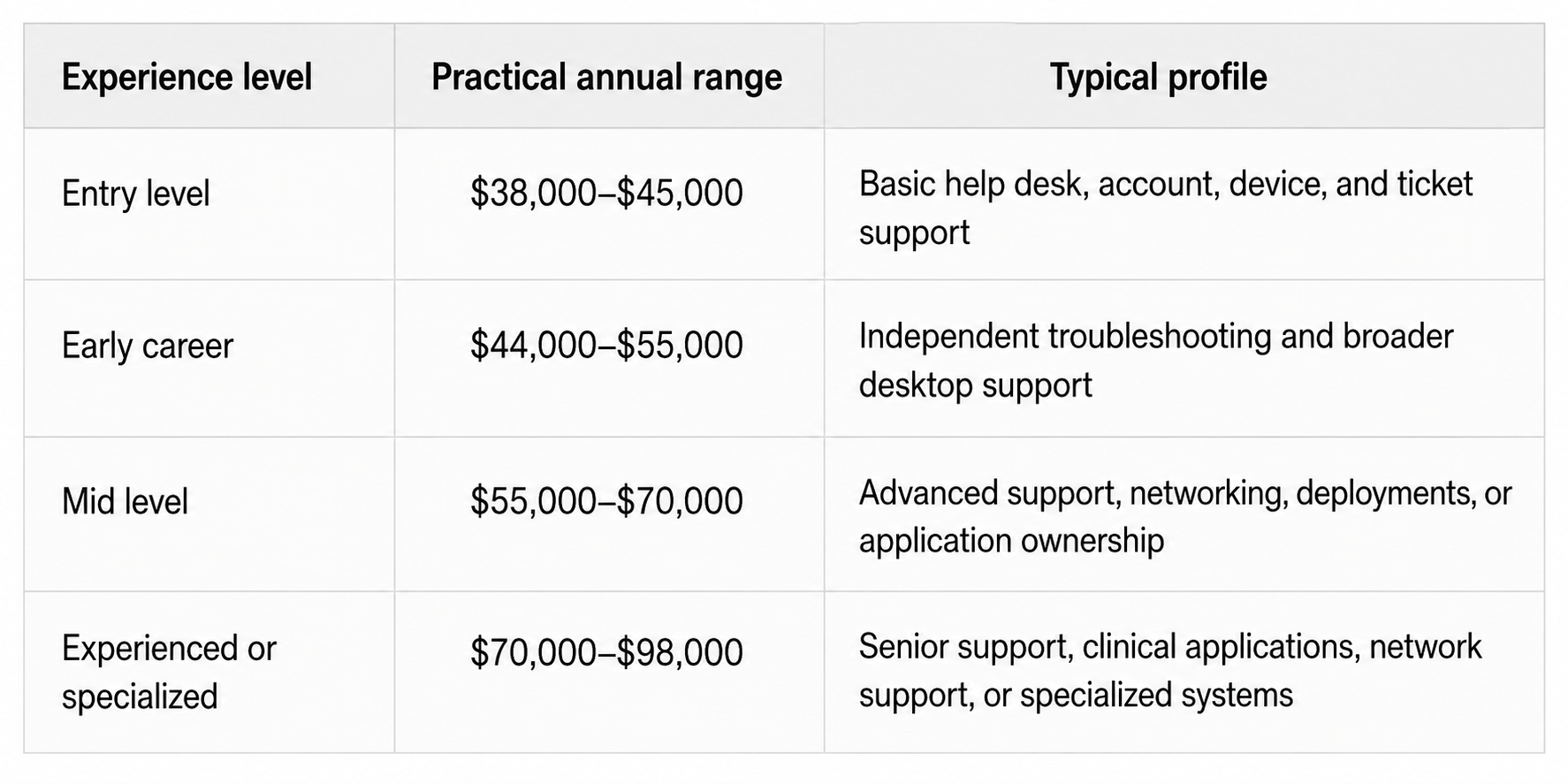
For comparison, BLS reported that the lowest 10% of computer user support specialists earned below $38,780, while the highest 10% earned above $98,010.
Salary by Location
Pay can change significantly between cities, states, and regions. Employers consider local labor markets, living costs, competition for technical workers, and the availability of candidates with healthcare experience.
A higher salary in an expensive metropolitan area does not automatically provide greater purchasing power. Compare the entire offer, including health insurance, retirement contributions, paid leave, overtime, shift differentials, remote-work costs, and commuting requirements.
Factors That Affect Healthcare IT Technician Pay
Experience
Candidates who can resolve incidents independently, communicate clearly, and recognize when to escalate a problem often qualify for higher pay.
Certifications
Certifications may strengthen an application by providing evidence of foundational knowledge. Their value depends on the employer and the position; they do not guarantee employment or a salary increase.
Technical Skills
Experience with Windows, Microsoft 365, hardware, networking, Active Directory, ticketing platforms, endpoint management, mobile devices, remote-support tools, and basic cybersecurity can improve your competitiveness.
Healthcare Systems Knowledge
Knowledge of EHR workflows, identity management, clinical terminology, downtime procedures, and secure handling of health information can distinguish a healthcare candidate from a general help desk applicant.
Employer Type
A small clinic, national insurer, regional hospital, software vendor, and managed service provider may define the role differently and use different compensation structures.
Shift, On-Call, and Overtime Requirements
Night, weekend, holiday, rotating, and on-call schedules may include additional compensation, although policies vary by employer.
Specialized Responsibilities
Technicians who progress into network support, EHR configuration, application support, interfaces, cybersecurity, or project implementation may qualify for higher-paying positions.
Entry-Level Healthcare IT Technician Requirements
There is no universal list of healthcare IT technician requirements. Employers commonly evaluate education, technical ability, customer service, documentation, communication, and the candidate’s ability to work responsibly around sensitive information.
Education Requirements
Depending on the position, an employer may accept:
- A high school diploma with relevant skills or certifications
- Technical or vocational training
- Some college-level IT coursework
- An associate degree
- A bachelor’s degree
- Equivalent professional experience
BLS reports that computer user support candidates may qualify through college coursework, while some employers accept a high school diploma combined with relevant IT certifications. Network support positions are more likely to request an associate degree.
Technical Skills
An entry-level applicant should develop practical familiarity with:
- Windows installation, settings, and troubleshooting
- Basic macOS support
- Computer components and peripheral devices
- IP addressing, Wi-Fi, DNS, DHCP, and connectivity testing
- User accounts, permissions, and identity systems
- Microsoft 365 applications
- Ticket documentation
- Remote desktop and support tools
- Malware prevention and safe browsing practices
- Mobile device configuration
Employers do not necessarily expect beginners to know every system. They do expect them to troubleshoot methodically, protect information, document what they did, and ask for help at the appropriate time.
Healthcare Knowledge
Healthcare IT workers may encounter electronic protected health information. The HIPAA Security Rule requires regulated organizations to use administrative, physical, and technical safeguards that protect the confidentiality, integrity, and availability of electronic protected health information.
An entry-level technician should understand the importance of:
- Verifying a user before changing access
- Avoiding unnecessary exposure to patient information
- Following approved access procedures
- Securing unattended workstations
- Reporting suspected security incidents
- Using only authorized tools and storage locations
- Respecting clinical priorities and downtime processes
This is practical workplace awareness, not legal advice. Employees must follow their organization’s policies and training.
Soft Skills
Strong support technicians demonstrate:
- Clear communication
- Patience with nontechnical users
- Customer service
- Calm decision-making
- Accurate documentation
- Prioritization
- Problem-solving
- Teamwork
- Respect for confidential information
People skills are especially important. BLS occupational data for 2025 found that more than basic people skills were required for 97% of computer user support specialists.
Which Certifications Help With Healthcare IT Technician Jobs?
CompTIA A+
CompTIA A+ is closely aligned with entry-level support. Its skill areas include operating systems, mobile devices, troubleshooting, networking, security, system configuration, backup, recovery, and technical support.
It can be useful for candidates applying to help desk, service desk, desktop support, and junior technician positions.
CompTIA Network+
CompTIA Network+ can help when a position involves switches, wireless networks, IP connectivity, network devices, cloud networking, VPNs, troubleshooting, or infrastructure support. CompTIA’s credential information identifies wired and wireless network configuration, maintenance, security, and troubleshooting as core skills.
CompTIA Security+
CompTIA Security+ may be relevant when a healthcare role includes stronger cybersecurity, access control, threat, risk, or data-protection responsibilities. The credential covers core security functions, including threats, vulnerabilities, risk mitigation, access control, cryptography, and security management.
Other Relevant Training
Depending on the role, useful training may include:
- Microsoft administration and endpoint support
- IT service management fundamentals
- Cloud support
- Vendor-specific EHR training
- Healthcare privacy and security awareness
- Epic, Oracle Health, or other application training provided by an employer
The former CompTIA Healthcare IT Technician certification and HIT-001 exam are retired and should not be presented as currently available. Candidates searching for that credential should consider current certifications such as A+, Network+, or Security+, depending on their target role.
Can You Get a Healthcare IT Job Without Experience?
Yes, but you must provide another form of evidence that you can perform the work.
Useful ways to build that evidence include:
- Creating a small home lab with Windows users and permissions
- Practicing hardware and operating-system troubleshooting
- Writing sample support tickets and resolution notes
- Volunteering to help a nonprofit with basic technology
- Completing an internship or entry-level customer support role
- Preparing for a relevant certification
- Documenting technical projects on your résumé
- Practicing explanations for common support scenarios
Beginner scenario: A retail customer service employee studying for CompTIA A+ builds a virtual Windows lab, practices password resets and network troubleshooting, and documents each exercise. During an interview, the candidate connects customer de-escalation experience with technical problem-solving. That combination may support an application even without previous hospital employment.
Common Healthcare IT Technician Jobs
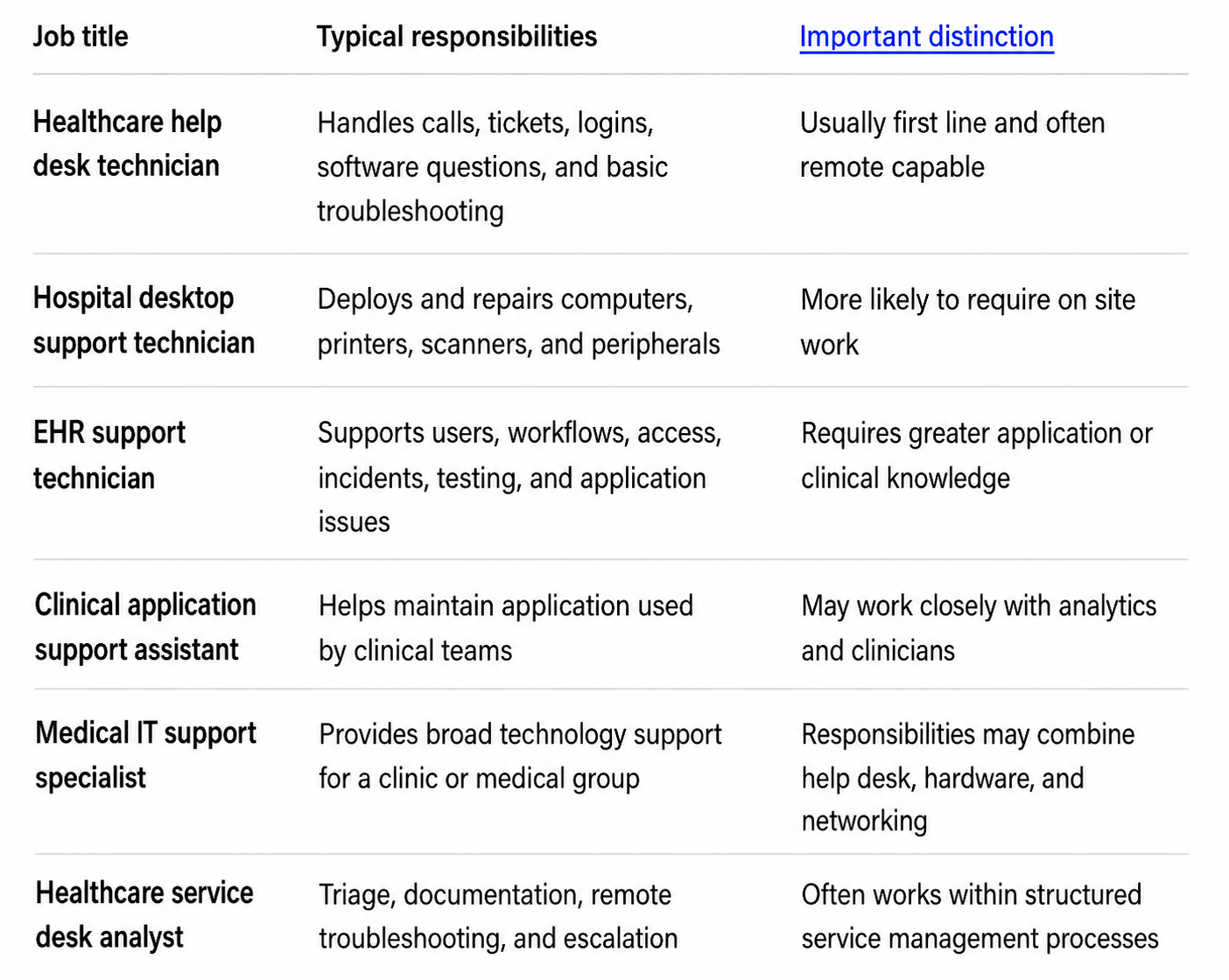
Current healthcare job postings illustrate these differences. An HCA technical analyst position focuses on facility desktop equipment and incidents, while an EHR support analyst serves as an on-site resource for clinical applications and second-level support.
CompTIA Healthcare IT Technician Jobs: What Does This Search Mean Today?
People searching for CompTIA healthcare IT technician jobs may expect to find positions connected to the old HIT-001 credential.
Because that examination is no longer active, employers are more likely to focus on current support skills, practical experience, customer service, healthcare familiarity, or certifications such as CompTIA A+, Network+, and Security+.
Do not limit your search to the exact phrase “CompTIA healthcare IT technician.” Search for the actual job responsibilities and alternative titles.
Remote Healthcare IT Jobs
Some remote healthcare IT jobs are available, particularly in service desk, account support, ticket triage, software troubleshooting, EHR application support, training, and user guidance.
Current healthcare employers advertise remote roles involving EHR configuration, hospital billing systems, application maintenance, and clinical workflow support. These more specialized remote positions commonly require prior healthcare or application experience.
Remote-Friendly Responsibilities
- Password and account assistance
- Software troubleshooting
- Ticket intake and prioritization
- Remote desktop support
- EHR user guidance
- Application support
- User training
- Documentation
Roles That Often Require On-Site Work
- Replacing failed workstations
- Deploying equipment
- Connecting printers and scanners
- Repairing physical devices
- Supporting network cabling
- Troubleshooting devices in clinical areas
BLS confirms that some support specialists can telework, while others must be on-site or travel to user locations.
Before applying to a remote job, confirm that the posting appears on the employer’s official career page. Be cautious if someone offers employment without a normal interview, requests money, sends a check for equipment, or asks you to purchase equipment through a particular vendor. UnitedHealth Group, for example, has published warnings about counterfeit-check and fake recruitment schemes.
How to Find Healthcare IT Jobs Near Me
When searching for healthcare IT jobs near me, begin with the employers that operate healthcare facilities in your area.
Practical methods include:
- Reviewing hospital and clinic career pages
- Checking regional healthcare networks
- Searching universities with medical centers
- Reviewing government healthcare employers
- Looking at health insurers and healthcare software vendors
- Contacting healthcare staffing agencies
- Searching managed service providers with medical clients
- Using job-board location filters
- Networking with local IT professionals
Use several search phrases:
- Entry-level hospital IT technician
- Healthcare help desk technician
- EHR support specialist
- Medical desktop support
- Clinical application support
- Healthcare service desk analyst
- Technical analyst hospital
- IT support specialist clinic
Searching alternative titles is important because “healthcare IT technician” is not used consistently across employers.
Example Career Path
A realistic beginner path might look like this:
- Learn computer hardware, operating systems, networking, and security fundamentals.
- Prepare for CompTIA A+ or another relevant entry-level certification.
- Build a small home lab.
- Practice ticket-based troubleshooting and documentation.
- Apply for help desk, service desk, clinic support, and hospital desktop roles.
- Learn healthcare systems and workflows through the first position.
- Progress into networking, EHR support, application analysis, cloud support, or cybersecurity.
This is an example, not a guaranteed timeline. Career progress depends on available positions, performance, training, location, and the experience gained on the job.
How to Improve Your Chances of Getting Hired
Tailor your résumé to each position rather than submitting the same document everywhere.
Highlight:
- Technical projects
- Customer service experience
- Troubleshooting examples
- Certifications in progress or completed
- Measurable accomplishments
- Ticketing or documentation experience
- Healthcare terminology or workflow knowledge
- Availability for required shifts
Prepare interview stories explaining how you identified a problem, gathered information, tested possible causes, communicated with the user, documented the result, and escalated when necessary.
A home-lab résumé entry could say:
Windows Support Lab: Created virtual Windows workstations, configured local users and permissions, tested network connectivity, documented five troubleshooting scenarios, and practiced restoring systems from backups.
Is a Healthcare IT Technician Career Worth It?
Healthcare IT support can be a worthwhile entry point for people who enjoy technology, troubleshooting, and helping others.
Potential advantages include:
- Entry-level positions that may not require a four-year degree
- Transferable IT support skills
- Exposure to healthcare applications and workflows
- Opportunities to move into networking, cybersecurity, or application support
- Work that contributes to reliable healthcare operations
Potential challenges include:
- High-pressure incidents
- Frustrated or busy users
- Shift and on-call work
- Strict security and privacy responsibilities
- Continuous learning
- The need to work on-site for many hardware-related positions
The career is most suitable for someone who can remain calm, communicate clearly, follow procedures, and take responsibility for secure and accurate work.
Frequently Asked Questions About Healthcare IT Technician Jobs and Salary
How much does a healthcare IT technician make?
A 2026 U.S. job-title estimate places the average healthcare IT technician salary at approximately $44,376 per year, with many advertised salaries between about $38,000 and $49,000. Broader or more advanced IT support positions may pay more.
What is the average entry-level healthcare IT salary?
A practical entry-level expectation is approximately $38,000 to $45,000 per year in the United States. Location, employer, shift schedule, certification, customer service experience, and technical ability can move an offer above or below that range.
What qualifications do you need to become a healthcare IT technician?
Employers may accept a high school diploma, technical training, college coursework, a degree, relevant certifications, or equivalent experience. Candidates also need troubleshooting, communication, documentation, customer service, and basic security skills. Requirements vary, so review each posting carefully.
Is CompTIA A+ useful for healthcare IT jobs?
Yes. CompTIA A+ covers many skills used in entry-level support, including operating systems, hardware, mobile devices, networking, troubleshooting, security, and technical support. It can strengthen an application, but it does not guarantee employment.
Is the CompTIA Healthcare IT Technician certification still available?
No. The former CompTIA Healthcare IT Technician credential and HIT-001 exam have been retired. Candidates should not purchase materials that describe HIT-001 as an active exam. Current alternatives may include CompTIA A+, Network+, or Security+, depending on the intended role.
Can I work in healthcare IT without a degree?
Yes. Some entry-level support positions accept relevant certifications, practical skills, technical training, or experience instead of a four-year degree. More specialized application, engineering, management, or analyst roles are more likely to request a degree or substantial equivalent experience.
Are remote healthcare IT jobs available?
Yes, especially in service desk, account support, EHR application support, software troubleshooting, training, and ticket triage. Hardware deployment, printer support, workstation replacement, and physical network work generally require an on-site presence.
How can I find healthcare IT jobs near me?
Search hospital and clinic career pages, health insurers, healthcare software companies, medical universities, government healthcare employers, and managed service providers. Use multiple job titles rather than searching only for “healthcare IT technician.”
Can I enter healthcare IT with customer service experience?
Customer service experience can be valuable because support technicians must listen, ask clear questions, manage frustration, and explain solutions. Strengthen that experience with IT fundamentals, a home lab, documented projects, and certification study.
Final Takeaway
In 2026, a realistic U.S. healthcare IT technician salary is often around $38,000 to $49,000, with higher earnings possible as you gain experience or move into networking, EHR systems, application support, or cybersecurity.
Entry-level employers may consider candidates without a four-year degree when they can demonstrate practical troubleshooting, clear communication, customer service, accurate documentation, and responsible handling of sensitive information.
A useful next step is to choose a target role, review several local job descriptions, identify the most frequently requested skills, and build a study plan around those requirements. Globalcerts training resources and practice exams can help you strengthen your IT support knowledge and prepare for a relevant certification without implying that certification alone guarantees a job.