CompTIA Headquarters Jobs: Careers, Locations, and Certifications That Can Help
Searching for CompTIA jobs can lead to two very different career paths.
You may be looking for a position directly with CompTIA, such as a role in certification development, technology, marketing, customer support, operations, or partner services. Alternatively, you may be searching for jobs at other organizations that prefer candidates with certifications such as CompTIA A+, Network+, or Security+.
Understanding this distinction can make your job search faster and more focused.
This guide explains the types of jobs at CompTIA that may exist, how to approach the application process, which qualifications can strengthen your candidacy, and how CompTIA certifications may support broader IT career goals.

What Are CompTIA Jobs?
The phrase CompTIA jobs is commonly used in two ways:
- Positions directly employed by CompTIA as an organization
- Positions at other companies that value CompTIA certifications
These paths have different employers, application processes, and qualification requirements.
Jobs Directly at CompTIA
CompTIA operates within the technology, workforce-development, membership, and certification industries. Like other professional organizations, it may require employees across technical and nontechnical departments.
Potential role categories may include:
- Certification program management
- Exam and assessment development
- Information technology
- Software and digital product operations
- Customer or member support
- Marketing and communications
- Sales and business development
- Finance and human resources
- Research and industry relations
- Events and partner services
These examples do not indicate current vacancies. Candidates should always review current job descriptions before applying.
Jobs That Value CompTIA Certifications
Many people searching for CompTIA certification jobs are not trying to work for CompTIA itself. They are looking for IT positions at companies that recognize CompTIA credentials.
Depending on the role, useful certifications may include:
- CompTIA Tech+
- CompTIA A+
- CompTIA Network+
- CompTIA Security+
- CompTIA Linux+
- CompTIA Cloud+
- CompTIA CySA+
- CompTIA PenTest+
- CompTIA Project+
A certification can demonstrate relevant knowledge, but it does not guarantee employment. Employers may also consider experience, communication ability, practical skills, education, and interview performance.
Where Is CompTIA Located?
Readers searching for CompTIA locations should verify current corporate and regional information before applying. Office arrangements, hiring regions, and workplace policies may change over time.
A position connected to a headquarters team may not necessarily require daily work from a central office. Some departments may use on-site, hybrid, or remote arrangements depending on business needs and the specific role.
CompTIA Headquarters Jobs
The phrase CompTIA headquarters jobs generally refers to corporate positions supporting the organization’s central operations.
Departments may include:
- Certification and assessment programs
- Technology and platform operations
- Marketing and communications
- Membership services
- Finance and administration
- Sales and partnerships
- Customer support
- Human resources
- Events and industry programs
A headquarters-related role could be technical, operational, administrative, or customer-facing. Do not assume that every corporate position requires an IT certification.
Remote and Hybrid CompTIA Careers
Remote or hybrid availability may depend on the department, position, hiring region, and employment requirements.
A listing described as remote may still include restrictions related to:
- State or country of residence
- Time-zone availability
- Work authorization
- Travel
- Training attendance
- Occasional office visits
Read the full description instead of applying based only on the job title.
Does Location Matter When Applying?
Location can affect whether you are eligible for a role. Before applying, review:
- Required work authorization
- Time-zone expectations
- Commuting requirements
- Regional employment restrictions
- Business travel expectations
- Whether remote work is permanent or conditional
Never assume that “remote” means work from any country or location.
What Types of Jobs May Be Available at CompTIA?
The following categories illustrate the types of work that may exist within a certification and technology-industry organization. They should not be treated as a list of current openings.
Certification and Exam Development Roles
Certification teams may help plan, create, review, maintain, and deliver professional exams.
Responsibilities may involve:
- Coordinating subject-matter experts
- Reviewing exam objectives
- Managing assessment-development projects
- Supporting exam security and quality
- Analyzing test performance
- Working with psychometric specialists
- Maintaining certification programs
These positions may value experience in education, assessment, project management, IT, data analysis, or certification operations.
Technology and Product Roles
Technology teams may support internal systems, customer-facing platforms, websites, learning products, data systems, and cybersecurity operations.
Possible responsibilities include:
- Software development
- IT support
- Cloud administration
- Cybersecurity
- Product management
- Data analysis
- Systems integration
- Platform reliability
Technical certifications may strengthen an application, but the required credential and experience will vary by role.
Customer Support and Member Services
Support professionals may assist certification candidates, members, partners, instructors, and training organizations.
Their work could include:
- Answering account or program questions
- Resolving access problems
- Explaining procedures
- Escalating complex cases
- Maintaining customer records
- Supporting candidates through email, chat, or phone
Customer-service experience can be especially valuable because these roles require patience, accuracy, and clear communication.
Marketing, Sales, and Partner Roles
Marketing and commercial teams may promote certification programs, industry initiatives, events, training resources, or membership services.
Potential roles may involve:
- Content marketing
- Email campaigns
- Digital advertising
- Search engine optimization
- Social media
- Account management
- Business development
- Partner support
A technical background may help, but strong communication and commercial skills can be equally important.
Operations, Finance, and Human Resources
Corporate operations keep an organization functioning effectively.
Roles may cover:
- Budgeting and accounting
- Contract administration
- Compliance
- Recruiting
- Employee support
- Procurement
- Program coordination
- Administrative services
These positions may not require a CompTIA certification unless technical knowledge is directly relevant to the work.
Events, Research, and Industry Relations
CompTIA-related programs may include conferences, research, workforce initiatives, communications, community programs, and engagement with industry stakeholders.
Useful experience may include:
- Event planning
- Research and reporting
- Public relations
- Program management
- Community engagement
- Government or industry relations
- Survey development
- Stakeholder communication
What Qualifications Do Jobs at CompTIA Require?
Requirements vary significantly by position. A technical product role will have different expectations from a marketing, finance, or customer-support role.
Employers may evaluate:
- Education or equivalent experience
- Relevant employment history
- Technical knowledge
- Communication ability
- Customer-service skills
- Project-management experience
- Analytical thinking
- Industry knowledge
- Remote collaboration skills
- Familiarity with certification programs
Always separate required qualifications from preferred qualifications. You may still be a reasonable candidate when you meet most essential requirements but not every preferred item.
Are CompTIA Certifications Required to Work at CompTIA?
Not necessarily.
A CompTIA certification may be helpful for positions involving IT, cybersecurity, technical education, exam development, or certification programs. It may be less relevant to roles in accounting, human resources, event planning, or general administration.
The job description should be your primary guide. Do not earn an unrelated certification simply because the employer is CompTIA.
Transferable Skills That Can Strengthen an Application
You may already have useful experience from another industry.
Examples include:
- A customer-service professional who can explain difficult information calmly
- A teacher who can develop learning materials and coordinate assessments
- A project coordinator who can track deadlines and communicate with stakeholders
- A marketer who can turn technical subjects into understandable content
- A support technician who can troubleshoot user problems
- A data analyst who can identify trends and explain findings
The strongest applications connect previous results directly to the responsibilities in the new role.
How to Find and Apply for CompTIA Careers
A focused application is usually more effective than sending the same résumé to every opening.
Step 1: Identify the Type of Role You Want
Decide whether you are targeting:
- Technical work
- Certification development
- Customer support
- Marketing or sales
- Program coordination
- Finance or administration
- Research or events
This helps you choose relevant skills and examples for your application.
Step 2: Review Current Job Descriptions Carefully
Check each listing for:
- Location
- Work arrangement
- Required experience
- Preferred certifications
- Technical skills
- Travel expectations
- Application instructions
Do not rely only on the title. Two jobs with similar names may have very different responsibilities.
Step 3: Tailor Your Résumé
Match your experience to the employer’s priorities.
Use the language of the job description naturally, but do not copy entire sentences. Highlight relevant outcomes rather than listing only routine duties.
Step 4: Write a Focused Cover Letter
A useful cover letter should explain:
- Why the specific position interests you
- Which experience makes you relevant
- How your skills connect to the role
- Why you are interested in the certification or technology industry
Avoid repeating your résumé word for word.
Step 5: Prepare for the Interview
Prepare examples involving:
- A problem you solved
- A difficult customer or stakeholder
- A project you organized
- A technical issue you investigated
- A deadline you managed
- A mistake you corrected
- A process you improved
Technical candidates should also be prepared to explain concepts clearly rather than only defining terms.
Step 6: Follow Up Professionally
A short follow-up message after an interview can reinforce your interest. Thank the interviewer, mention one relevant discussion point, and confirm your interest in the role.
Avoid repeated messages or demands for an immediate decision.
Practical Résumé Examples for CompTIA Job Applicants
The following numbers are hypothetical examples. Replace them with your own accurate results.
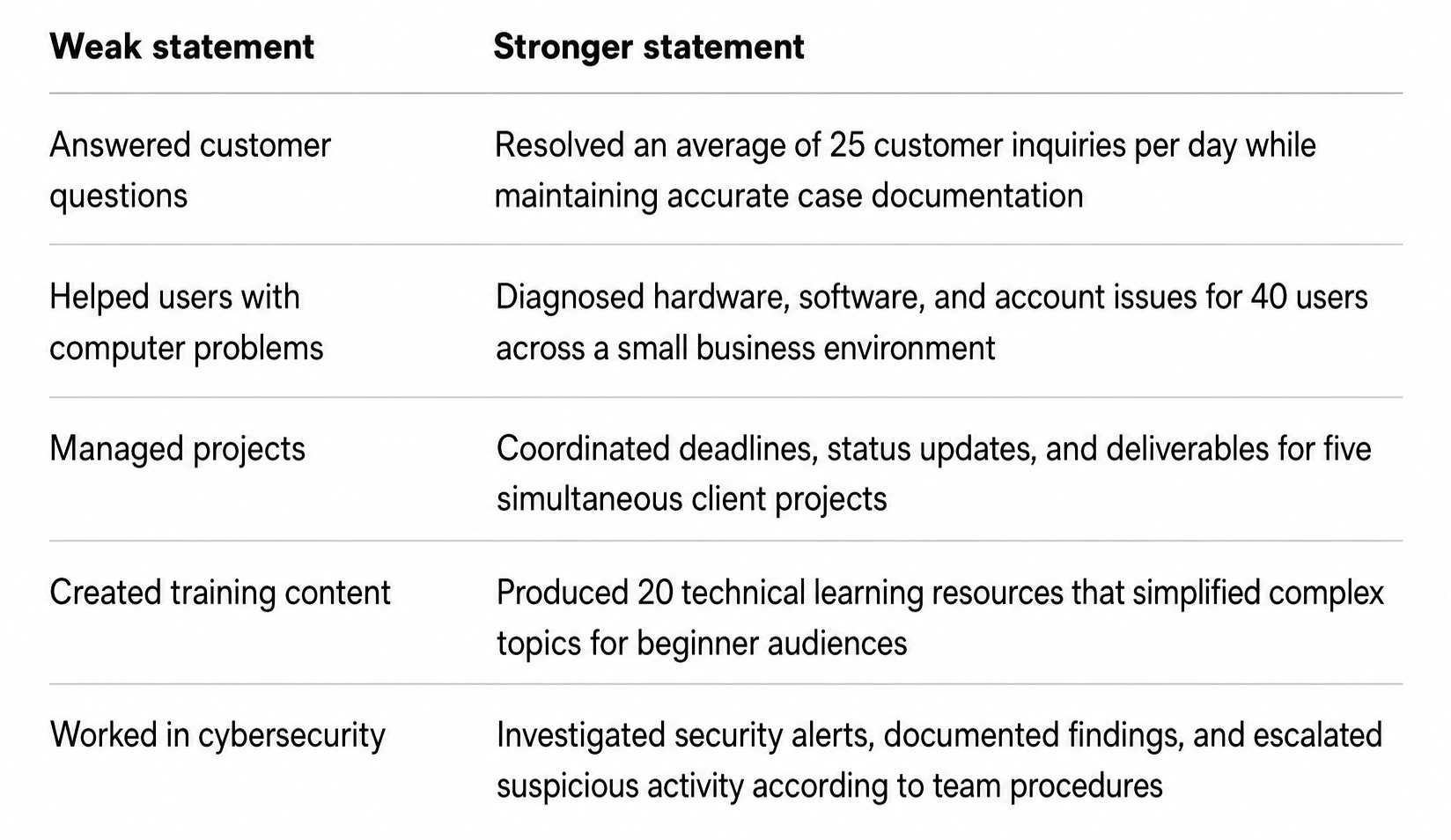
A stronger résumé statement normally includes an action, context, and result. Never invent metrics. Use numbers only when you can support them.
Entry-Level CompTIA Jobs and Opportunities for Beginners
Entry-level CompTIA jobs may include positions directly within the organization or beginner-friendly IT roles at other employers.
Possible starting points may include:
- Internships
- Program coordinator roles
- Customer-support positions
- Junior technical roles
- Administrative positions
- Content or community support
- Help desk and desktop support
- Technical support roles
Entry-level does not always mean no experience. Employers may still expect evidence that you can communicate professionally, solve problems, manage responsibilities, and learn new systems.
How to Compete Without Extensive Experience
You can strengthen your application by:
- Building a home lab
- Completing hands-on projects
- Earning a relevant beginner certification
- Volunteering for technical responsibilities
- Documenting troubleshooting exercises
- Creating a portfolio
- Practising interview responses
- Improving written communication
For example, a career changer interested in IT support might earn CompTIA A+, practise installing operating systems, document common troubleshooting tasks, and use those projects as evidence of practical effort.
Which CompTIA Certifications Can Help Your Career?
The right certification depends on your target role, current knowledge, and experience.
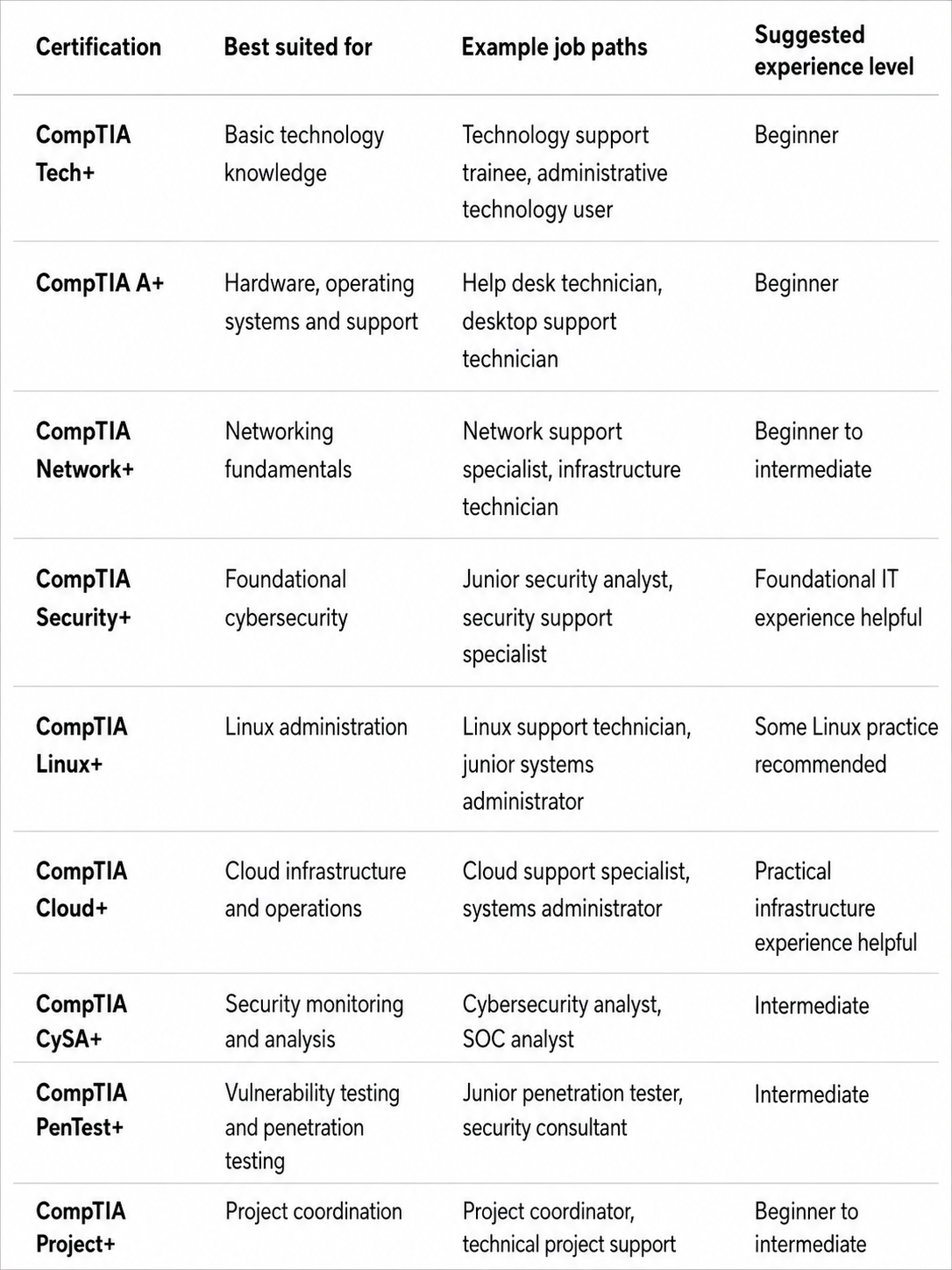
Best Starting Certification for Beginners
A complete beginner may start with CompTIA Tech+ to build broad technology knowledge.
Candidates targeting help desk or technical support often choose CompTIA A+. Those who already understand computer support and want to move toward infrastructure may consider Network+.
Choose based on your career goal rather than collecting credentials without a plan.
Certifications for Cybersecurity Careers
A common progression begins with basic computer and networking knowledge before moving into security.
For example:
- Build IT support fundamentals
- Learn networking concepts
- Study foundational cybersecurity
- Gain practical experience
- Progress toward analyst or testing credentials
An IT support technician might use Security+ as one part of a transition into cybersecurity. However, lab experience, networking knowledge, and practical security projects remain important.
Certifications for IT Support and Networking
CompTIA A+ is commonly associated with entry-level support skills, while Network+ focuses more heavily on network concepts and troubleshooting.
A help desk professional may begin with A+ and later add Network+ when preparing for infrastructure, network support, or junior systems roles.
A certification path should reflect the work you want to perform next.
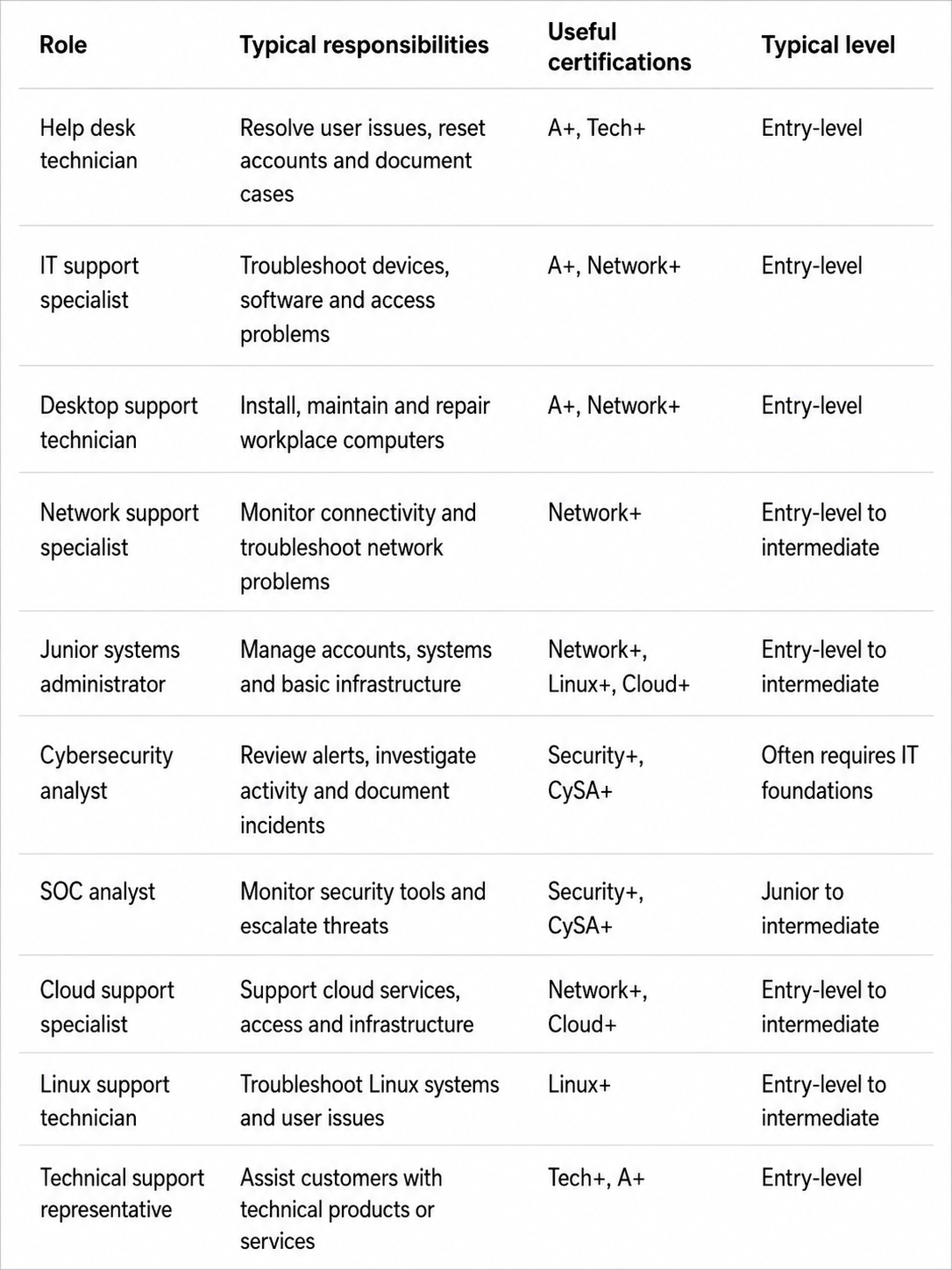
Jobs You Can Pursue With CompTIA Certifications
The following positions are usually offered by employers other than CompTIA.
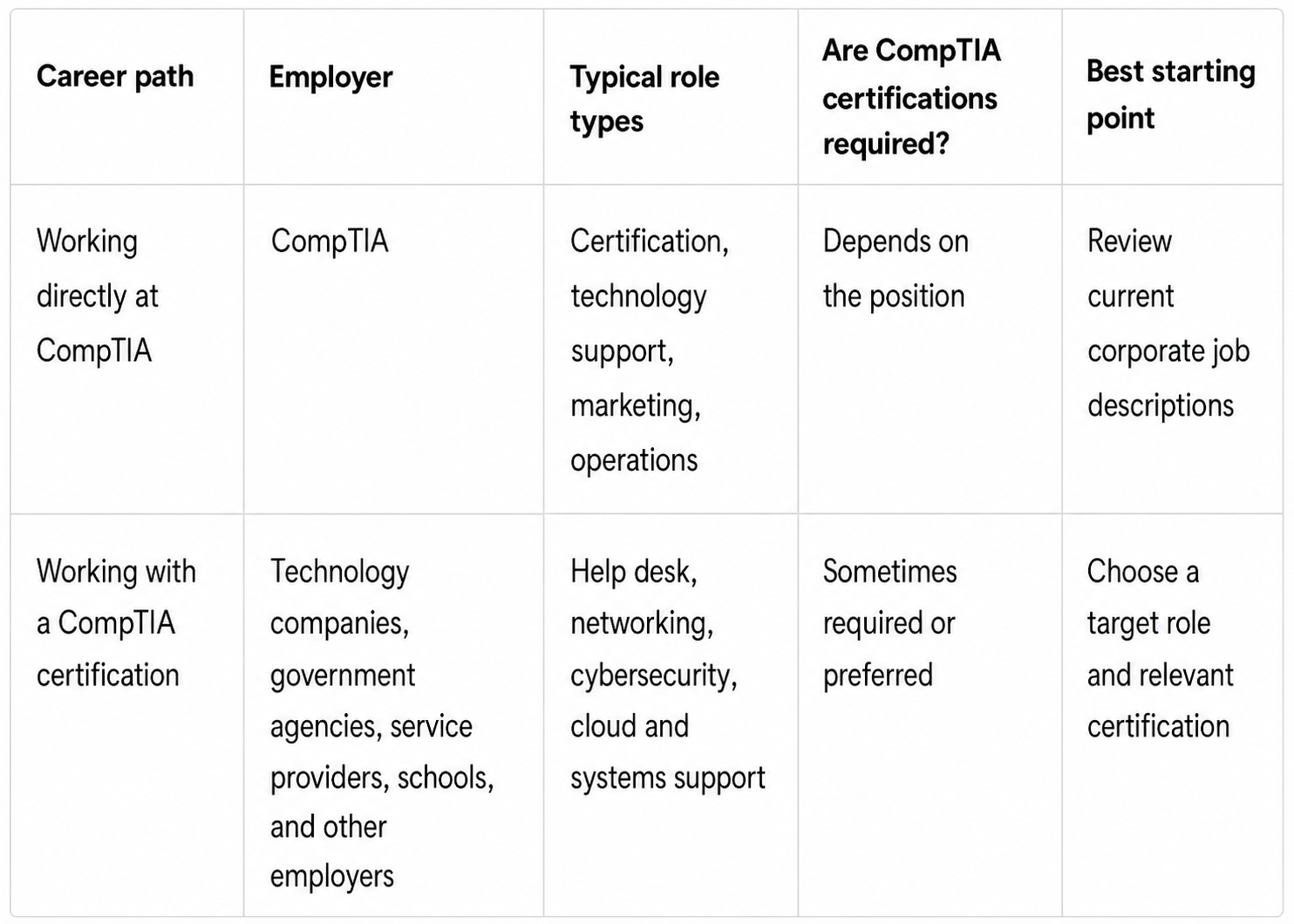
Working at CompTIA vs. Working With a CompTIA Certification
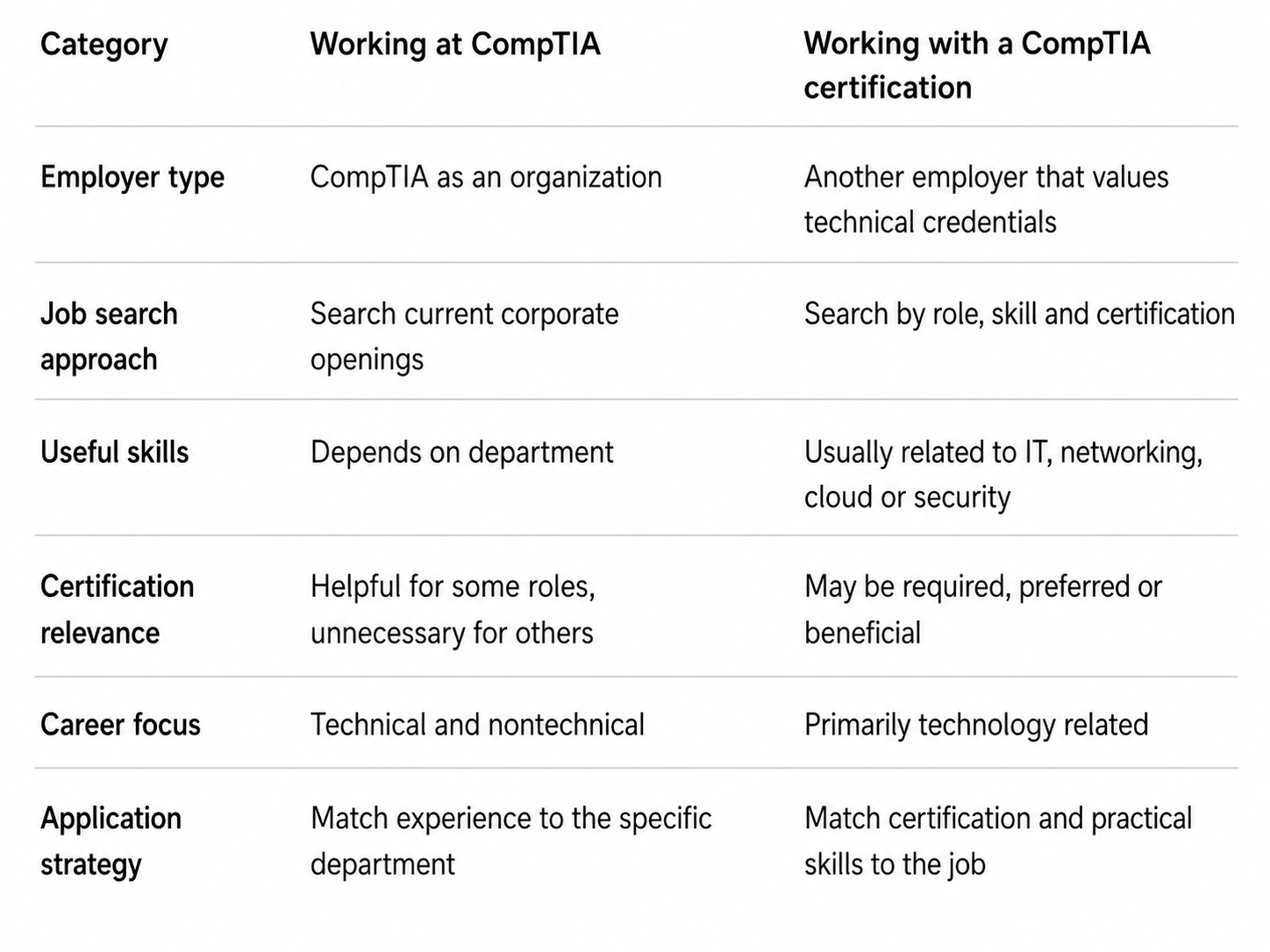
The key distinction is simple: working at CompTIA means CompTIA is your employer; working with a CompTIA certification means another employer recognizes your credential.
Common Mistakes When Searching for CompTIA Jobs
Avoid these common errors:
- Assuming every search result is a job directly at CompTIA
- Applying without reviewing location requirements
- Treating certifications as a replacement for practical experience
- Sending a generic résumé
- Ignoring hands-on skills
- Searching only for jobs with “CompTIA” in the title
- Expecting certification to guarantee employment
- Entering interviews without practical examples
Search for job titles such as “help desk technician,” “network support specialist,” or “junior cybersecurity analyst,” not only the name of the certification.
How Globalcerts Can Support Your Career Preparation
Choosing the right certification is only one step. You must also understand the exam objectives and practise applying technical concepts.
Globalcerts practice resources can help you:
- Review certification topics
- Identify knowledge gaps
- Become familiar with exam-style questions
- Apply concepts to realistic scenarios
- Build a more structured preparation routine
Practice exams cannot guarantee a passing result or a job offer. They can, however, help you identify where additional study is needed.
Choose the CompTIA certification that matches your career goal and prepare with realistic Globalcerts practice exams.
Frequently Asked Questions About CompTIA Jobs
Where is CompTIA headquartered?
CompTIA maintains corporate operations, but office locations and workplace arrangements may change. Candidates should verify current corporate information before making travel, relocation, or application decisions. The current job description is the best source for determining where a particular employee is expected to work.
How do I find current jobs at CompTIA?
Review CompTIA’s current corporate career listings and search by department, job function, and location. Read each description carefully because eligibility, experience requirements, and remote-work conditions may differ. Avoid relying on old job-board copies that may no longer reflect an active vacancy.
Does CompTIA offer remote jobs?
Remote or hybrid positions may be available depending on current organizational needs. Availability can vary by department, hiring region, and role. A remote position may still require residence in a particular area, specific working hours, occasional travel, or legal authorization to work in the hiring country.
Do I need a CompTIA certification to work at CompTIA?
Not for every position. Technical, cybersecurity, certification-development, or training roles may value relevant credentials. Jobs in marketing, finance, human resources, events, or administration may prioritize different qualifications. Follow the requirements in the job description rather than assuming certification is mandatory.
What entry-level jobs can I get with CompTIA A+?
CompTIA A+ may support applications for help desk technician, IT support specialist, desktop support technician, field support, and technical support roles. Employers may also expect communication skills, customer-service ability, hands-on troubleshooting practice, and familiarity with common operating systems and devices.
Is CompTIA Security+ useful for cybersecurity jobs?
Security+ can help demonstrate knowledge of foundational security concepts. It may be relevant to junior security analyst, security support, SOC, and compliance-related roles. However, candidates should also develop networking knowledge, practical lab experience, troubleshooting ability, and examples of security projects.
Can CompTIA certifications help career changers?
They can provide a structured way to learn technical concepts and show commitment to a new career direction. Career changers should combine certification study with projects, labs, volunteer experience, transferable skills, and a résumé that explains how their previous work relates to the target position.
What is the difference between CompTIA jobs and CompTIA certification jobs?
CompTIA jobs are positions where CompTIA is the employer. CompTIA certification jobs are positions at other organizations that request, prefer, or benefit from certifications such as A+, Network+, or Security+. Understanding the difference helps you use more accurate job-search terms.
Which CompTIA certification should a beginner earn first?
The answer depends on your starting knowledge and intended role. Tech+ may suit someone learning basic technology concepts, while A+ is commonly associated with IT support. Network+ may be appropriate for candidates who already understand basic computer systems and want to focus on networking.
Do CompTIA certifications guarantee a job?
No certification guarantees employment. A credential can strengthen your résumé and demonstrate relevant knowledge, but employers also evaluate experience, practical ability, communication, professionalism, and interview performance. Treat certification as one part of a broader career-development plan.
Conclusion
The term CompTIA jobs can describe two separate opportunities: careers directly with CompTIA and careers at other organizations that value CompTIA certifications.
Start by choosing the type of work you want. Review the required skills, build practical experience, select a certification connected to your target role, and tailor each application carefully.
A focused candidate with relevant projects, clear communication, and realistic expectations will usually present a stronger application than someone relying on certification alone.
When you are ready to prepare, explore Globalcerts practice exams for the CompTIA certification that best supports your career goal.