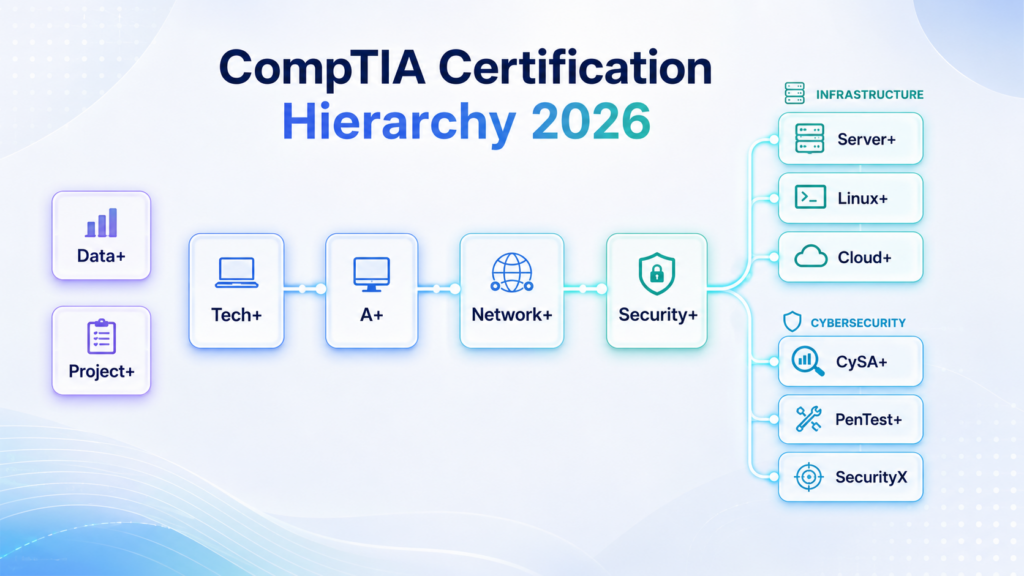
CompTIA Certification Hierarchy 2026: Which Certification Should You Get First?
Which CompTIA certification should I get first? For most people, the answer depends on two things: how much IT experience you already have and the job you want next.
A complete beginner may benefit from CompTIA Tech+ or A+, while someone who already understands computers and networking may be ready for Network+ or Security+. An experienced IT professional may skip those starting points entirely and move into a specialized certification.
That is the most important thing to understand about the CompTIA certification hierarchy: it is better viewed as a career and skill progression, not one mandatory ladder that everyone must follow.
In 2026, CompTIA’s certification ecosystem covers core IT skills, infrastructure, cybersecurity, data, project skills, and advanced specialties. Current credentials include familiar certifications such as A+, Network+, and Security+, as well as newer or renamed credentials such as Tech+, CloudNetX, SecurityX, DataAI, and SecAI+.
This guide explains the CompTIA certification levels, which CompTIA certs make sense in order, what you can skip, and how to build a practical CompTIA certification roadmap around your career.
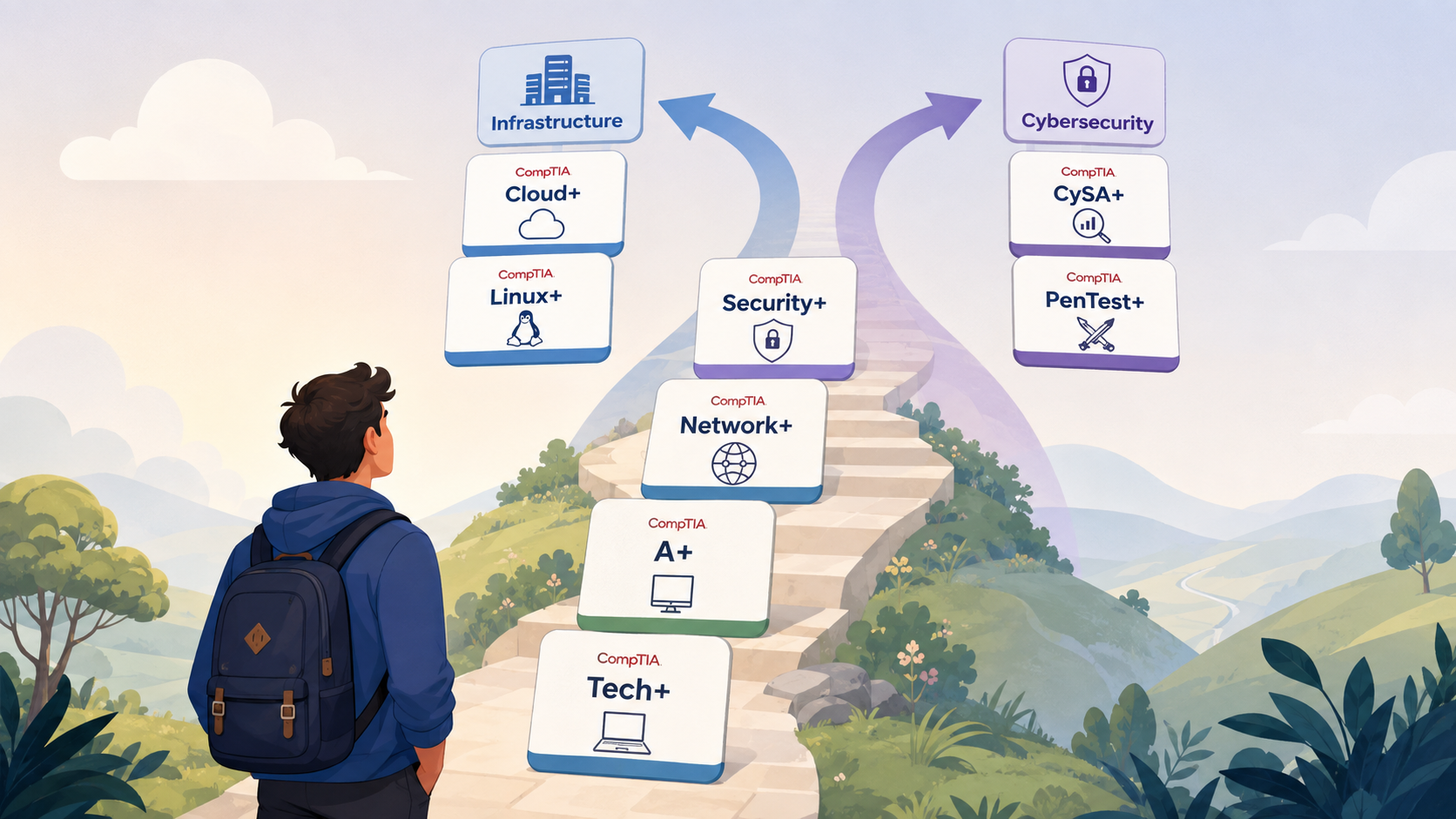
What Is the CompTIA Certification Hierarchy?
The CompTIA certification hierarchy is an informal way of organizing CompTIA certifications from foundational knowledge through job-focused and advanced technical skills.
CompTIA does not require every candidate to complete one universal certification sequence. Instead, its certifications cover different career paths and levels of technical depth. Current certification paths commonly include core skills, infrastructure, cybersecurity, data and analytics, and professional skills.
For career planning, you can think of the CompTIA hierarchy in five broad groups:
- Foundational certifications for people learning basic technology concepts.
- Core IT certifications for support, networking, and security fundamentals.
- Infrastructure certifications for Linux, servers, cloud, and systems roles.
- Cybersecurity certifications for defensive, offensive, and advanced security work.
- Advanced and specialized certifications for experienced professionals working with complex security, cloud networking, data, or AI environments.
These are useful learning categories rather than mandatory prerequisites.
For example, you do not have to earn A+ before Network+, and you do not have to earn Network+ before Security+. CompTIA may recommend prior knowledge or experience, but those recommendations should not be confused with enforced prerequisites. Network+, for example, has no strict prerequisite even though A+ knowledge and hands-on networking experience can make preparation easier.
CompTIA Certification Levels Explained
Here is a practical way to understand the major CompTIA certification levels in 2026.
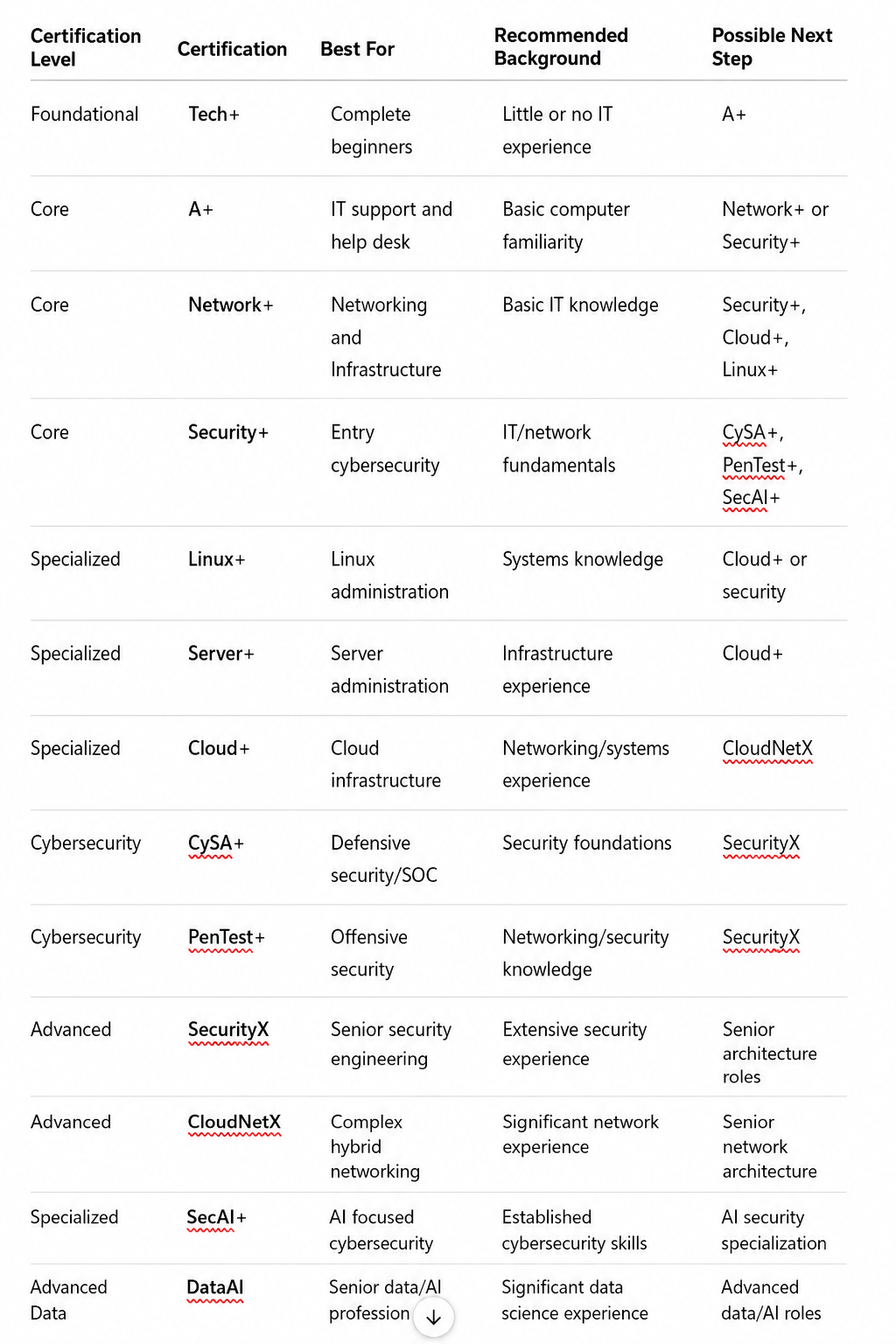
This table is a career-planning guide rather than an official prerequisite ladder. Current CompTIA offerings include Tech+, A+, Network+, Security+, Cloud+, Linux+, Server+, CySA+, PenTest+, SecurityX, CloudNetX, Data+, DataSys+, Project+, and DataAI, with SecAI+ introduced in 2026.
Foundational Level
CompTIA Tech+ is the most beginner-oriented starting point.
It replaced the older IT Fundamentals+ positioning and covers broad technology basics such as computing, infrastructure, applications, software concepts, databases, and security. It is intended for learners with little or no prior IT experience.
Tech+ makes sense if you:
- Have almost no technical background.
- Are unsure whether IT is the right career.
- Find A+ material overwhelming.
- Want to learn basic IT terminology first.
You may skip Tech+ if you already understand basic computer hardware, operating systems, software, networking terminology, and security concepts.
Entry-Level and Core IT Certifications
The three certifications most people associate with a traditional CompTIA certification path are:
A+ → Network+ → Security+
CompTIA A+ focuses on the practical foundations of IT support, including devices, operating systems, networking basics, troubleshooting, and security.
CompTIA Network+ goes deeper into network concepts, implementation, operations, security, and troubleshooting.
CompTIA Security+ establishes foundational cybersecurity knowledge covering threats, controls, architecture, security operations, risk, and related topics.
This progression works well because each stage builds useful context for the next. It is still a recommended learning progression, not a mandatory certification order.
Intermediate and Specialized Certifications
Once you have foundational IT knowledge, your path can branch.
You might pursue:
- Linux+ for Linux administration and systems work.
- Server+ for server hardware and server operations.
- Cloud+ for cloud infrastructure and operations.
- Data+ for analytics.
- DataSys+ for database-related skills.
- Project+ if project management is part of your technology role.
- CySA+ for security monitoring, detection, and defensive operations.
- PenTest+ for penetration testing and offensive security.
The right certification depends more on your target job than on completing every credential below it.
Advanced CompTIA Certifications
Beginners generally should not start with expert-level credentials simply because they appear higher in the CompTIA hierarchy.
SecurityX, formerly known as CASP+, is positioned for experienced cybersecurity practitioners working with enterprise security architecture, engineering, and operations.
CloudNetX is an advanced credential focused on designing, securing, automating, operating, and troubleshooting complex on-premises and cloud networks. Its certification criteria reference substantial professional networking experience.
DataAI, formerly DataX, is CompTIA’s advanced data-science credential and was renamed in January 2026 to reflect the increasing overlap between data science and AI.
CompTIA also introduced SecAI+ in 2026 for experienced cybersecurity professionals working where artificial intelligence and security intersect.
CompTIA Certs in Order: Is There a Recommended Sequence?
For a person starting a general IT career, the most familiar sequence remains:
A+ → Network+ → Security+
Why does this order make sense?
- A+ develops broad IT support, hardware, software, operating-system, and troubleshooting knowledge.
- Network+ explains how systems communicate and how networks are implemented and maintained.
- Security+ builds on IT and networking concepts to explain how those systems are protected.
However, this is not the correct path for everyone.
A computer science student who already manages Linux systems and understands TCP/IP may not need A+. A working network administrator may go straight to Security+. Someone targeting help desk employment may earn A+ and begin applying for jobs without immediately taking Network+.
Think of CompTIA certs in order as a learning recommendation, not a rule.
Which CompTIA Certification Should You Get First?
If You Have No IT Experience
Start with Tech+ if technology concepts are completely new to you.
If you are already comfortable using computers and are committed to pursuing an IT support career, starting directly with A+ may be more efficient.
Tech+ is specifically positioned as a beginner credential requiring no prior experience.
If You Want an IT Support or Help Desk Job
A+ is usually the most practical starting certification.
Imagine someone moving from retail into IT with no professional technical experience. Studying A+ gives that learner exposure to Windows, hardware, networking basics, troubleshooting, devices, and security—the types of topics they are likely to encounter in a support environment.
A logical path could be:
A+ → Help Desk Experience → Network+ or Security+
After earning A+, consider using a CompTIA A+ study guide and CompTIA practice exams as internal resources for structured preparation.
If You Already Understand IT Fundamentals
You do not need to collect beginner credentials simply to complete a ladder.
If you already configure PCs, understand operating systems, know basic networking, and have practical troubleshooting experience, examine the objectives for A+. If most of the material is already familiar, moving directly to Network+, Security+, or another career-specific certification may make more sense.
If You Want to Work in Networking
A practical CompTIA certification path is:
A+ or equivalent knowledge → Network+ → Cloud+, Linux+, or CloudNetX later
Network+ has no strict certification prerequisite, although previous A+ knowledge and networking experience can help.
Someone already working with switches, routers, TCP/IP, VLANs, wireless networks, and troubleshooting may reasonably start directly with Network+.
If You Want to Work in Cybersecurity
For cybersecurity, the best first certification depends heavily on your technical background.
A complete beginner might follow:
A+ → Network+ → Security+
Someone with strong IT and networking fundamentals might start with:
Security+
Network+ is not a mandatory prerequisite for Security+. Security+ itself does not require you to hold another CompTIA credential first, although networking and IT administration knowledge are highly useful preparation.
If You Already Work in IT
Use your existing experience to skip material you have already demonstrated professionally.
For example, a network administrator with five years of experience probably does not need to return to Tech+ or A+ simply because those certifications appear earlier in a roadmap.
That professional might choose:
Security+ → CySA+
or:
Security+ → PenTest+
depending on the desired security role.

CompTIA Certification Roadmap by Career Goal
Your CompTIA certification roadmap should follow your career goal rather than a single universal hierarchy.
IT Support Career Path
Tech+ if needed → A+ → Network+ or Security+ → Specialized Certification
A+ provides the strongest alignment with general support skills. Network+ makes sense when support work is becoming more network-focused, while Security+ may be the better next step for someone moving toward security.
Networking Career Path
A+ or equivalent knowledge → Network+ → Linux+ / Cloud+ → CloudNetX
CloudNetX belongs much later in the path because it targets advanced hybrid networking and architecture rather than beginner networking skills.
Cybersecurity Career Path
A common path is:
IT Fundamentals → Network Fundamentals → Security+ → CySA+ or PenTest+ → SecurityX
The branch matters.
Choose CySA+ if you are interested in areas such as:
- SOC operations
- Threat detection
- Incident response
- Security monitoring
- Vulnerability management
Choose PenTest+ if you are more interested in:
- Penetration testing
- Vulnerability exploitation
- Offensive security
- Security assessment
CompTIA released an updated CySA+ version in June 2026 emphasizing modern security operations and increasingly AI-driven defensive environments.
Cloud and Infrastructure Career Path
One possible progression is:
Network+ → Linux+ or Server+ → Cloud+ → CloudNetX
Not every infrastructure professional needs all four.
A Linux administrator may prioritize Linux+. A cloud operations professional may move from Network+ directly toward Cloud+. An experienced network architect dealing with hybrid cloud environments may eventually consider CloudNetX.
Advanced Cybersecurity Career Path
An experienced professional could follow:
Security+ → CySA+ and/or PenTest+ → SecurityX
A security professional specializing in artificial intelligence may also consider SecAI+, which CompTIA introduced as a specialized credential addressing security of AI systems, AI-related risk, governance, and the use of AI within cybersecurity operations.
Can You Skip CompTIA A+ and Start With Network+ or Security+?
Yes. A+ is not a mandatory prerequisite for Network+ or Security+.
Whether skipping it is a good idea depends on your existing skills.
Consider these examples:
- Complete beginner: A+ will probably make later certifications easier to understand.
- Computer science student: May already know enough to start with Network+ or Security+.
- Help desk technician: Could move directly into Network+ or Security+ based on career goals.
- Network administrator: Probably does not need A+.
- Experienced IT professional moving into cybersecurity: Security+ may be the logical starting point.
Do not pay for a certification solely because you think every CompTIA credential must be completed in sequence.
Should You Take Network+ Before Security+?
Network+ is helpful before Security+, but it is not mandatory.
Cybersecurity relies heavily on understanding how networks operate. Concepts such as ports, protocols, network segmentation, routing, wireless networking, DNS, firewalls, and traffic flows are easier to secure when you first understand how they work.
However, you can learn those networking concepts without earning the Network+ certification itself.
For example, an IT technician with two years of hands-on networking experience may study Security+ directly. A complete beginner struggling to understand IP addressing, protocols, and network traffic may benefit considerably from studying Network+ first.
For a deeper comparison, a natural internal link here would be Network+ vs Security+.
What Comes After CompTIA Security+?
There is no single certification that everyone should take after Security+.
Choose according to your career direction:
- SOC or defensive security: Security+ → CySA+
- Penetration testing: Security+ → PenTest+
- Advanced security engineering: Security+ → CySA+/PenTest+ → SecurityX
- AI security: Security+ plus deeper cybersecurity experience → SecAI+
- Cloud security: Security+ → Cloud+ plus hands-on cloud security skills
- Networking: Security+ → deeper networking training or Network+
- Hands-on security: Add labs, SIEM practice, Linux, scripting, networking, and security scenarios
SecurityX should generally be considered an advanced destination rather than the automatic next exam after Security+.
A natural internal link here would be a CompTIA Security+ career guide.
Do You Need Every CompTIA Certification?
No. Most professionals do not need every CompTIA certification.
Collecting certifications without connecting them to a career objective can waste both time and money.
Instead, choose certifications based on:
- Your current technical knowledge
- Your target job
- Your professional experience
- Skills requested in job descriptions
- Your biggest technical gaps
- Your long-term career direction
Consider two learners.
Learner A wants to become a desktop support technician. A+ may have immediate value, while PenTest+ would have little relevance to the short-term goal.
Learner B already manages enterprise networks and wants to move into cybersecurity. Starting with Tech+ and A+ would probably repeat skills already gained through work. Security+ or a more specialized security path may be more efficient.
The certification roadmap should fit the person—not the other way around.
How to Choose Your CompTIA Certification Path
Use this six-step framework.
- Identify your target role. Decide whether you want support, networking, infrastructure, cloud, cybersecurity, data, or another field.
- Evaluate your current knowledge. Compare what you already know with the certification objectives.
- Review what the certification validates. Do not choose based only on popularity.
- Check real job requirements. Look at vacancies for the role you want and identify recurring skills and certifications.
- Build hands-on skills alongside study. Use labs, troubleshooting exercises, command-line practice, and realistic scenarios.
- Choose the next certification only when it supports your next career step.
This produces a much more useful CompTIA career path than simply earning certifications from easiest to hardest.
Example CompTIA Certification Paths for Beginners
Example 1: Complete Beginner to IT Support
Maria has no professional IT experience.
A possible path:
Tech+ → A+ → Home Lab → Help Desk Applications → Network+
Tech+ helps her learn basic terminology. A+ provides job-relevant support knowledge. She then builds hands-on experience rather than immediately collecting another credential.
Example 2: IT Support Technician to Cybersecurity
Daniel has worked on a help desk for 18 months and already troubleshoots endpoints, accounts, permissions, and basic networking.
A possible path:
A+ knowledge → Network+ → Security+ → SOC Labs → CySA+
He may not need another beginner certification because his job has already provided practical IT experience.
Example 3: Networking Professional Moving Into Security
Alex has four years of network administration experience.
A possible path:
Existing Networking Experience → Security+ → CySA+ or PenTest+
Starting with Tech+ or A+ would add little value because Alex has already developed those foundational skills professionally.
These examples illustrate possible paths—not mandatory sequences.
Certification Alone Is Not Enough: Build Hands-On Skills
A certification can validate knowledge, but passing an exam should not be the end goal.
Combine certification study with:
- Performance-based questions
- Practice exams
- Virtual labs
- Troubleshooting exercises
- Command-line practice
- Network configuration exercises
- Linux practice
- Security investigations
- Incident-response scenarios
Hands-on preparation is especially useful because CompTIA certifications above the most basic level commonly test the application of knowledge through scenarios and performance-oriented tasks.
Use practice questions to identify gaps, then reproduce the concept in a lab whenever possible.
Natural internal-link opportunities include CompTIA practice exams and Security+ practice questions.
How to Prepare for Your First CompTIA Exam
Once you choose your certification:
- Review the current exam objectives. Use them as your study checklist.
- Build a realistic schedule. Consistent study is more useful than occasional marathon sessions.
- Understand concepts instead of memorizing answers.
- Use exam-style practice questions.
- Complete hands-on labs whenever possible.
- Track weak objectives and revisit them.
- Practice performance-based questions.
- Take timed practice exams before scheduling the real exam.
Globalcerts practice resources can be used to test your understanding after studying each objective and to identify the areas that still require work.
The goal is not simply to recognize the right answer. You should understand why it is right and be able to apply the concept in a realistic IT scenario.
CompTIA Certification Hierarchy FAQ
What is the CompTIA certification hierarchy?
The CompTIA certification hierarchy is a practical way to organize certifications by knowledge level and career specialization. Beginners often start with Tech+ or A+, followed by certifications such as Network+ and Security+. From there, professionals usually branch into infrastructure, cybersecurity, cloud, data, or other specialties. There is no single mandatory ladder that every candidate must complete.
What is the first CompTIA certification I should get?
If you have almost no IT knowledge, Tech+ is the most beginner-oriented option. If you already understand basic computers and want an IT support job, A+ is usually the more practical starting certification. People with existing IT experience may start with Network+, Security+, or a specialized certification instead.
What are the CompTIA certification levels?
CompTIA certifications can practically be grouped into foundational, core, specialized/intermediate, and advanced levels. Tech+ sits near the beginning, A+/Network+/Security+ establish broad core skills, certifications such as Linux+, Cloud+, CySA+, and PenTest+ provide specialization, and credentials such as SecurityX, CloudNetX, and DataAI target advanced professionals.
Should I take A+ before Network+?
Not necessarily. A+ is useful if you need stronger computer hardware, operating-system, troubleshooting, and support fundamentals. Network+ does not strictly require A+, so someone with equivalent experience can start directly with Network+. CompTIA-related guidance describes A+ knowledge as helpful preparation rather than an enforced prerequisite.
Should I take Network+ before Security+?
Network+ can make Security+ easier because cybersecurity depends heavily on networking knowledge. However, Network+ is not mandatory. If you already understand TCP/IP, ports, protocols, routing, network devices, and troubleshooting, you may be able to prepare directly for Security+.
Can I take Security+ without A+?
Yes. You do not need A+ before taking Security+. A learner with sufficient IT and networking knowledge can start directly with Security+. Complete beginners may find the A+ → Network+ → Security+ learning progression easier because each certification builds useful technical context for the next.
What is the correct order for CompTIA certifications?
There is no single correct order. A common beginner progression is A+ → Network+ → Security+, but career specialization should determine what comes next. Networking professionals may pursue Cloud+ or Linux+, while cybersecurity professionals may move toward CySA+, PenTest+, SecurityX, or other specialized credentials.
Which CompTIA certification is best for cybersecurity?
Security+ is generally the most logical CompTIA starting point for someone who already has basic IT and networking knowledge and wants to enter cybersecurity. From there, CySA+ supports defensive-security development, PenTest+ supports offensive-security development, and SecurityX targets significantly more experienced practitioners.
What certification comes after Security+?
Possible next certifications include CySA+, PenTest+, Cloud+, SecAI+, or eventually SecurityX. The right choice depends on whether you want defensive security, penetration testing, cloud security, AI security, or advanced security engineering. SecAI+ was introduced in 2026 as a specialized certification addressing the intersection of AI and cybersecurity.
Do I need every CompTIA certification?
No. Earning every CompTIA credential is unnecessary for most careers. Choose certifications that address your target role and current skill gaps. Someone pursuing help desk work needs a very different roadmap from an experienced network architect or penetration tester.
Final Recommendation: Which CompTIA Certification Should You Start With?
The best starting point in the CompTIA certification hierarchy depends on what you already know and where you want to go.
A simple decision guide is:
- Complete beginner: Tech+ if you need basic technology foundations.
- IT support candidate: A+.
- Networking candidate: A+ if needed, then Network+.
- Cybersecurity candidate with weak IT foundations: A+ → Network+ → Security+.
- Cybersecurity candidate with solid IT/network knowledge: Security+.
- Experienced IT professional: Start with the certification that fills your next career-specific skill gap.
Do not treat certifications like levels in a game that must all be completed.
Choose the certification connected to your next role, review its current exam objectives, build practical skills, and use practice exams, labs, and performance-based questions to make sure you can apply what you learn before taking the real exam.