

What Is CompTIA Inc.? Certifications, Exams, Costs, and Career Paths Explained
CompTIA Inc. is an organization that develops vendor-neutral information technology certifications covering technical support, networking, cybersecurity, cloud infrastructure, Linux, data, and project management. CompTIA stands for the Computing Technology Industry Association.
For people entering IT, CompTIA matters because its certifications provide structured ways to learn foundational concepts and demonstrate knowledge through standardized exams. Popular credentials such as CompTIA A+, Network+, and Security+ frequently appear in training programs and job descriptions, although earning one does not guarantee employment.
This guide explains what CompTIA does, whether it is legitimate, how its certification programs and exams work, what they may cost, and which credentials align with different IT career paths. If you are a complete beginner or a professional planning your next specialization, you will find practical guidance for choosing an appropriate starting point.
What Does CompTIA Mean?
CompTIA means Computing Technology Industry Association. The organization develops professional certifications and educational resources for the global technology workforce.
CompTIA certifications validate knowledge and skills in defined areas of IT. Candidates study the published objectives for a particular exam version, take the exam under supervised conditions, and receive the certification after meeting all applicable requirements.
CompTIA is separate from technology manufacturers such as hardware, software, and cloud-platform vendors. Its certifications generally focus on principles and skills that can apply across multiple products and environments.
What Does CompTIA Do?
CompTIA is best known for creating and maintaining vendor-neutral IT certifications. Its work includes:
- Developing certification exam objectives
- Creating and administering certification exams
- Updating exams as technologies and job roles change
- Supporting workforce education and skills development
- Publishing IT industry research and career resources
- Managing certification verification and renewal programs
- Providing training products and learning resources
CompTIA works with subject-matter experts when developing certification content. Exams are delivered under controlled conditions through authorized testing services, including Pearson VUE testing centers and eligible online-proctored appointments.
Are CompTIA Certifications Vendor-Neutral?
Yes. Most CompTIA certifications are described as vendor-neutral, meaning they test concepts and skills that are not limited to one company’s products.
For example, Network+ covers networking concepts such as addressing, routing, switching, wireless technologies, troubleshooting, and security. The exam may refer to commonly used technologies, but it is not centered on configuring one manufacturer’s network equipment.
A vendor-specific certification, by comparison, may test how to configure a particular cloud platform, operating system, security product, or networking environment.
Both types can be valuable:
- A vendor-neutral certification can build broad knowledge that transfers between environments.
- A vendor-specific certification can demonstrate skill with a platform used by a particular employer.
Your target role and the technologies named in local job advertisements should guide your choice.
Is CompTIA Legitimate and Recognized?
Is CompTIA a Legitimate Certification Provider?
Yes, CompTIA is a legitimate certification provider with a long history in the technology industry. The organization was established in 1982, and its A+ certification has been available since the 1990s.
CompTIA exams are administered under formal testing policies through Pearson VUE. Candidates must meet identification, security, scheduling, and conduct requirements. The certification program also includes exam-development procedures, candidate agreements, score reporting, credential verification, and renewal rules.
CompTIA credentials are recognized by many employers, training institutions, government programs, and technology professionals. However, recognition is not identical for every certification, job, employer, or country.
Are CompTIA Certifications Accredited or Industry Recognized?
Several CompTIA certification programs are accredited under the ISO/IEC 17024 personnel-certification standard through the ANSI National Accreditation Board. Accreditation applies to specific certification programs, so candidates should check the status of the exact credential they are considering.
Industry recognition also depends on context. Security+, for example, may appear more frequently in cybersecurity and government-related job requirements than a data or project credential. A+ may be more relevant to a help-desk position than to a software-development role.
Before paying for an exam, search for your target job title in your location and record which certifications employers actually request.
What CompTIA Certification Can and Cannot Do
A CompTIA certification can:
- Provide an organized learning path
- Validate knowledge covered by published objectives
- Strengthen a résumé when the credential is relevant
- Help a career changer demonstrate commitment to IT
- Satisfy or support certain employer requirements
- Prepare a learner for more specialized study
A certification cannot guarantee a job, promotion, salary, or practical competence in every working environment.
Employers may also consider experience, education, projects, communication skills, troubleshooting ability, portfolio evidence, and familiarity with their technology stack.
For example, a career changer studying A+ could build a virtual Windows environment, document common troubleshooting procedures, volunteer to support devices for a community group, and apply for help-desk positions. The certification supports the application, while the practical work provides evidence that the candidate can use the knowledge.
CompTIA Certification Programs Explained
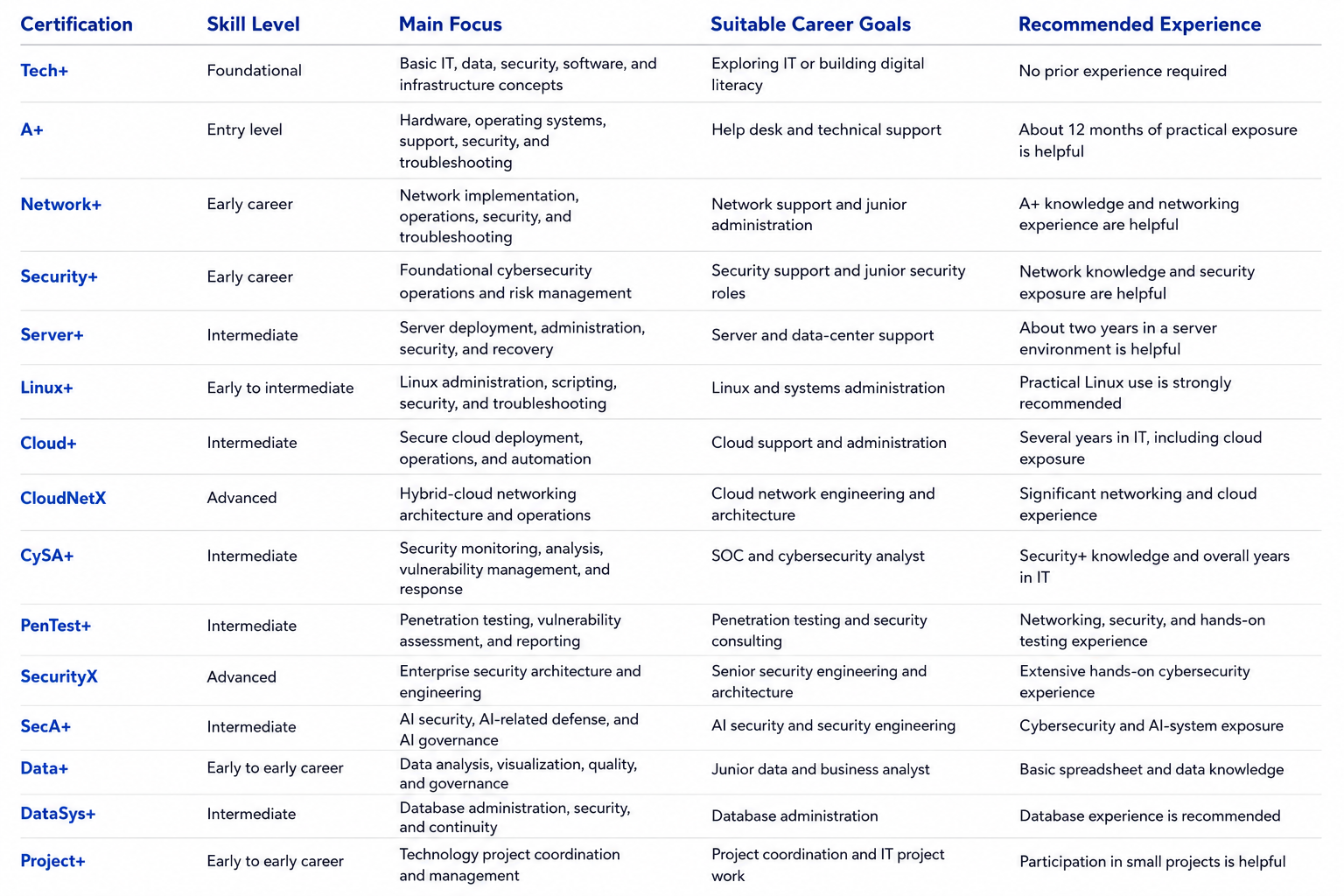
The CompTIA portfolio covers introductory knowledge, core IT operations, infrastructure, cybersecurity, data, artificial intelligence, and project work. The catalog changes as new certifications launch and older exams retire, so always verify the current exam before purchasing a voucher.
Foundational and Core Certifications
CompTIA Tech+ introduces essential technology concepts and is the successor to the retired ITF+ certification. It can suit students, nontechnical professionals, and complete beginners who want to explore IT before committing to a technical path.
CompTIA A+ focuses on entry-level IT support. It covers hardware, operating systems, software, networking, security, cloud concepts, mobile devices, and troubleshooting. Candidates must pass two current A+ exams to earn the certification.
Network+ addresses networking technologies, operations, security, implementation, and troubleshooting.
Security+ validates foundational cybersecurity knowledge, including threats, vulnerabilities, security architecture, operations, governance, risk, and incident response.
Infrastructure and Cloud Certifications
Server+ covers server hardware, administration, security, disaster recovery, and troubleshooting in on-premises and hybrid environments.
Linux+ focuses on administering Linux systems, including configuration, security, scripting, containers, troubleshooting, and operational practices.
Cloud+ addresses secure cloud deployment, management, operations, troubleshooting, automation, and high availability across different cloud environments.
CloudNetX is positioned at a higher level for experienced professionals working with secure and scalable hybrid-cloud network architectures. It is not an entry-level alternative to Network+.
Cybersecurity Certifications
A common suggested progression is:
- Security+ for foundational security knowledge
- CySA+ for defensive analysis, monitoring, vulnerability management, and incident response
- PenTest+ for penetration testing, vulnerability assessment, reporting, and remediation
- SecurityX for advanced security architecture, engineering, governance, and enterprise operations
SecurityX is the current name for the advanced credential formerly called CASP+. The name changed with the newer certification version, so candidates may still encounter “CASP+” in older job descriptions and learning materials.
SecAI+ focuses on securing artificial intelligence systems, using AI in security operations, and applying AI-related governance and risk practices. It is intended for professionals who already possess cybersecurity experience rather than complete beginners.
Data, Project, and Other Professional Certifications
Data+ covers foundational data analysis, visualization, governance, and interpretation.
DataSys+ is intended for professionals responsible for database deployment, management, maintenance, security, and business continuity.
CompTIA also offers newer credentials addressing advanced data and AI work. These are aimed at experienced professionals and should not be treated as beginner substitutes for Data+.
Project+ covers the fundamental skills required to manage smaller technology projects, including planning, communication, risk, documentation, schedules, and change control.
The following overview reflects the current portfolio available in 2026. CompTIA continues to introduce new credentials and retire older versions, so candidates should confirm availability in the official certification catalog before registering.
Which CompTIA Certification Should You Take First?
Best Starting Point for Complete Beginners
A complete beginner should compare Tech+ and A+.
Choose Tech+ if you are still exploring whether IT suits you or need an introduction to computers, networks, software, security, and databases.
Choose A+ if you already intend to pursue technical support and are prepared to learn troubleshooting in greater depth. A+ is more directly connected to entry-level support responsibilities, but earning it requires passing two exams.
Consider a student with no technical background who is unsure whether to pursue support, data, or cybersecurity. Tech+ may provide a manageable introduction. If that student already repairs personal computers, understands basic operating-system settings, and wants a help-desk job, beginning with A+ may be more practical.
Starting with CompTIA A+
CompTIA A+ is suitable for aspiring:
- Help-desk technicians
- Desktop support technicians
- Field service technicians
- IT support specialists
- Junior technical support professionals
A+ covers a broad range of topics because support professionals encounter varied problems. Candidates study device hardware, Windows and other operating systems, networking, account security, cloud concepts, software troubleshooting, and professional support procedures.
Remember that A+ requires two current exams. Passing only one core exam does not earn the full certification.
Starting with Network+ or Security+
Someone who already has support experience may not need to begin with A+.
Start with Network+ if your target work involves network support, connectivity, infrastructure, or systems administration and you already understand basic computer hardware and operating systems.
Start with Security+ if you have solid networking knowledge and want to move toward security operations, administration, compliance, or cybersecurity support.
For example, an IT support professional who enjoys diagnosing connectivity failures may choose Network+. A support professional who already understands ports, protocols, access controls, and network troubleshooting but regularly assists with phishing, endpoint protection, and account-security incidents may choose Security+.
Choosing a Certification Based on Your Career Goal
These are suggested paths, not mandatory prerequisites:
How Do CompTIA Exams Work?
CompTIA Exam Formats
Depending on the certification, a CompTIA exam may include:
- Multiple-choice questions: Select one answer.
- Multiple-response questions: Select more than one answer.
- Performance-based questions: Complete a practical task or solve a problem in a simulated environment.
- Other interactive items: Match, arrange, configure, or interpret information.
Not every exam uses the same mixture. Review the official page and objectives for the exact exam code you plan to take.
Online Testing vs Testing at a Test Center
CompTIA exams are generally scheduled through Pearson VUE. Eligible candidates may choose between online testing and an authorized testing center.
Online testing may be convenient, but it normally requires:
- A compatible computer
- A successful system test
- Stable internet access
- A webcam and microphone
- An acceptable identification document
- A private, quiet, and uncluttered testing space
- Compliance with remote-proctor instructions
A testing center supplies the testing equipment and controlled environment. This may be preferable if your home connection is unreliable, your room cannot meet security requirements, or you want on-site assistance with the check-in process.
Language, location, exam, and accommodation availability may affect which delivery methods you can use.
Scoring, Passing Scores, and Exam Policies
Question count, exam duration, score scale, passing score, and retake policy differ by certification and exam version.
Do not assume that the rules for Security+ also apply to A+, Data+, or SecurityX. Check the current exam page for:
- Exam code
- Launch and retirement dates
- Maximum number of questions
- Time limit
- Passing score
- Available languages
- Recommended experience
- Testing options
Candidates must accept CompTIA’s examination policies. Misconduct, sharing protected exam content, using unauthorized materials, or violating online-testing rules can lead to invalidated results or other penalties.
What Happens After You Pass?
Candidates usually see a preliminary score after completing an exam. After the result is processed, they can access their certification account, confirm certification status, and follow the available instructions for digital credentials or verification.
If the certification requires two exams, as A+ does, passing the first exam is only part of the process. The credential is awarded after both required exams from the approved series have been passed.
A typical journey looks like this:
- Choose Network+ based on a networking career goal.
- Confirm the current exam code and download its objectives.
- Study networking concepts and complete hands-on labs.
- Use practice exams to identify weak areas.
- Purchase a valid voucher and schedule through Pearson VUE.
- Complete identification and testing requirements.
- Take the exam and receive the result.
- Access the certification record after passing.
How Much Do CompTIA Certifications Cost?
Exam Voucher Costs
CompTIA exam prices vary significantly. Entry-level exams may cost a little over $100 in the United States, while advanced credentials can exceed $500. As of August 2026, the US list price for an A+ voucher is around $274 per core exam, meaning the two required exams cost approximately $548 before optional training or retakes.
Treat any quoted amount as a temporary reference. Prices can differ because of:
- Country and regional pricing
- Currency conversion
- Taxes
- Academic eligibility
- Voucher type
- Training bundles
- Promotional or partner discounts
- Future price changes
Always check the official store for the country where you will test before creating your budget.
Certifications That Require More Than One Exam
CompTIA A+ requires two exams, so its total exam cost is the price of two vouchers. A page advertising the price of one A+ exam is not showing the full amount required to earn the certification.
Most other current CompTIA certifications are earned through one exam, but requirements can change. Confirm the current certification page rather than relying on an older article or course description.
Additional Preparation and Retake Costs
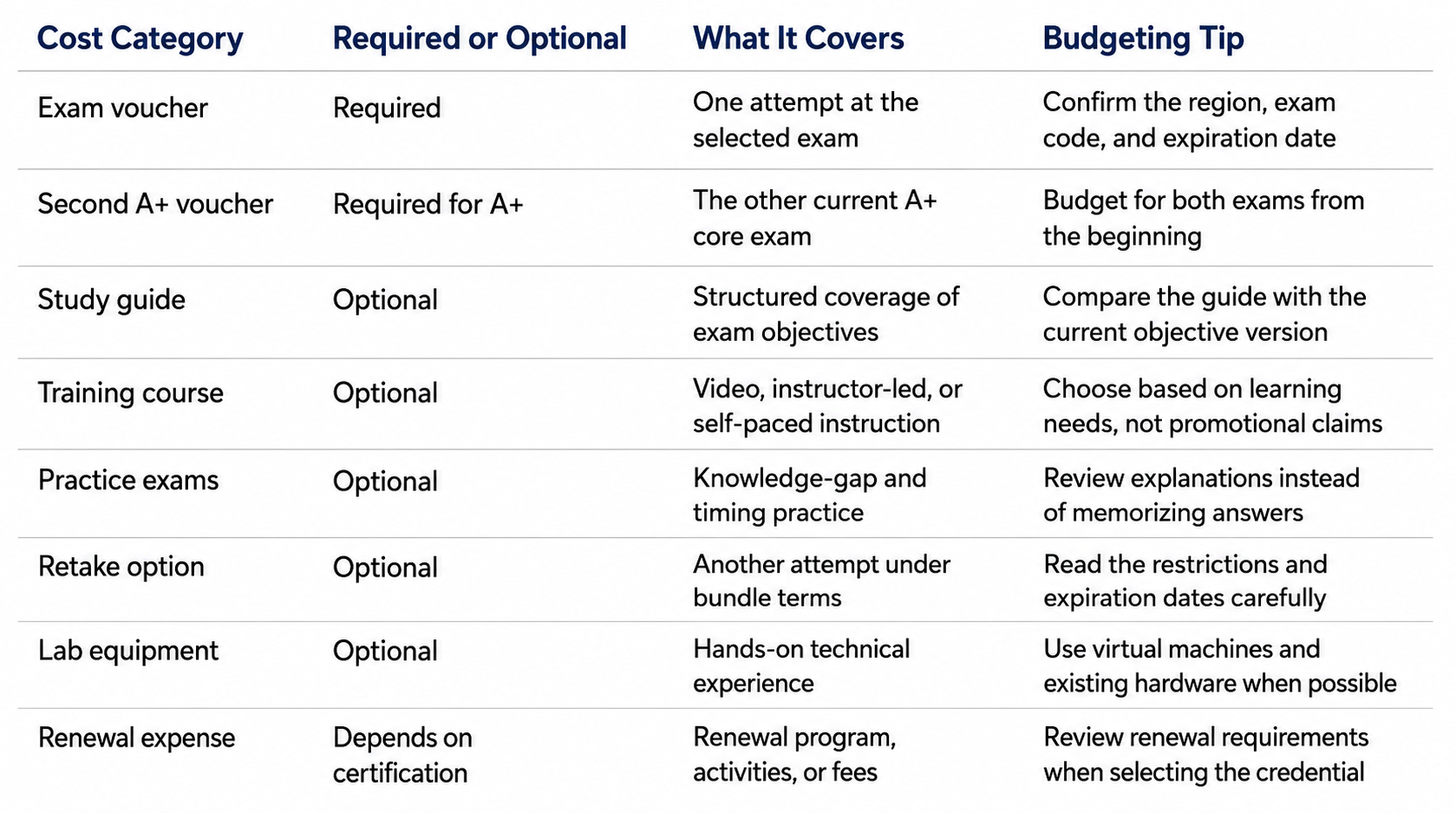
Your total budget may include:
Ways to Reduce CompTIA Certification Costs
Possible cost-saving options include:
- Academic discounts where available and where you are eligible
- Employer tuition or certification reimbursement
- Government or workforce-development programs
- Veteran or military education benefits where applicable
- Authorized training bundles that genuinely cost less than separate purchases
- School or university certification programs
- Virtual labs instead of buying unnecessary physical equipment
- Careful preparation before scheduling the exam
Avoid unofficial voucher sellers and unusually cheap offers from sources you cannot verify. Check voucher expiration dates, regional restrictions, exam compatibility, and retake conditions before purchasing.
Do CompTIA Certifications Expire?
Certification Validity and Renewal
Most current CompTIA certifications in the Continuing Education program are valid for three years from the date earned. They must be renewed before expiration if the holder wants to keep them active.
However, not every CompTIA credential follows exactly the same rule. Some certifications, including certain current or legacy credentials, may be considered valid for life. Credentials earned before older policy changes may also have different status.
Check the renewal page for your exact certification rather than applying the three-year rule universally.
Continuing Education and CEUs
A continuing education unit, or CEU, is credit earned through an approved learning or professional-development activity.
Depending on the certification, eligible activities may include:
- Completing approved courses
- Attending relevant webinars or conferences
- Earning another qualifying certification
- Participating in certain work or teaching activities
- Publishing relevant material
- Completing an approved renewal course
- Passing a newer exam version
The required number of CEUs differs by credential. Activities must meet CompTIA’s rules and be documented when required.
Renewal Options
Common renewal routes may include:
- Completing CompTIA’s approved renewal training program for an eligible certification
- Earning the required CEUs and paying applicable continuing-education fees
- Passing a qualifying higher-level CompTIA certification
- Earning another approved industry certification
- Retaking the current version of the certification exam
A higher-level certification may renew certain lower-level credentials, but only according to CompTIA’s official renewal hierarchy. Confirm which certifications are renewed before choosing this route.
What Jobs Can CompTIA Certifications Help You Pursue?
Entry-Level IT Support Roles
Beginner certifications may complement applications for positions such as:
- Help-desk technician
- Service-desk analyst
- Desktop support technician
- Field service technician
- IT support specialist
- Junior computer technician
A+ is commonly associated with these roles, while Tech+ can demonstrate foundational understanding for internships or early learning opportunities.
Networking and Infrastructure Roles
Infrastructure certifications may align with roles such as:
- Network support technician
- Junior network administrator
- Systems support technician
- Linux support technician
- Junior systems administrator
- Server technician
- Cloud support associate
- Data-center technician
The certification alone may not be enough. Employers often expect candidates to troubleshoot real systems, document changes, understand security practices, and communicate clearly with users and colleagues.
Cybersecurity Roles
Security certifications may support progression toward:
- Junior security analyst
- Security operations center analyst
- Vulnerability analyst
- Incident-response analyst
- Security administrator
- Penetration tester
- Security engineer
- Security architect
Security+ is foundational, while CySA+, PenTest+, SecAI+, and SecurityX target more specialized or experienced candidates. A beginner should not assume that passing an advanced exam replaces the experience expected for an advanced role.
Certifications, Experience, and Employer Requirements
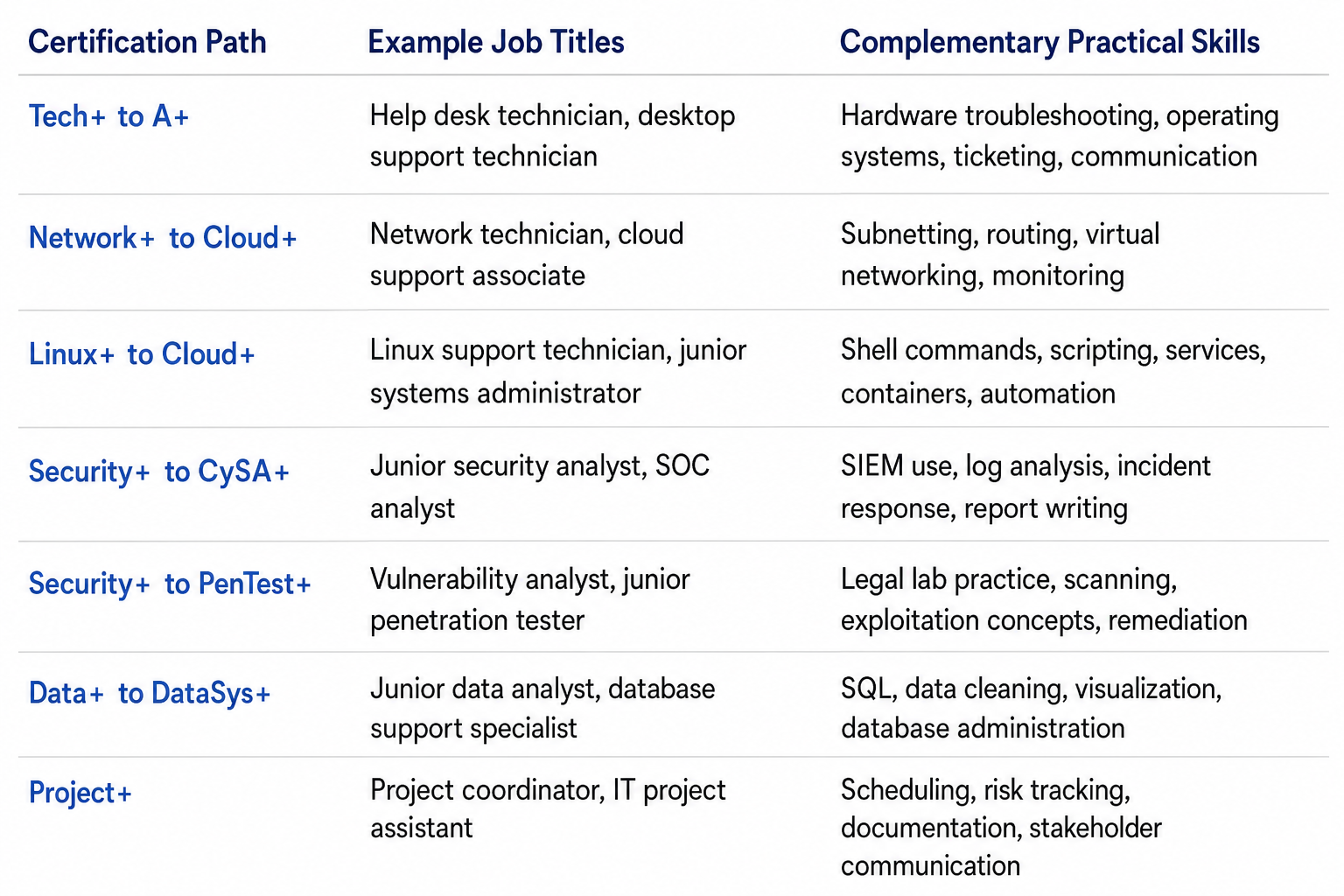
Job titles vary between organizations. Compare certification objectives with current advertisements in your city or country and identify the practical tools employers mention most often.
Are CompTIA Certifications Worth It?
The balanced answer is: a CompTIA certification can be worth it when it supports a specific career goal and is paired with practical skill development.
When a CompTIA Certification May Be Worth It
A certification may be a sensible investment when:
- You are entering IT and need a structured learning path.
- Relevant employers request or prefer the credential.
- You want to validate foundational knowledge.
- You are changing careers and need evidence of focused study.
- Your employer requires or funds the certification.
- The certification prepares you for a more specialized path.
- You need to close defined gaps in your technical knowledge.
When It May Not Be the Best First Step
Another route may make more sense when:
- Local employers prioritize a different credential.
- Your target role requires a specific vendor platform.
- Your largest gap is practical experience rather than theory.
- A degree or regulated qualification is required.
- A portfolio is more important for the chosen career.
- You already possess knowledge beyond the certification level.
- The exam and renewal costs do not fit your current budget.
For example, a career changer targeting cybersecurity might study Security+ while building a home lab, analyzing sample logs, documenting an incident-response exercise, and applying for support or junior security roles. The credential, lab evidence, and job applications work together.
Questions to Ask Before Paying for an Exam
- What exact job am I targeting?
- Do employers in my location request this certification?
- How much relevant knowledge or experience do I already have?
- How many hours can I study each week?
- What is the total cost of exams, preparation, and possible retakes?
- Which hands-on skills are missing from my résumé?
- Does the certification expire?
- How will I maintain it?
- Is the exam version current and available in my preferred language?
How to Prepare for a CompTIA Exam
Review the Current Exam Objectives
Download the objectives for the exact exam code you intend to take. Exam names can remain similar even when their content changes.
Use the objectives as a checklist:
- Mark topics you understand.
- Identify topics that require study.
- Connect each topic with a lab or practical exercise.
- Recheck weak areas before scheduling.
- Confirm the exam’s retirement date.
Do not prepare from materials written exclusively for a retired exam version.
Create a Realistic Study Plan
A working beginner might use an eight-week schedule:
- Weeks 1–2: Review the first major objective areas and create notes.
- Weeks 3–4: Continue content study and begin short labs.
- Weeks 5–6: Complete remaining objectives and increase practical work.
- Week 7: Take practice exams and analyze mistakes.
- Week 8: Review weak areas and complete final timed practice.
Someone studying six hours per week could use three 90-minute weekday sessions and one longer weekend session. Adjust the plan to the exam’s scope and your previous experience.
Combine Study Materials with Hands-On Practice
Useful activities include:
- Installing Windows or Linux in a virtual machine
- Creating users, groups, and permissions
- Practising command-line troubleshooting
- Configuring a small virtual network
- Capturing and interpreting network traffic
- Reviewing operating-system and security logs
- Writing a basic incident report
- Troubleshooting a retired computer
- Creating a small data-cleaning and visualization project
- Maintaining a project schedule and risk register
Hands-on work turns definitions into skills and gives you examples to discuss during interviews.
Use Practice Exams Effectively
Practice exams can help you:
- Identify weak objective areas
- Practise reading questions carefully
- Improve time management
- Become familiar with common question structures
- Check whether your understanding is consistent
- Decide what to review next
After each attempt, study every explanation—including questions answered correctly by guessing. Return to the official objectives and learning materials when a result reveals a weak topic.
Practice questions should be original preparation material, not copied or leaked exam questions. No legitimate practice exam can guarantee a passing result.
Globalcerts CompTIA practice exams can be used as one part of this process. Select the practice set for your exact certification and exam version, then use the results to guide targeted review and additional lab work.
How to Begin Your CompTIA Certification Path
- Choose a target IT role.
- Review current job requirements in your location.
- Select the relevant certification based on those requirements.
- Confirm the current exam version and retirement timeline.
- Download and review the exam objectives.
- Build a study and hands-on practice plan.
- Use practice exams to identify weak areas.
- Schedule the exam when consistently prepared.
Frequently Asked Questions About CompTIA Inc.
What does CompTIA stand for?
CompTIA stands for the Computing Technology Industry Association. It is an IT industry organization known primarily for developing professional certifications. Its certification portfolio covers foundational technology knowledge, technical support, networking, cybersecurity, cloud infrastructure, Linux, data, databases, artificial intelligence, and project management.
What is CompTIA Inc. known for?
CompTIA Inc. is best known for vendor-neutral certifications such as A+, Network+, Security+, Linux+, Cloud+, CySA+, and PenTest+. These credentials validate knowledge against published objectives rather than concentrating entirely on one manufacturer’s products. CompTIA also provides training resources, workforce research, industry education, and certification-renewal programs.
Is CompTIA a legitimate organization?
Yes. CompTIA is an established certification provider whose exams are administered under formal testing and security policies through Pearson VUE. Many employers and training institutions recognize its certifications, although the relevance of an individual credential depends on the role, employer, industry, and country. Candidates should verify demand for the certification in their own job market.
Are CompTIA certifications recognized by employers?
Many employers recognize CompTIA certifications, particularly when the credential relates directly to the role. A+ may be relevant to technical support, Network+ to networking, and Security+ to cybersecurity-related work. Recognition does not mean that every employer requires or values each credential equally. Experience, practical skills, education, and platform-specific knowledge may also influence hiring decisions.
What is the best CompTIA certification for beginners?
Tech+ may suit someone who wants a broad introduction to technology before choosing a career path. A+ is often a stronger starting point for a beginner committed to technical support. Someone with existing IT knowledge may begin with Network+ or Security+. The best choice depends on the target job, current knowledge, study budget, and certifications requested by local employers.
Do you need IT experience before taking a CompTIA exam?
CompTIA exams generally do not impose formal experience prerequisites, but the organization publishes recommended experience for many certifications. A beginner can attempt an exam without working in IT, although practical exercises make the material easier to understand. Intermediate and advanced credentials such as CySA+, PenTest+, CloudNetX, SecAI+, and SecurityX are better suited to candidates with relevant hands-on experience.
How much does a CompTIA certification cost?
The cost depends on the exam, testing region, taxes, currency, discount eligibility, and voucher type. Some introductory exams cost a little over $100 in the United States, while advanced exams can exceed $500. A+ requires two paid exams, so candidates must calculate both vouchers. Training, practice materials, labs, retakes, and renewal may create additional expenses.
Can you take CompTIA exams online?
Many CompTIA exams can be taken through Pearson VUE’s online-proctored testing service, subject to exam, language, location, and accommodation availability. Candidates need an acceptable computer, webcam, microphone, stable internet connection, approved identification, and a private testing space. An authorized testing center may be more suitable if the home environment cannot meet the technical or security requirements.
How long do CompTIA certifications remain valid?
Most certifications covered by CompTIA’s Continuing Education program remain valid for three years from the date earned. Holders can renew through qualifying activities, approved training, higher-level certifications, renewal programs, or another permitted route. Some credentials and older certification statuses follow different rules, so candidates should review the policy for the exact certification they hold.
Can a CompTIA certification help you get an IT job?
A relevant certification can strengthen an application by showing that you passed a standardized exam covering defined skills. It may also satisfy a stated job requirement. However, it does not guarantee employment. Candidates are usually more competitive when they combine certification study with labs, projects, communication skills, practical experience, and applications tailored to the employer’s actual requirements.
Final Thoughts
CompTIA Inc. develops vendor-neutral certifications for people at different stages of an IT career, from complete beginners to experienced cybersecurity, cloud, and data professionals.
The right certification is not necessarily the most advanced one. It is the credential that aligns with a specific career goal, fills a genuine knowledge gap, and appears in relevant job requirements. Whatever path you choose, combine exam preparation with practical exercises that demonstrate how you apply what you have learned.
When you are ready to test your knowledge, explore Globalcerts CompTIA practice exams, select the correct exam version, and use your results to identify topics that need more attention before exam day.