
What Is the CompTIA IT Operations Specialist (CIOS) Certification?
The CompTIA IT Operations Specialist (CIOS) is a stackable credential awarded to eligible professionals who hold active CompTIA A+ and CompTIA Network+ certifications. It represents a combined foundation in computer support, troubleshooting, networking, security practices, and IT operations.
There is no separate CIOS exam. Instead, candidates earn the underlying A+ and Network+ certifications. CompTIA then generally issues the CIOS stackable credential when both certifications are active and associated with the same certification account.
This guide explains the requirements, skills, costs, career relevance, and practical steps involved in earning CIOS.

What Is the CompTIA IT Operations Specialist Certification?
What CIOS Means
CIOS stands for CompTIA IT Operations Specialist. It is part of the CompTIA certification pathway and recognizes professionals who have earned two complementary certifications:
- CompTIA A+, which focuses primarily on device support, operating systems, security, software, hardware, and technical troubleshooting
- CompTIA Network+, which covers network concepts, implementation, operations, security, and troubleshooting
Together, these certifications represent a broader entry-level skill set than either credential demonstrates alone. Someone holding CIOS has studied both endpoint support and foundational networking—the two areas frequently involved in everyday IT operations.
The credential represents a combined technical foundation, not an advanced specialization or a specific job title.
Is CIOS a Standalone Certification?
CIOS is not a standalone certification with its own exam. It is a stackable credential based on certifications a candidate has already earned.
A standalone certification such as A+ or Network+ has defined exam requirements. CIOS works differently: candidates qualify by maintaining the required combination of active CompTIA certifications.
This distinction is important when planning your studies. You cannot register for a “CIOS exam.” Your preparation should focus on the applicable CompTIA A+ Core 1 and Core 2 exams and the current CompTIA Network+ exam.
How Do CompTIA Stackable Certifications Work?
What Is a Stackable Certification?
A stackable certification recognizes a specific combination of CompTIA credentials. It shows that a certification holder has developed knowledge across multiple connected technical areas.
Think of the individual certifications as building blocks. Each certification validates its own objectives, while the stackable credential describes the broader skill profile created when those blocks are combined.
Eligible candidates generally receive the stackable credential automatically after earning the required active certifications. However, candidates should check their CompTIA certification account to confirm that the credential has been issued correctly.
How CIOS Combines CompTIA A+ and Network+
A+ and Network+ address different but closely connected parts of IT operations. A+ concentrates on supporting devices, users, software, and operating systems. Network+ expands that foundation into network infrastructure, services, connectivity, and troubleshooting.
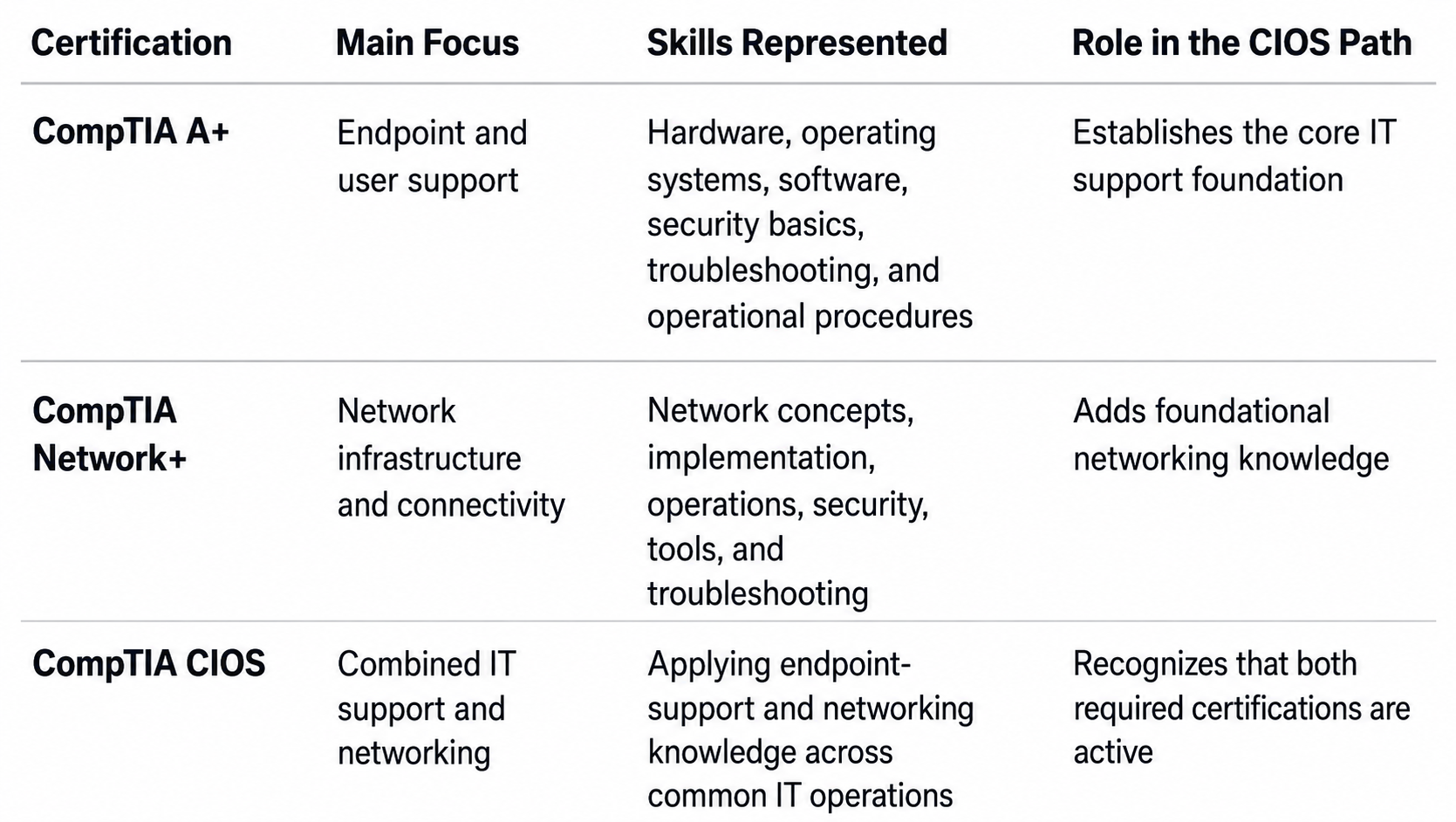
This combination is useful because many technical problems do not fit neatly into a single category. A laptop that cannot access a business application, for example, may have a device configuration issue, an operating-system problem, or a network connectivity failure.
What Are the CIOS Certification Requirements?
The main CompTIA IT Operations Specialist requirements are straightforward: you must hold active CompTIA A+ and CompTIA Network+ certifications.
Because exam versions and certification policies can change, candidates should confirm the current requirements before purchasing vouchers or selecting study materials.
CompTIA A+ Requirements
CompTIA A+ uses a two-exam structure. Candidates must pass the applicable Core 1 and Core 2 exams from the same active exam series to earn the certification.
At the time of writing, the current series consists of:
- 220-1201: CompTIA A+ Core 1
- 220-1202: CompTIA A+ Core 2
At a high level, the two exams cover areas such as hardware, mobile devices, networking, operating systems, security, cloud and virtualization concepts, software troubleshooting, and operational procedures.
Exam codes and available versions change over time. Always ensure your course, study guide, practice questions, and exam vouchers match the current series.
CompTIA Network+ Requirements
CompTIA Network+ requires candidates to pass its applicable certification exam. At the time of writing, the current exam is N10-009.
The certification covers foundational knowledge related to network architecture, devices, services, implementation, operations, security, and troubleshooting. It helps candidates understand how endpoints communicate and how to investigate connectivity or performance problems.
Network+ builds naturally on many of the introductory networking concepts covered in A+, but it examines networking in greater depth.
Do You Need to Take a Separate CIOS Exam?
No. There is no separate CompTIA CIOS exam.
You earn the CIOS stackable credential by holding active A+ and Network+ certifications. This means the full pathway normally involves three exams: two for A+ and one for Network+.
There is also generally no separate CIOS exam fee. Your main certification costs come from the examinations and preparation resources required for A+ and Network+.
How to Earn the CompTIA IT Operations Specialist Credential
Here is the typical path for earning CompTIA CIOS:
- Review the current CompTIA A+ requirements. Confirm the active Core 1 and Core 2 exam codes before selecting materials or buying vouchers.
- Prepare for and pass both A+ exams. Build knowledge through structured study, practical exercises, and troubleshooting practice.
- Prepare for and pass the current Network+ exam. Focus on understanding how networks operate rather than memorizing isolated terms.
- Confirm that both certifications are active. The required credentials should be valid and connected to the same CompTIA account.
- Verify that CIOS has been issued. Check your certification records and digital credentials after meeting the requirements.
- List your credentials clearly. Add A+, Network+, and CIOS appropriately to your résumé or LinkedIn profile.
If you already hold one of the two certifications, you are partway through the path. For example, an active A+ holder would normally need to earn Network+ to complete the required combination.
What Skills Does the CIOS Credential Represent?
The CompTIA IT Operations Specialist credential represents a combination of support and networking knowledge. Relevant skill areas include:
- Installing, configuring, and supporting computers and mobile devices
- Working with operating systems and common software
- Diagnosing hardware and software problems
- Applying basic cybersecurity practices
- Understanding network concepts, protocols, ports, and services
- Configuring basic wired and wireless connectivity
- Investigating network availability and performance issues
- Following documentation, safety, backup, and change procedures
- Providing technical support to users
- Communicating clearly while gathering information and explaining solutions
These skills can help a technician investigate an issue across multiple layers. Instead of assuming that every connection problem is caused by the network, the technician can check the device, operating system, network configuration, local infrastructure, and relevant services methodically.
CIOS represents foundational capability rather than advanced specialization. It does not replace deeper study in areas such as cybersecurity, cloud infrastructure, Linux administration, server management, or enterprise networking.
Practical Example of the CIOS Path
Consider a beginner named Elena who wants to move into IT support. She starts with CompTIA A+ and learns how computer components work, how operating systems are configured, how to follow security practices, and how to troubleshoot common device and software problems.
After earning A+, Elena begins studying for Network+. She learns more about addressing, routing, switching, wireless networks, network services, security controls, and structured troubleshooting. Once both certifications are active, she becomes eligible for the CIOS certification as a stackable credential.
The combined knowledge becomes useful when a user reports that a laptop cannot reach a shared workplace application. Elena can:
- Confirm whether the laptop is connected to the correct network.
- Check its IP configuration and relevant network settings.
- Determine whether other devices can reach the application.
- Test whether the problem affects the device, local network, or service.
- Review operating-system settings, security controls, and recent changes.
- Document the findings and escalate the issue when appropriate.
This example combines device support, communication, networking, and troubleshooting. The certifications do not guarantee Elena a job, but the learning path can help her develop knowledge relevant to entry-level technical work.
How Much Does the CIOS Certification Path Cost?
There is usually no separate CIOS exam or exam fee. However, candidates must budget for the exams required to earn A+ and Network+.
Potential expenses include:
- Two CompTIA A+ exam vouchers
- One CompTIA Network+ exam voucher
- Voucher bundles or optional retake coverage
- Instructor-led or self-paced training
- Study guides and video courses
- Practice exams
- Hands-on labs
- Certification renewal activities
The total CIOS certification cost varies by country, currency, taxes, available discounts, training provider, bundle selection, and voucher policy. Students and eligible organizations may also have access to different purchasing options.
Check current pricing and policies directly with CompTIA or an authorized provider before purchasing anything. Avoid relying on an older article or video because exam versions, fees, and promotions can change.
How Long Does It Take to Earn CIOS?
There is no universal completion time. Your schedule will depend on:
- Previous technical experience
- Familiarity with hardware and operating systems
- Existing networking knowledge
- Weekly study time
- Access to hands-on practice
- Whether you already hold A+ or Network+
- How much review you need between exams
A complete beginner studying several hours each week may need multiple months to prepare for all three exams. Someone who already provides technical support may move more quickly through familiar topics, although experience does not remove the need to study the current objectives.
A candidate who already holds an active A+ certification only needs to complete the Network+ requirement. Likewise, an active Network+ holder can concentrate on the two A+ exams.
Choose a schedule based on demonstrated understanding, not an arbitrary deadline. It is usually better to adjust your exam date than to rush through unfamiliar subjects.
What Jobs Can CIOS-Related Skills Support?
Skills covered by A+, Network+, and CIOS can be relevant to positions such as:
- Help-desk technician
- IT support specialist
- Desktop support technician
- Technical support specialist
- Field service technician
- Junior network technician
- Network support specialist
Actual requirements vary significantly by employer. Some organizations prioritize certifications, while others emphasize experience, education, communication skills, or familiarity with their specific technologies.
Employers may recognize CompTIA A+ and Network+ more readily than the CIOS name. For that reason, list the individual certifications clearly on your résumé. You may include CIOS as an additional stackable credential, but it should not replace the underlying certifications.
A clear certification section might list:
- CompTIA A+
- CompTIA Network+
- CompTIA IT Operations Specialist (CIOS) — Stackable Credential
You can strengthen your profile further by documenting practical work, including home labs, troubleshooting exercises, volunteer support, or entry-level technical projects.

Is the CompTIA IT Operations Specialist Certification Worth It?
The answer depends on your experience and career direction. The strongest value comes from the knowledge and the two underlying certifications—not simply from adding the CIOS badge to your profile.
CIOS May Be Worth Considering If You:
- Are beginning an IT career
- Want both support and networking knowledge
- Already hold A+ or Network+
- Plan to pursue infrastructure or cybersecurity certifications later
- Want a structured entry-level certification path
- Need to strengthen your troubleshooting foundation
For a career changer, the pathway can provide an organized way to study devices, operating systems, networks, security basics, and support procedures.
CIOS May Be Less Relevant If You:
- Already have substantial IT operations experience
- Need a specialized cloud, security, Linux, or advanced networking credential
- Are targeting jobs built around another vendor or technology
- Only want the CIOS badge without developing the underlying skills
- Have job requirements that prioritize a different certification
Before committing, review several realistic job listings for your intended role and location. Look for recurring requirements, then compare them with the A+ and Network+ objectives.
CIOS can be a useful recognition of a balanced entry-level foundation, but the practical skills and individual certifications usually carry the greatest value.
CIOS vs. Other CompTIA Certification Paths
CIOS is one possible direction within the broader CompTIA certification pathway:
- CIOS: Combines foundational IT support and networking knowledge through A+ and Network+.
- CompTIA Security+: Focuses on foundational cybersecurity concepts, threats, controls, architecture, and operations.
- CompTIA Linux+: Develops skills related to Linux administration, security, scripting, and troubleshooting.
- CompTIA Server+: Concentrates on deploying, managing, securing, and troubleshooting server environments.
- CompTIA Cloud+: Addresses cloud architecture, deployment, operations, security, DevOps fundamentals, and troubleshooting.
The right next step depends on your intended work. Security+ may suit someone moving toward cybersecurity, while Linux+ may be more relevant for Linux administration. Server+ or Cloud+ may fit infrastructure-focused plans.
Do not select a certification only because it appears to be the next level. Compare its objectives with the tasks performed in the roles you actually want.
How to Prepare for CompTIA A+ and Network+
A structured study process can make the path easier to manage:
- Download and review the current exam objectives. Use them as a checklist for every topic.
- Create a weekly schedule. Divide large domains into manageable study sessions.
- Use hands-on labs. Practise operating-system tools, device configuration, command-line utilities, and basic networking.
- Work through troubleshooting exercises. Learn how to identify symptoms, test theories, implement solutions, and document results.
- Answer realistic practice questions. Use them to check understanding and become comfortable with the exam style.
- Review every incorrect answer. Understand why the correct option works and why the alternatives do not.
- Track weak topics. Revisit subjects that repeatedly cause confusion.
- Avoid relying only on memorization. Exams may require you to apply several concepts to a technical problem.
- Schedule each exam when your performance is consistent. Use multiple indicators, including labs, topic reviews, and varied question sets.
Globalcerts practice exams can help you become familiar with question formats, identify knowledge gaps, and review important A+ and Network+ topics. They should be used alongside current exam objectives, learning materials, and hands-on practice.
Globalcerts questions are preparation resources, not official CompTIA exam questions, and practice results cannot guarantee an exam outcome.
Frequently Asked Questions
What does CIOS stand for?
CIOS stands for CompTIA IT Operations Specialist. It is a stackable credential that recognizes the combined foundational skills represented by active CompTIA A+ and Network+ certifications. These skills include endpoint support, operating systems, hardware, security basics, network concepts, connectivity, and technical troubleshooting.
Is CompTIA CIOS a real certification?
Yes. CompTIA CIOS is a recognized CompTIA stackable credential, but it works differently from a standalone certification. You do not earn it by passing an exam named CIOS. You qualify by holding the required active A+ and Network+ certifications.
Which certifications are required for CIOS?
You need active CompTIA A+ and CompTIA Network+ certifications. A+ requires its applicable Core 1 and Core 2 exams, while Network+ requires its applicable certification exam. Check current exam versions and policies before purchasing vouchers or choosing preparation materials.
Is there a separate CompTIA CIOS exam?
No. There is no separate CIOS exam. The assessment takes place through the required A+ and Network+ examinations. Once both certifications are active and associated with your account, CompTIA generally issues the stackable credential automatically.
Do I need to earn CompTIA A+ before Network+?
CompTIA does not require you to earn A+ before taking Network+. However, many beginners choose A+ first because it introduces hardware, operating systems, troubleshooting, and basic networking. Candidates with existing networking knowledge may prefer a different order.
How much does the CIOS certification path cost?
The cost includes two A+ exam vouchers and one Network+ exam voucher, plus any optional training, practice exams, labs, study guides, or retake coverage. There is generally no separate CIOS exam fee. Prices vary by country, taxes, discounts, bundles, and voucher policies.
Does CompTIA CIOS expire?
CIOS depends on the status of its underlying certifications. If a required certification becomes inactive, the stackable credential’s active status may be affected. Because renewal rules can change, review the current CompTIA continuing-education and renewal policies for A+ and Network+.
What jobs can I pursue with A+, Network+, and CIOS?
The related skills may support applications for help-desk, desktop support, field service, IT support, technical support, junior network technician, and network support positions. Hiring requirements differ, and no certification guarantees employment. Practical experience and communication skills also matter.
Should I list CIOS on my résumé?
Yes, if the credential is active and relevant. However, list CompTIA A+ and Network+ separately and prominently, because employers may recognize those names more readily. Add CIOS as a stackable credential that reflects your combined IT support and networking foundation.
What certification should I pursue after CIOS?
Choose based on your intended role. Security+ can support a cybersecurity direction, Linux+ may suit Linux administration, Server+ relates to server infrastructure, and Cloud+ focuses on cloud environments. Review job requirements and certification objectives before deciding.
Final Takeaway
The CompTIA IT Operations Specialist is a stackable credential for professionals who hold active CompTIA A+ and Network+ certifications. It does not require a separate CIOS exam. Instead, it recognizes the combined support, hardware, operating-system, security, networking, and troubleshooting knowledge represented by the underlying certifications.
The pathway may suit beginners, career changers, and support professionals who want a structured foundation across endpoints and networks. Its greatest value comes from building practical knowledge and earning the two individual certifications—not from the stackable title alone.
Start with whichever required certification you do not yet hold. Review the current exam objectives, build a realistic study schedule, practise the technical tasks, and use relevant Globalcerts training and practice exams to support your preparation.