
CompTIA CEU Requirements Explained: How Many CEUs Do You Need to Renew?
If you hold a renewable CompTIA certification, passing the exam is only the beginning. Most certifications in the CompTIA Continuing Education program must be renewed on a three-year cycle, and one common renewal method is earning Continuing Education Units, or CEUs.
Understanding CompTIA CEU requirements matters because the number of credits you need depends on your certification. For example, CompTIA A+ requires 20 CEUs, while Security+ requires 50 CEUs and SecurityX requires 75 CEUs.
You also have more than one way to renew. Depending on your certification and situation, you may accumulate CEUs, complete an eligible CertMaster CE course, pass a newer exam, or earn another qualifying certification.
Here is what you need to know before your expiration date arrives.

What Are CompTIA CEUs?
CEU stands for Continuing Education Unit. CompTIA uses CEUs to recognize eligible professional development completed while your certification is active.
Instead of proving your knowledge only by retaking an exam, you may be able to maintain your certification through activities such as:
- Completing relevant IT training
- Attending qualifying webinars or conferences
- Completing college coursework
- Earning another IT certification
- Gaining relevant professional experience
- Teaching or mentoring
- Creating eligible instructional material
- Publishing relevant IT content
The important point is that not every IT activity automatically qualifies.
For many continuing education activities, at least 50% of the content must relate to one or more objectives for the certification you are renewing. Activities must also be completed during your current renewal cycle, and documentation may be required.
How Many CEUs Do You Need to Renew a CompTIA Certification?
The required number of CompTIA CEUs depends on the certification.
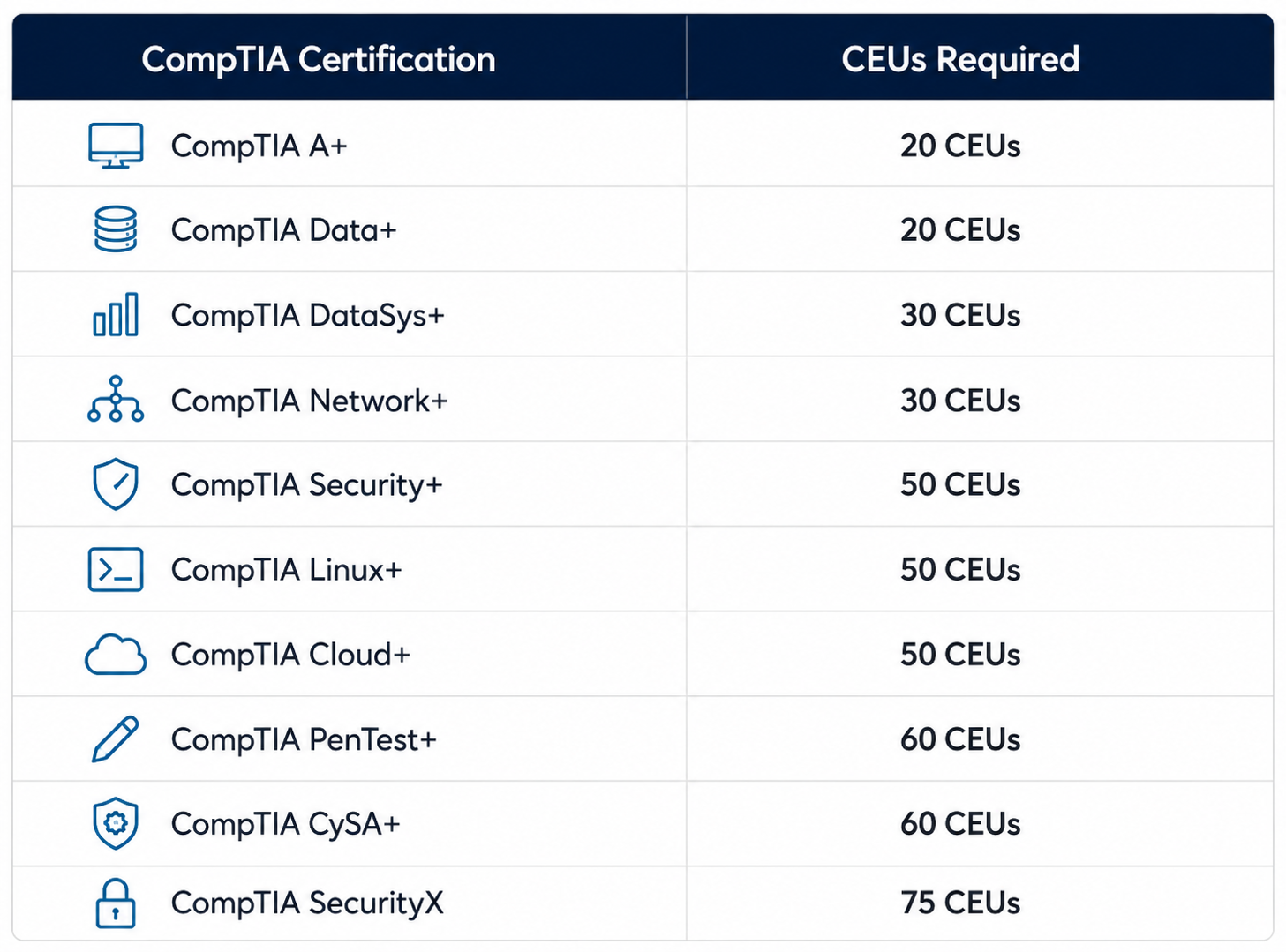
Here are CEU totals currently listed in CompTIA’s Continuing Education materials:
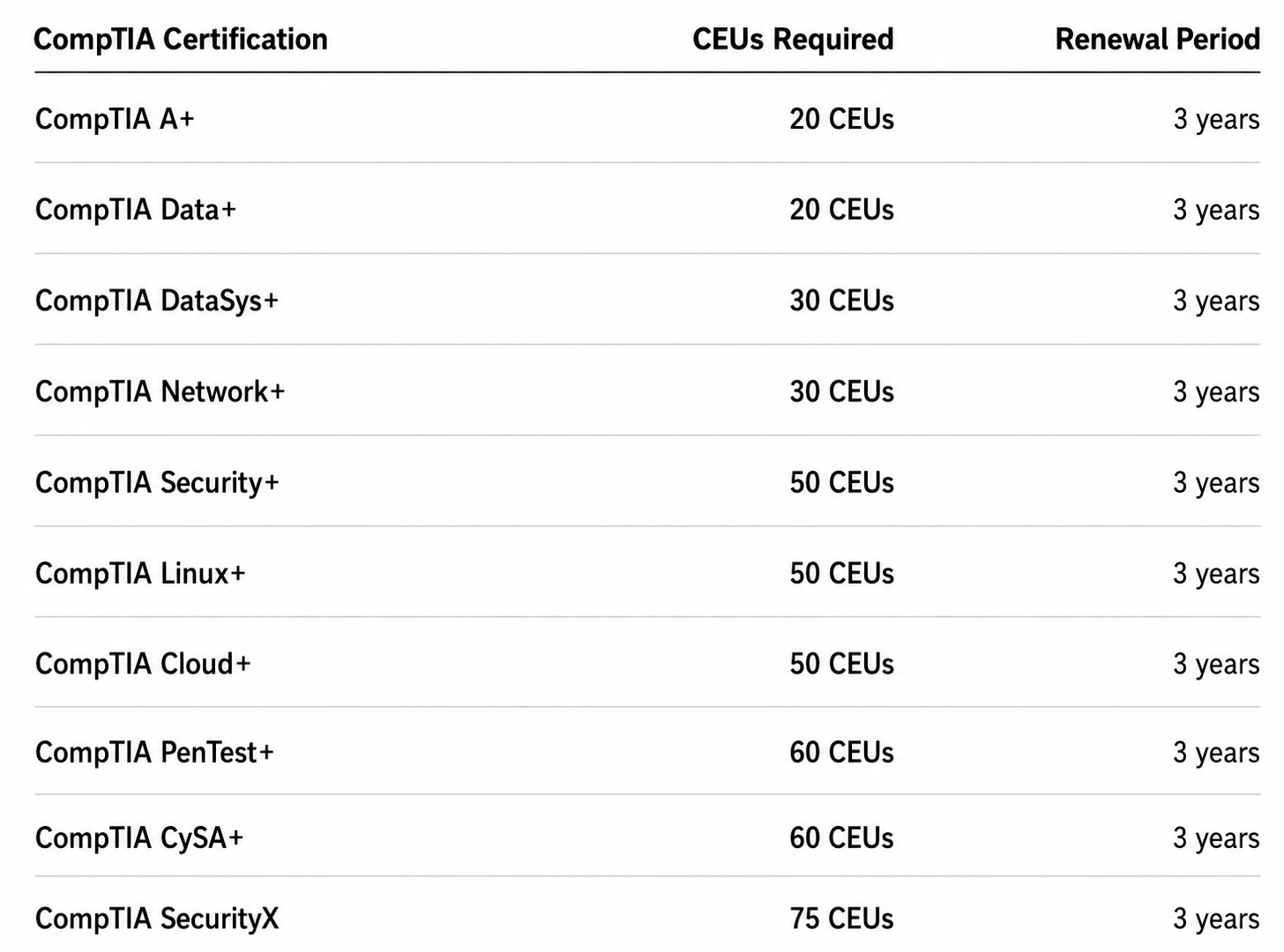
CompTIA continues to introduce and update certifications, so do not assume that every credential follows the same CEU rules. Check the renewal requirements associated with the specific certification you hold before creating your renewal plan.
CompTIA A+ CEU Requirements
To renew CompTIA A+ through accumulated CEUs, you need 20 CEUs during the three-year renewal cycle.
Because A+ has one of the lowest CEU requirements, completing relevant training may be enough to meet the full requirement.
An A+ holder who plans to progress professionally should also compare CEU renewal with earning Network+, because earning a qualifying higher-level certification can be a more useful long-term option.
CompTIA Network+ CEU Requirements
CompTIA Network+ requires 30 CEUs within the three-year cycle when you use the multiple-activity CEU renewal path.
Network+ holders can earn credits through qualifying networking training, professional activities, certification programs, webinars, college courses, and other accepted activities.
If you already plan to earn Security+, completing that certification while Network+ remains active can also provide a more direct renewal path.
CompTIA Security+ CEU Requirements
CompTIA Security+ requires 50 CEUs during its three-year renewal period when renewing through CEU accumulation.
This is one of the most commonly searched Security+ CEU requirements because many holders need the certification for cybersecurity, IT security, government, or defense-related roles.
You do not necessarily need one 50-hour course. Eligible activities can generally be combined, provided each activity meets CompTIA’s rules and any applicable category limits.
CEU Requirements for Other CompTIA Certifications
Other established CE requirements include:
- Linux+: 50 CEUs
- Cloud+: 50 CEUs
- CySA+: 60 CEUs
- PenTest+: 60 CEUs
- SecurityX: 75 CEUs
- Data+: 20 CEUs
- DataSys+: 30 CEUs
SecurityX is the current name of the certification previously known as CASP+.
How Does the CompTIA Continuing Education Program Work?
The basic renewal process is easier to understand when you separate it into steps.
- Identify your expiration date. Your CE certification generally operates on a three-year renewal cycle.
- Choose your renewal method. This might be CEUs, CertMaster CE, another certification, or an eligible exam.
- Complete qualifying activities during your active renewal cycle.
- Keep the required documentation. Certificates, course details, employer letters, transcripts, or other evidence may be necessary.
- Submit your CEUs through your CompTIA certification account when using the multiple-activity route.
- Pay any applicable Continuing Education fees.
- Complete all renewal requirements before your deadline.
For traditional CEU renewal, current fee structures generally mean a total three-year CE fee of $75 for A+ and Data+ and $150 for many other CE certifications, although you should verify the amount shown in your CompTIA account before paying.
Some single-activity renewal methods can waive separate CE fees.
How to Earn CompTIA CEUs
If you are researching how to earn CompTIA CEUs, you have several potential options.
Earn Another IT Certification
A qualifying CompTIA or non-CompTIA certification may provide enough credits to cover some or all of your CEU requirement.
The exact value depends on both certifications. Do not assume that every Microsoft, Cisco, AWS, ISC2, ISACA, or other vendor credential will automatically provide the number of CEUs you need.
Check eligibility before relying on a certification as your primary renewal method.
Complete Training or Courses
Training is one of the most flexible ways to collect CEUs.
For qualifying training, CompTIA generally awards one CEU for each hour of training, up to the applicable limit for the certification.
The training normally must:
- Be completed during your current CE cycle
- Relate sufficiently to the certification objectives
- Include appropriate evidence of completion
- Provide enough information for CompTIA to verify the activity
A completion certificate should normally identify details such as your name, course, training provider, date, and training duration.
Attend IT Conferences and Events
Relevant conference sessions can count toward renewal.
However, there are category limits. For example, current CompTIA guidance caps conference CEUs at different levels depending on the certification.
That means attending dozens of hours of conferences does not necessarily allow you to claim dozens of CEUs.
Gain Relevant Work Experience
Relevant professional experience may contribute to your renewal.
CompTIA has historically permitted up to three CEUs per year for qualifying work experience, for a maximum of nine CEUs during a three-year cycle.
Your work must be sufficiently related to the objectives of the certification being renewed, and employer documentation is normally required.
Work experience is therefore useful, but it generally cannot satisfy an entire 20-, 30-, 50-, 60-, or 75-CEU requirement by itself.
Teach, Mentor, or Create IT Content
Professional participation can also contribute CEUs when it meets current program rules.
Potential activities include:
- Teaching eligible IT material
- Mentoring
- Creating instructional material
- Participating in eligible subject-matter-expert activities
- Publishing relevant articles or other technical content
Each activity has its own eligibility rules and possible maximums. Always check the current category requirements before calculating your CEU total.
Can You Earn Free CompTIA CEUs?
Yes, free CompTIA CEUs are possible, although “free” does not mean automatically eligible.
Potential sources include:
- Free technical webinars
- Vendor-provided training
- Employer-sponsored courses
- Professional conferences or virtual events
- Relevant work experience
- Free technical education programs
- Qualifying professional activities
For example, suppose a Security+ holder attends several free cybersecurity webinars. The sessions may provide useful CEUs if they meet CompTIA’s relevance, timing, documentation, and category-limit requirements.
The mistake would be assuming that every webinar displaying the word “cybersecurity” automatically qualifies.
Verify the activity before depending on it for renewal.
Can a Higher-Level CompTIA Certification Renew Another Certification?
Yes. One of the most useful parts of CompTIA continuing education is that earning certain higher-level CompTIA certifications can fully renew qualifying certifications you already hold.
Common examples include:
- Network+ can renew A+
- Security+ can renew Network+ and A+
- CySA+ or PenTest+ can renew Security+, Network+, and A+ when the applicable hierarchy requirements are met
- SecurityX can renew qualifying certifications beneath it, including CySA+, PenTest+, Security+, Network+, and A+
Cloud and Linux certification relationships have their own rules, so do not treat the certification hierarchy as one simple vertical ladder.
Example: Suppose you currently hold Security+ and plan to move into security operations. If you earn CySA+ while your Security+ remains eligible for renewal, that new certification can also satisfy the renewal of Security+ and qualifying lower-level credentials.
This is why planning your next certification before paying for separate renewal activities can save both time and duplicated effort.
CertMaster CE vs. Earning CEUs: What Is the Difference?
CertMaster CE is CompTIA’s self-paced renewal option for certain certifications.
It is currently associated with A+, Network+, and Security+, subject to version and eligibility requirements.
An important limitation is that CertMaster CE is intended to bridge knowledge between certification generations. You cannot assume the currently available CertMaster CE course can renew the same exam generation you just passed.
Check your certification version and the eligibility statement for the current CertMaster CE release before purchasing it.
Practical Example: Renewing CompTIA Security+
Assume Maya holds an active CompTIA Security+ certification and needs 50 CEUs.
She decides not to pursue CySA+ or PenTest+ yet, so she uses the multiple-activity CEU path.
Her plan could look like this:
- Complete relevant security training with documented training hours.
- Claim eligible work-experience CEUs.
- Attend qualifying cybersecurity webinars within the permitted category maximum.
- Keep completion certificates, agendas, course descriptions, and employer documentation.
- Confirm that the activities relate sufficiently to Security+ objectives.
- Submit the activities through her certification account.
- Reach the required 50 CEUs and pay the applicable CE fees before the renewal deadline.
Another Security+ holder might take a completely different route by earning CySA+ or completing an eligible CertMaster CE course.
There is no requirement that everyone renew in exactly the same way.
Common Mistakes to Avoid When Earning CompTIA CEUs
A little planning prevents most renewal problems.
Waiting until the final weeks. If an activity is rejected, you need enough time to replace those credits.
Assuming every IT course qualifies. Relevance to your certification objectives matters.
Losing your documentation. Keep certificates, transcripts, course descriptions, event records, and employer letters.
Ignoring category limits. Some activities have maximum CEUs even if you spend more hours completing them.
Using irrelevant training. A course can be technically advanced and still fail to match the certification you are renewing.
Forgetting CE fees. Reaching your CEU total does not necessarily mean every renewal requirement is finished.
Relying on old renewal charts. CompTIA changes certification names, exam versions, products, and renewal relationships.
What Happens If You Do Not Earn Enough CEUs Before Expiration?
If you are using CEUs, complete the qualifying activities within your active three-year renewal cycle.
CompTIA may provide a limited administrative submission period after expiration for outstanding fees or CEUs that were already earned while the certification was active. That should not be treated as extra study time.
You generally cannot wait until the certification has expired and then start earning the missing CEUs.
If you are approaching your deadline and are short on credits, immediately review:
- How many CEUs remain
- Which qualifying activities you have already completed
- Whether documentation is available
- Whether a single-activity renewal option is available
- Whether you planned to earn a qualifying higher certification anyway
The safest strategy is to finish renewal before the certification expiration date.
Should You Earn CEUs or Pursue Your Next CompTIA Certification?
That depends on your career plan.
Accumulating CEUs may make sense when:
- You already complete relevant training through work
- You want to maintain your current certification
- You are not ready for another certification exam
CertMaster CE may make sense when:
- Your certification and exam version are eligible
- You prefer one structured renewal activity
- You do not want to track numerous CEU submissions
A higher-level certification may make sense when:
- You were already planning to advance
- The new certification fully renews your current credential
- The new credential supports your next job target
A typical progression might be A+ → Network+ → Security+, followed by a more specialized credential such as CySA+ or PenTest+ depending on your career direction.
Before paying solely to maintain an existing certification, ask whether the same time and budget could move you toward the next credential while also satisfying renewal.
Planning your next CompTIA certification? Globalcerts practice exams can help you check your knowledge, identify weaker areas, and prepare more effectively for exam day.
Frequently Asked Questions About CompTIA CEU Requirements
How many CEUs do I need for CompTIA A+?
CompTIA A+ requires 20 CEUs when you use the CEU accumulation method. The qualifying activities must be completed during your three-year renewal cycle and meet CompTIA’s eligibility requirements.
How many CEUs do I need for CompTIA Network+?
CompTIA Network+ requires 30 CEUs over the three-year CE cycle. You can combine eligible training and professional activities or use another qualifying renewal method.
How many CEUs do I need for CompTIA Security+?
Security+ requires 50 CEUs when renewing through multiple CE activities. Qualifying higher-level certifications and eligible CertMaster CE options can provide alternative renewal paths.
How long do I have to earn CompTIA CEUs?
CE certifications generally operate on a three-year renewal cycle. Activities used as CEUs must normally be completed during that active cycle, so plan from your actual certification expiration date rather than assuming you have until the end of a calendar year.
Can I earn CompTIA CEUs for free?
Yes. Free webinars, employer training, qualifying vendor education, professional activities, and relevant work experience may provide CEUs. Eligibility, documentation, relevance, and category caps still apply.
Do CompTIA CEUs expire?
CEUs are associated with a particular renewal cycle. Activities used for renewal must fall within the applicable CE period. Do not assume unused or excess CEUs will automatically carry forward into another three-year renewal cycle.
Can one activity count toward multiple CompTIA certifications?
Potentially, but it depends on the certifications, activity relevance, and your renewal setup. When several certifications are linked through CompTIA’s renewal hierarchy, renewing the appropriate higher certification can automatically renew qualifying lower-level certifications.
Does earning another CompTIA certification renew my current certification?
It can. For example, Security+ can renew Network+ and A+, while qualifying higher cybersecurity certifications can renew Security+. The exact relationship depends on CompTIA’s current certification hierarchy.
Do I have to pay a fee after earning all my CEUs?
When using the standard multiple-activity CEU route, Continuing Education fees generally apply. Some single-activity methods, including qualifying higher-level CompTIA certifications and eligible CertMaster CE renewal, may waive separate CE fees.
What happens if my CompTIA certification expires before I renew it?
Do not assume you can simply earn missing CEUs afterward. Any administrative grace period is intended for completing outstanding submission requirements for activities earned during the original cycle, not for earning new CEUs. Complete your renewal before expiration whenever possible.
Final Thoughts on CompTIA CEU Requirements
The most important part of managing CompTIA CEU requirements is knowing your number and your deadline.
An A+ holder may need 20 CEUs, Network+ requires 30, Security+ requires 50, CySA+ and PenTest+ require 60, and SecurityX requires 75 under the established CEU path.
From there, choose eligible activities, keep the documentation, watch category limits, and avoid leaving everything until the final weeks.
And before accumulating CEUs simply because your certification is approaching expiration, check whether your next planned certification could renew the credential you already have. In some cases, continuing forward is also the simplest way to stay current.