Best CompTIA Study Materials in 2026: Humble Bundle vs Practice Exams, Books and Labs
Choosing the right CompTIA study resources can be harder than expected. A quick search brings up books, video courses, practice exams, PBQ preparation, virtual labs, flashcards, free tutorials, and discounted bundles containing dozens of digital resources.
The challenge is not finding study material. It is figuring out which material actually helps at each stage of your preparation.
The best CompTIA study materials in 2026 are rarely a single book, course, or practice test. Most candidates benefit from combining a structured learning resource with hands-on practice, realistic exam questions, and targeted review.
Humble Bundle can sometimes provide an inexpensive way to build a large digital study library, while dedicated practice exams and labs serve very different purposes.
Below, we compare Humble Bundle resources, books, practice exams, PBQs, video training, and labs so you can build a CompTIA study plan around your certification, experience level, learning style, and budget.
What Are the Best CompTIA Study Materials in 2026?
For most candidates, the strongest CompTIA preparation combines several types of resources rather than relying on one.
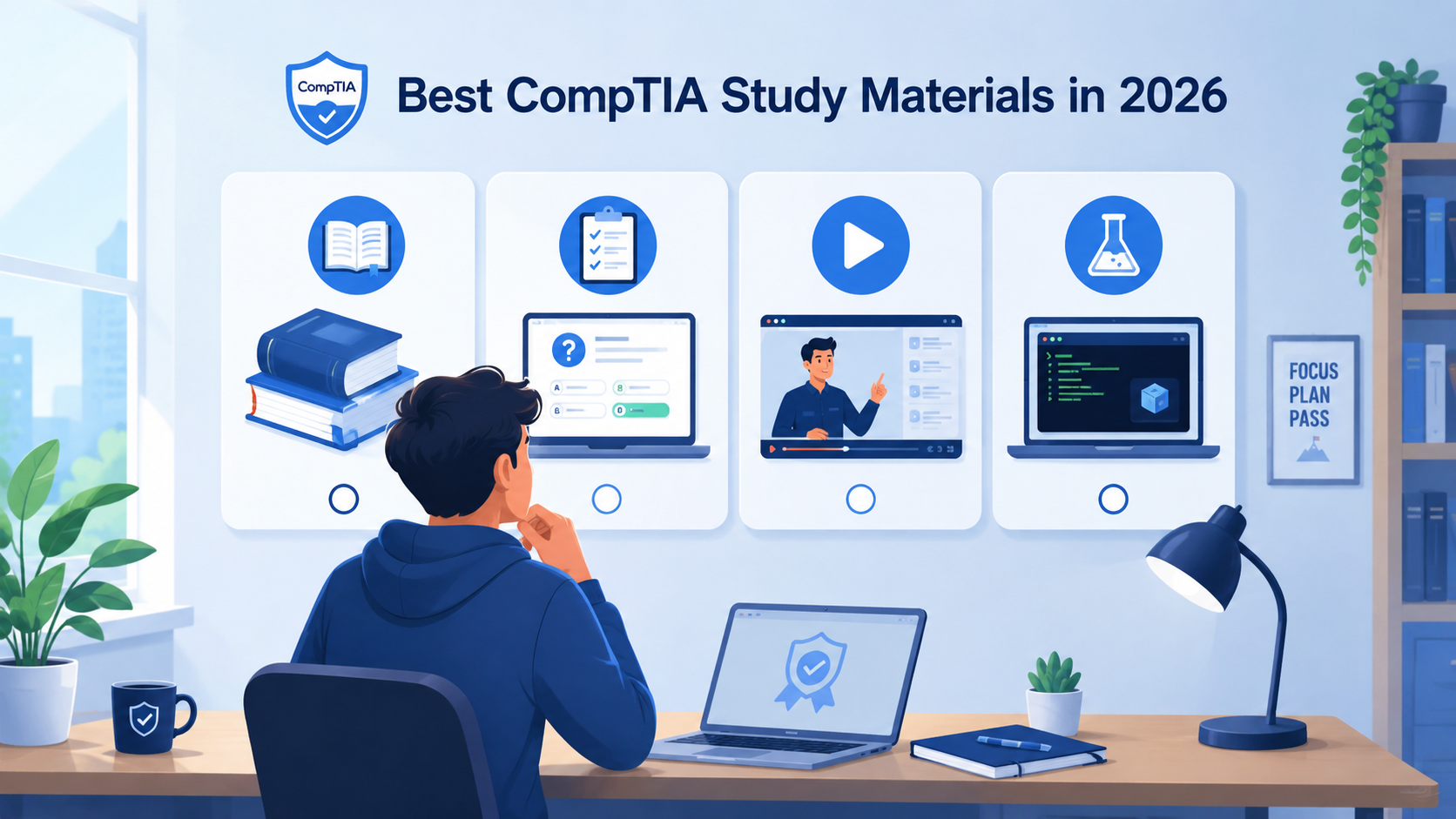
A useful study stack normally includes:
- A structured book, course, or study guide for learning the objectives
- Videos for topics that are easier to understand visually
- Hands-on labs for technical practice
- Practice questions for reinforcement
- Full-length CompTIA practice exams for readiness assessment
- PBQ-style exercises for practical scenarios
- Flashcards or notes for final review
Each resource solves a different problem.
A candidate preparing for CompTIA Security+, for example, could learn the objectives through a structured study guide, reinforce security concepts with video demonstrations, practice log analysis and configuration tasks in labs, and then use realistic practice exams to identify remaining weaknesses.
That combination is generally more useful than repeatedly consuming the same type of material.
What Is the CompTIA Humble Bundle?
When people search for Humble Bundle CompTIA, they are usually looking for discounted collections of certification-related books, courses, or technical training materials.
A technology bundle may include combinations of:
- Digital certification books
- Technical reference books
- Study guides
- Training courses
- Practice resources
- Cybersecurity or networking material
- Linux and programming resources
- Other certification-focused content
The exact content and availability of bundles can change, so candidates should always evaluate the resources included rather than assuming every bundle provides the same value.
A bundle containing ten or twenty books may look impressive, but quantity is less important than whether the materials match your current exam objectives.
Why CompTIA Candidates Consider Humble Bundle
The biggest attraction is usually value.
A bundle can sometimes give learners access to a broad technical library for significantly less than purchasing every resource individually.
This may be particularly useful if you are studying multiple topics.
For example, someone planning to progress from CompTIA A+ to Network+ and then Security+ may find a collection covering hardware, networking, operating systems, Linux, and cybersecurity useful beyond a single exam.
Bundles can also work well as reference libraries. Even after passing an exam, you may want to return to a networking, Linux, cloud, scripting, or cybersecurity book later.
Limitations of Humble Bundle CompTIA Materials
More material does not automatically mean better preparation.
Potential drawbacks include:
- Some books may target an older exam version.
- Certain resources may cover topics far beyond the certification objectives.
- Quality can vary between publishers and instructors.
- A large library can make it difficult to decide what to study first.
- Reading alone does not develop practical troubleshooting skills.
- Bundles may offer limited realistic exam simulation.
- PBQ preparation may be minimal or absent.
The biggest risk is information overload.
If you have twelve books available for Security+, you probably should not attempt to read all twelve before taking the exam. Choose one strong primary resource and treat the remaining material as supplementary references.
CompTIA Study Books and Study Guides
A CompTIA study guide is often one of the best starting points because it gives your preparation structure.
Good study guides typically organize concepts around the certification objectives and explain the terminology, technologies, processes, and troubleshooting methods candidates are expected to understand.
Books are particularly useful for:
- Building foundational knowledge
- Studying objectives systematically
- Reviewing difficult topics
- Creating notes
- Looking up technical terminology
- Revisiting weak domains
Advantages of CompTIA Books
Books let you control your pace.
You can stop at a difficult networking concept, reread it, create notes, compare diagrams, and return to it later without moving through an instructor’s timeline.
They also provide depth. A well-written book can explain why a technology works rather than simply telling you what answer to select.
This is particularly useful for certifications such as Network+, Linux+, CySA+, and PenTest+, where understanding technical relationships matters more than memorizing isolated definitions.
Disadvantages of Relying Only on Books
Books primarily teach knowledge.
CompTIA exams may also require you to apply that knowledge to troubleshooting, configuration, security, and scenario-based problems.
Reading about subnetting is different from solving a network addressing problem.
Reading about Linux permissions is different from interpreting permissions or working with commands.
Reading about incident response is different from reviewing logs and deciding what action should happen next.
For example, a Security+ candidate could use a study guide to learn authentication methods, cryptography, vulnerabilities, and security controls. After learning those concepts, the candidate should apply them through scenario questions and security-related exercises rather than simply rereading the chapter.
CompTIA Practice Exams
CompTIA practice exams serve a different purpose from books and courses.
Their primary job is to test whether you can apply what you have learned.
Good practice exams help candidates:
- Identify weak objectives
- Practice time management
- Recognize scenario-based question patterns
- Improve decision-making
- Reinforce concepts through explanations
- Discover knowledge gaps
- Become comfortable working under exam-like conditions
They become particularly useful after you have already completed a meaningful portion of your primary training.
What Makes a Good CompTIA Practice Exam?
A useful practice test should reflect the current exam objectives.
Look for practice resources that:
- Cover the major exam domains
- Use realistic technical scenarios
- Include plausible incorrect answers
- Explain why the correct answer is correct
- Explain why distractors are incorrect
- Test understanding rather than obscure trivia
- Include certification-appropriate difficulty
- Avoid material far outside the exam scope
Detailed explanations are especially important.
A score tells you that you missed a question. A good explanation helps you understand why.
Practice Exams Should Not Be Used for Memorization
Repeatedly taking the same exam until you remember the answers can create false confidence.
Suppose you miss a Network+ question about a switch configuration problem.
A weak review process looks like this:
“The answer was VLAN. I will remember VLAN next time.”
A better review process asks:
- What problem was the scenario describing?
- Which clues pointed toward VLAN configuration?
- Why were the other technologies inappropriate?
- Which exam objective covers the topic?
- Could I solve a different scenario testing the same concept?
The goal is transferable knowledge.
If the wording changes on exam day, you should still understand the concept.
CompTIA Performance-Based Questions and PBQ Practice
Performance-based questions, commonly called CompTIA PBQs, evaluate applied knowledge through more interactive or scenario-oriented tasks.
Depending on the certification, preparation might involve:
- Troubleshooting exercises
- Matching activities
- Ordering tasks
- Network diagrams
- Command-line scenarios
- Configuration decisions
- Security incident scenarios
- System administration tasks
Candidates often find PBQs challenging because they require several pieces of knowledge to work together.
A multiple-choice question might ask which command performs a task.
A practical scenario may require you to determine which command is appropriate based on the system state and desired outcome.
That difference matters.
PBQ-style preparation should complement conceptual learning. It should not replace it.
You still need to understand the underlying technologies before practical exercises become useful.
CompTIA Labs and Hands-On Practice
CompTIA labs help turn theory into practical understanding.
They can be especially valuable for certifications involving networking, operating systems, cybersecurity, administration, troubleshooting, or command-line tools.
Useful lab activities may include:
- Configuring operating systems
- Troubleshooting network connectivity
- Working with Linux commands
- Managing users and groups
- Changing file permissions
- Reviewing system and security logs
- Configuring services
- Working with virtual machines
- Investigating security events
- Practicing administrative tasks
A lab does not have to be complicated.
A Linux+ candidate could create a virtual Linux machine and practice navigating directories, managing permissions, reviewing processes, editing configuration files, and using common commands.
That experience makes command-related exam questions easier to understand because the commands are connected to something you have actually done.
Who Benefits Most From CompTIA Labs?
Labs are particularly valuable for:
- Beginners with little professional IT experience
- Career changers entering technical roles
- Candidates preparing for Linux+, Network+, CySA+, or PenTest+
- Learners who remember by doing
- Candidates who know terminology but struggle with scenarios
Consider a career changer studying Network+.
Reading about DNS, DHCP, addressing, routing, and switching builds theoretical understanding. Creating a small virtual network, examining IP configurations, troubleshooting connectivity, and reviewing network settings turns those ideas into practical knowledge.
Video Courses and Instructor-Led CompTIA Training
Video courses are another common part of CompTIA training.
They work particularly well when a topic benefits from visual explanation.
For example, seeing an instructor walk through a subnetting problem, Linux terminal session, network diagram, firewall rule, or log analysis exercise may be easier to follow than reading the same process.
Video training can be useful for:
- Complete beginners
- Visual learners
- Technical demonstrations
- Difficult concepts
- Rapid topic review
- Following structured lessons
The main limitation is passive consumption.
Watching ten hours of videos can feel productive even if very little information is retained.
Improve video study by pausing regularly to:
- Take notes
- Recreate demonstrations
- Answer questions
- Explain concepts without looking at the video
- Perform related lab exercises
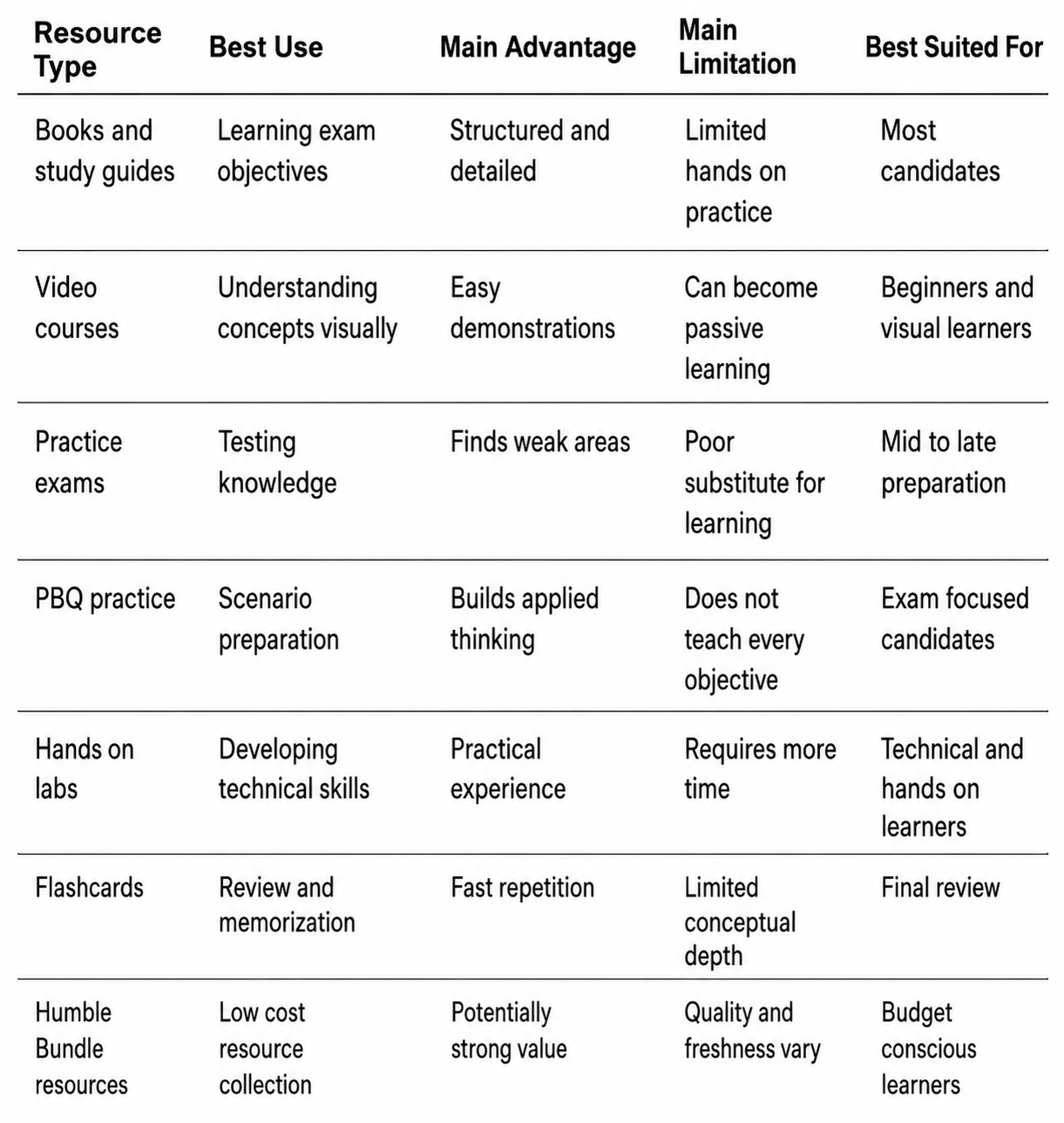
Humble Bundle vs Practice Exams vs Books vs Labs
The resources are easiest to compare by looking at the role each plays in your preparation.
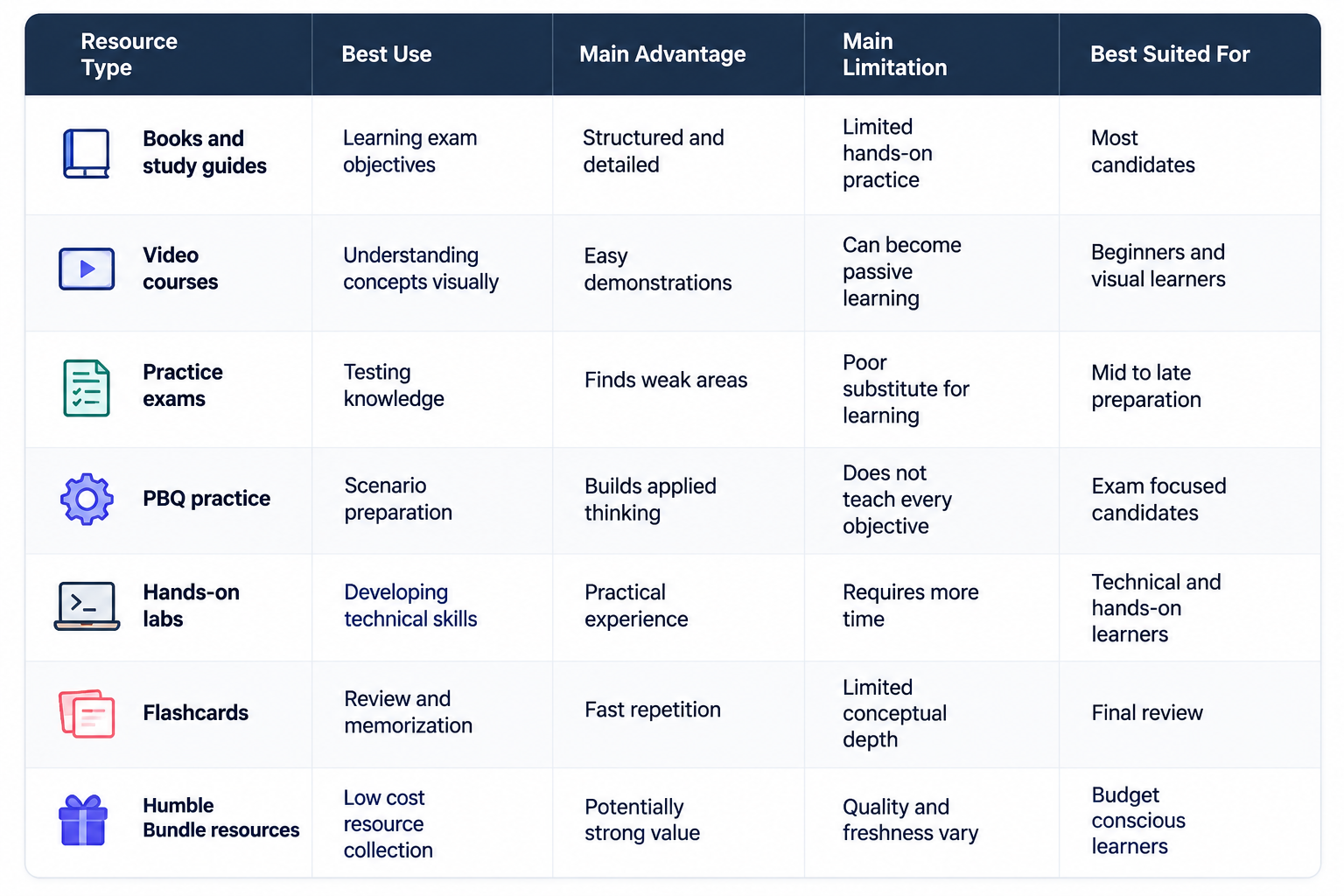
The important takeaway is that these resources are complementary.
A book explains.
A video demonstrates.
A lab lets you perform.
A practice question tests.
A PBQ asks you to apply.
A full practice exam evaluates how these skills work together under time pressure.
That is why choosing a combination of resources is usually more effective than searching for one “perfect” training product.
Which CompTIA Study Resource Is Best for Your Learning Style?
The best CompTIA study resources depend partly on how you learn and how much technical experience you already have.
Best for Complete Beginners
Start with one structured primary resource.
That might be:
- A study guide
- A structured video course
- A certification-specific training program
Study each objective in order and reinforce difficult concepts with demonstrations and simple labs.
Once you understand the fundamentals, add practice questions and eventually full-length exams.
Best for Experienced IT Professionals
Experienced candidates may not need extensive instruction on every foundational topic.
Instead:
- Review the current objectives.
- Identify unfamiliar areas.
- Study those gaps.
- Take practice questions.
- Perform labs for topics you rarely use professionally.
- Move into timed exam simulations.
An experienced network administrator studying Security+, for example, may already understand ports, protocols, routing, and basic infrastructure but need more focused review of governance, security architecture, cryptography, and incident response.
Best for Visual Learners
Combine:
- Video instruction
- Diagrams
- Network maps
- Demonstrations
- Labs
- Visual notes
Do not rely entirely on videos. Add practice questions so you can confirm that you retained what you watched.
Best for Hands-On Learners
Prioritize:
- Labs
- Virtual machines
- Command-line exercises
- Troubleshooting
- Configuration tasks
- PBQ-style activities
Use a study guide alongside those exercises so your practical work remains aligned with the exam objectives.
Best for Learners on a Budget
A budget-focused plan might combine:
- One current study guide
- Selected free educational resources
- A relevant bundle when available
- Home labs using virtual machines
- Targeted paid practice exams
- Flashcards or personal notes
Spending less does not automatically make a study plan worse.
The key is choosing resources that solve different preparation needs instead of buying several products that all do the same thing.
Can You Pass a CompTIA Exam Using Only Humble Bundle?
Potentially, but it depends heavily on what the bundle contains.
Important factors include:
- Which certification you are taking
- Your existing IT experience
- Whether the resources match the current exam code
- How recently the material was updated
- Whether practice questions are included
- Whether hands-on activities are available
- How effectively you use the resources
A collection containing current books, training content, and useful practice material could provide a strong foundation.
However, a bundle consisting mainly of reading material may leave practical and exam-simulation gaps.
For that reason, many candidates will benefit from adding realistic practice questions, PBQ preparation, or labs.
Can You Pass CompTIA Using Only Practice Exams?
Practice exams should generally be used for validation and reinforcement, not as your only learning resource.
They are excellent for discovering what you do not know.
They are much less effective when used as a shortcut around actually learning the objectives.
A better workflow is:
- Learn a domain.
- Complete practice questions.
- Review every error.
- Return to weak concepts.
- Perform practical exercises where appropriate.
- Continue to the next domain.
- Take full-length practice exams later.
That process uses questions as a diagnostic tool rather than a memorization exercise.
How to Build the Best CompTIA Study Plan in 2026
A strong CompTIA exam study plan does not need to be complicated.
Step 1: Review the Current Exam Objectives
Know exactly what the certification expects you to understand.
Use the objectives as the boundary for your study plan.
Step 2: Choose One Primary Learning Resource
Select one main study guide, course, or structured training platform.
Avoid switching between five different courses before completing one.
Step 3: Study One Domain at a Time
Break the exam into manageable sections.
Create notes and track difficult objectives.
Step 4: Reinforce Difficult Topics
Use videos, diagrams, alternative explanations, or reference books when your primary resource is unclear.
Step 5: Add Hands-On Practice
Perform relevant exercises instead of merely reading about technical tasks.
Step 6: Complete Domain-Level Practice Questions
Use questions to confirm your understanding before moving too far ahead.
Step 7: Take Full-Length Practice Exams
Once you have studied most objectives, begin timed simulations.
Step 8: Review Every Incorrect Answer
Do not simply check your score.
Determine why each answer was wrong.
Step 9: Revisit Weak Domains
Return to your study guide, labs, or videos for the objectives causing the most difficulty.
Step 10: Practice PBQ-Style Scenarios
Before exam day, make sure you have practiced applying concepts rather than only recognizing definitions.
Example CompTIA Study Stacks
There is no guaranteed formula, but the following combinations illustrate how different resource types can work together.
Budget Study Stack
A cost-conscious candidate could use:
- One current study guide
- Selected video resources
- Relevant bundle materials
- Practice questions
- Home labs or virtual machines
- Personal flashcards
This works best when the candidate carefully checks that every resource matches the current exam objectives.
Balanced Study Stack
A balanced approach might include:
- Structured study guide or course
- Hands-on labs
- Domain-level practice questions
- Full-length practice exams
- PBQ preparation
- Flashcards for final review
This gives you learning, application, testing, and review.
Intensive Exam-Prep Study Stack
Someone preparing on a tighter schedule could use:
- Current objective-based training
- Frequent hands-on labs
- Daily targeted practice questions
- Multiple timed practice exams
- Detailed error review
- Dedicated PBQ preparation
- Focused revision of weak domains
The goal is not simply to study more hours. It is to spend more time on the objectives that produce the greatest number of mistakes.
Common Mistakes When Choosing CompTIA Study Materials
Buying Too Many Resources
More resources can create more decisions instead of more learning.
Choose one primary resource first.
Using Outdated Exam Materials
Always confirm that your study material corresponds to the current exam version.
Studying Far Outside the Objectives
Extra knowledge can be valuable professionally, but it may not be the best use of limited exam-preparation time.
Watching Videos Without Practicing
Turn passive video sessions into active study by taking notes and reproducing demonstrations.
Memorizing Practice Answers
Study the concept behind the question rather than its wording.
Ignoring PBQs
Include scenario-based and practical preparation before exam day.
Skipping Hands-On Practice
If a certification covers commands, administration, troubleshooting, networking, or security analysis, practical experience can make those concepts easier to understand.
Taking Full Practice Exams Too Early
Use smaller question sets during early study and save complete simulations for later preparation.
Treating Practice Scores as the Only Readiness Metric
A high score is less meaningful if you have memorized the questions.
Ask whether you can explain why each answer is correct.
What Should You Look for Before Buying CompTIA Study Materials?
Use this checklist before purchasing another course, book, exam simulator, or bundle:
Does it match the current CompTIA exam code?
Does it follow the current objectives?
When was the resource published or updated?
Are explanations detailed enough to teach the concept?
Are practice questions realistic rather than trivia-based?
Does it include PBQ-style preparation where appropriate?
Are labs included?
Does the publisher or instructor have a credible technical background?
What are the access and refund terms?
Does the resource add something your existing materials do not already provide?
The final question is particularly important.
If you already own two books covering the same Security+ objectives, buying a third may provide less value than purchasing labs or high-quality practice exams.
Are Paid CompTIA Study Materials Worth It?
Sometimes.
Paid resources can be worthwhile when they provide something difficult to recreate yourself, such as:
- Structured learning
- Detailed feedback
- Realistic practice exams
- PBQ exercises
- Guided labs
- Exam simulations
- Well-organized objective coverage
- Time savings
Free resources may be sufficient for certain parts of your preparation, especially if you already have professional IT experience.
A candidate with years of Linux administration experience, for example, may need less introductory Linux training than someone using Linux for the first time.
Think in terms of value rather than simply free versus paid.
Ask what problem the resource solves.
Final Verdict: What Are the Best CompTIA Study Materials in 2026?
The best CompTIA study materials in 2026 are the resources that work together to cover learning, practical application, exam practice, and review.
For most candidates, that means combining:
- One structured learning resource
- Hands-on practice
- Realistic practice exams
- PBQ preparation
- Focused review of weak objectives
Humble Bundle CompTIA resources can offer excellent value when the included materials are current, relevant, and aligned with the certification you are studying.
Books provide depth.
Videos simplify difficult concepts.
Labs build practical understanding.
Practice questions expose knowledge gaps.
PBQs develop applied problem-solving.
The strongest study plan gives each resource a clear job.
Once you understand the material, use realistic practice exams to identify the objectives that still need work before exam day. Globalcerts provides certification-focused CompTIA practice exams, practice questions, and PBQ-style preparation that can be used alongside your main study materials to help turn weak areas into focused revision.
Frequently Asked Questions
What are the best CompTIA study materials in 2026?
The best approach usually combines a current study guide or course with labs, practice questions, full-length practice exams, PBQ preparation, and targeted review.
Is Humble Bundle good for CompTIA certification preparation?
It can be. The value depends on whether the included materials are current, relevant to your certification, and aligned with the current exam objectives.
Is the CompTIA Humble Bundle worth it?
A bundle can be worthwhile for learners who want several technical resources at a low combined cost. Evaluate the actual contents rather than the number of resources included.
Can I pass CompTIA using only a study guide?
It may be possible for an experienced candidate, but most learners benefit from adding practice questions and hands-on exercises to reinforce what they have read.
Are CompTIA practice exams worth buying?
Quality practice exams can be valuable because they identify weak objectives, improve time management, and help candidates practice applying knowledge to scenarios.
Do I need labs to pass a CompTIA certification?
Labs are not equally important for every candidate or certification, but hands-on practice can significantly improve understanding of administration, troubleshooting, networking, Linux, and security topics.
How many practice exams should I take before a CompTIA exam?
There is no universal number. Focus on whether you understand your mistakes and can consistently solve unfamiliar questions rather than trying to reach a specific number of completed tests.
What is the best way to study for CompTIA exams?
Review the objectives, choose one primary learning resource, study domain by domain, practice technical skills, answer practice questions, complete timed exams, and revisit weak areas.
Are free CompTIA study resources enough?
They can be useful, especially for experienced learners. Beginners may benefit from paid resources that provide stronger structure, explanations, labs, or realistic exam simulation.
How can I tell if CompTIA study materials are outdated?
Check the exam code, publication or update date, and stated objective coverage. If the resource targets an older version of the certification, use it carefully or replace it with current material.