
CompTIA Passing Scores: A+, Network+, Security+ and Other Exams Compared
The CompTIA passing score depends on the certification and exam version you take. CompTIA A+, Network+, Security+, and other exams do not all require the same score, even though most report results on a 100–900 scaled scoring range.
A scaled score is not the same as the percentage of questions you answered correctly. For example, earning 750 on a 100–900 scale does not automatically mean you answered 83.3% of the questions correctly.
This guide compares current CompTIA exam passing scores, explains how scaled scoring works, and shows you how to evaluate practice-test results before scheduling or retaking an exam.
Quick Comparison of CompTIA Exam Passing Scores
The following table compares several active CompTIA exams and their current requirements.
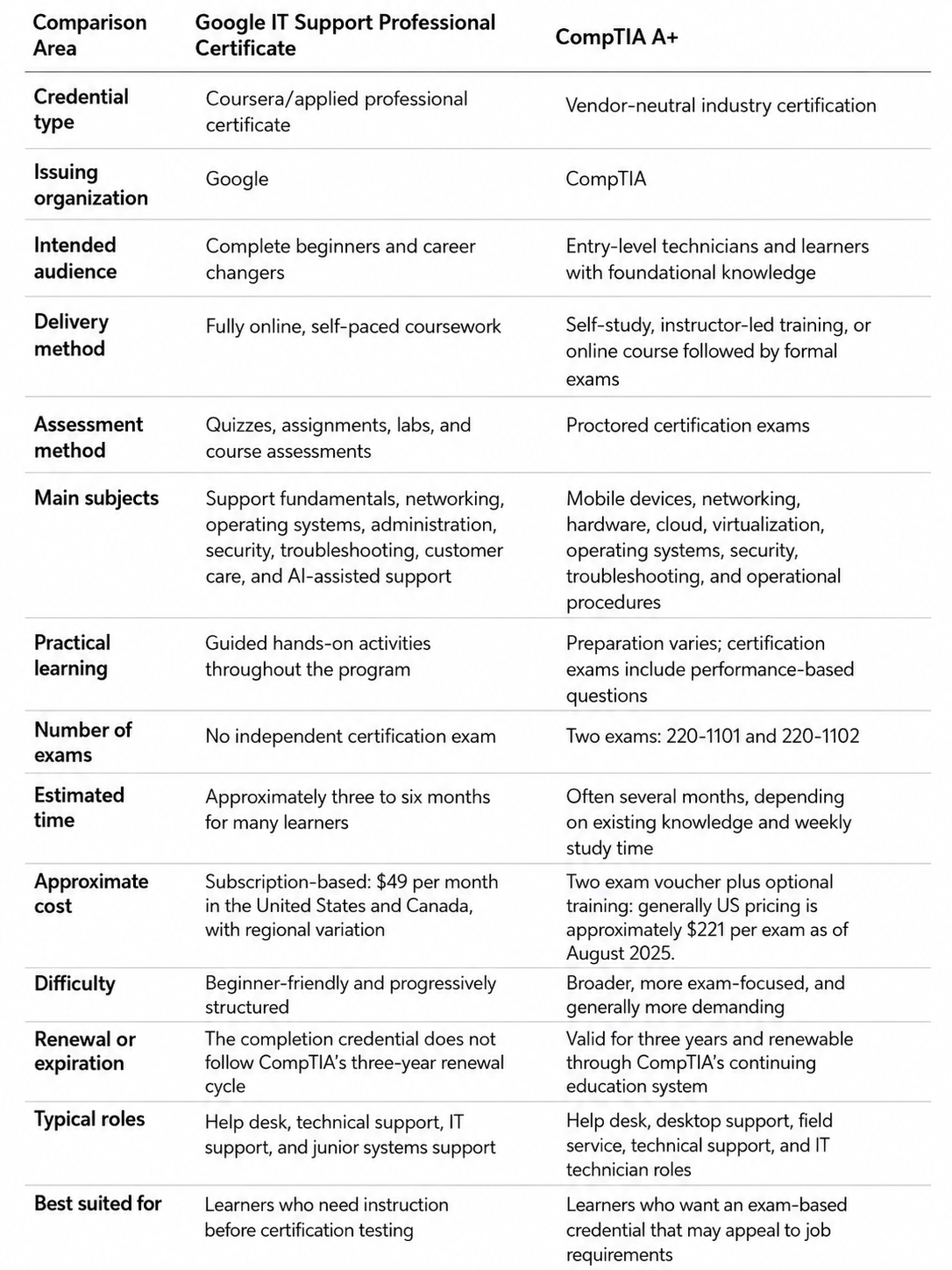
The A+, Network+, and Security+ details above reflect the active exam versions available in August 2026.
The additional exams were also checked against current exam references. Exam codes, durations, question limits, and passing scores can change when CompTIA introduces a new version.
Always confirm the current version before registering, especially when an exam is approaching retirement.
How Does the CompTIA Scoring Scale Work?
Most CompTIA certification exams use a scaled scoring system. Your performance is converted into a score within a specified range, usually 100 to 900.
This system allows different exam forms to be evaluated against a consistent passing standard. However, CompTIA does not publish a simple formula candidates can use to convert their score into an exact percentage of correctly answered questions.
Scaled Scores Versus Raw Percentages
Three terms are useful to understand:
- A raw score is generally the number of points earned before conversion.
- A percentage score represents a portion out of 100.
- A scaled score converts performance onto a defined reporting range.
Suppose an exam requires 750 on a 100–900 scale. Dividing 750 by 900 produces approximately 83.3%, but that calculation does not prove that you must answer 83.3% of the questions correctly.
The scale begins at 100 rather than zero, and the underlying conversion method is not publicly disclosed. Questions may also differ in format and scoring treatment.
Therefore:
750 out of 900 is a scaled passing standard, not a confirmed raw passing percentage.
Why CompTIA Uses Different Passing Scores
Different certifications measure different responsibilities and skill levels.
CompTIA A+ focuses on foundational IT support, hardware, operating systems, troubleshooting, and security. Network+ measures networking knowledge and operational skills, while Security+ evaluates the ability to apply security concepts in practical situations.
More advanced exams may cover incident response, penetration testing, server administration, cloud infrastructure, or security analytics. CompTIA establishes a passing standard for each individual exam rather than applying one universal score to every certification.
A higher passing score does not automatically mean an exam is proportionally harder. Exam scope, question design, expected candidate experience, and the scaled scoring process all contribute to the final requirement.
Are All Questions Worth the Same Number of Points?
Candidates should not assume that every question contributes exactly the same number of points.
CompTIA exams may contain:
- Single-answer multiple-choice questions
- Multiple-response questions
- Performance-based questions
- Other scenario-based item formats
CompTIA does not publish a complete per-question point table or raw-to-scaled conversion formula. It is therefore impossible to determine exactly how much each question affects your result.
Performance-based questions can require several actions within one scenario, but you should not assume a specific point value or partial-credit policy unless CompTIA publishes it for your exam.
CompTIA A+ Passing Score
The current CompTIA A+ passing score differs between Core 1 and Core 2. You must complete two separate exams because each core measures a different group of entry-level IT skills.
CompTIA A+ Core 1 Passing Score
The current Core 1 exam is 220-1201. It has a passing score of 675 on a 100–900 scale, allows a maximum of 90 questions, and has a 90-minute time limit.
Core 1 covers areas such as:
- Mobile devices
- Networking
- Computer hardware
- Virtualization and cloud computing
- Hardware and network troubleshooting
Because Core 1 produces its own result, passing Core 2 cannot compensate for an unsuccessful Core 1 attempt.
CompTIA A+ Core 2 Passing Score
The current Core 2 exam is 220-1202. It requires 700 on a 100–900 scale, with a maximum of 90 questions and a 90-minute duration.
Core 2 concentrates on:
- Operating systems
- Security
- Software troubleshooting
- Operational procedures
The different passing requirements reflect the fact that Core 1 and Core 2 are separate exams with different objectives.
Do You Need to Pass Both A+ Exams?
Yes. You must pass both current A+ core exams to earn the certification.
Passing only 220-1201 or only 220-1202 does not award a partial A+ certification. If you pass one exam but not the other, you still need to pass the matching companion exam before that exam series is retired.
This makes version planning important. When a new A+ series is released, confirm which two exams must be completed together rather than assuming exams from different series can be combined.
CompTIA Network+ Passing Score
The current CompTIA Network+ passing score is 720 on a 100–900 scale for exam N10-009.
The exam includes a maximum of 90 questions and provides 90 minutes for completion. Its objectives cover areas such as networking concepts, implementation, operations, security, and troubleshooting.
A 75% result on a third-party practice exam cannot be converted directly into an official score of 720. Practice tests normally report the percentage of questions answered correctly, while the real exam reports a scaled score.
When your Network+ practice results are below your target, review performance by domain. For example, an overall result of 78% might look encouraging, but it could hide a score of only 55% in network troubleshooting.
In that situation, focus on diagnosing connectivity issues, interpreting command output, understanding wireless problems, and selecting the correct remediation steps before taking another full test.
CompTIA Security+ Passing Score
The current CompTIA Security+ passing score is 750 on a 100–900 scale for exam SY0-701.
Security+ allows a maximum of 90 questions and has a 90-minute time limit. It evaluates broad security knowledge, including threats, vulnerabilities, security architecture, operations, identity, risk, and security program management.
Memorizing definitions is rarely enough for strong preparation. You may need to interpret a scenario, recognize an attack, select a control, analyze a security event, or choose the best response to a business requirement.
Performance-based practice is particularly useful because it requires you to apply several concepts together. You might understand firewall terminology but still struggle to interpret a rule set under time pressure.
Use your practice results to identify whether you can apply security concepts—not merely recognize the correct definition.
Passing Scores for Other CompTIA Exams
CompTIA offers certifications for several technical and professional paths beyond A+, Network+, and Security+.
- Cloud+ CV0-004: Requires 750. It is aimed at professionals who deploy, operate, and troubleshoot secure cloud environments.
- Linux+ XK0-006: Requires 720. It covers Linux administration, security, scripting, containers, and troubleshooting.
- Data+ V2 DA0-002: Requires 720. It focuses on data concepts, analysis, governance, visualization, and communicating findings.
- Project+ PK0-005: Requires 710. It is intended for professionals who manage smaller projects or contribute to project teams.
- Server+ SK0-005: Requires 750. It covers server hardware, administration, security, disaster recovery, and troubleshooting.
- CySA+ CS0-003: Requires 750. It evaluates security monitoring, vulnerability management, incident response, and threat analysis.
- PenTest+ PT0-003: Requires 750. It is intended for professionals who conduct penetration tests, identify vulnerabilities, and report findings.
These numbers should be used for comparison, not as proof that two exams with the same score have the same difficulty. Cloud+, Security+, Server+, CySA+, and PenTest+ may all require 750, but they test different job functions and assume different levels of experience.
What Percentage Do You Need to Pass a CompTIA Exam?
There is no reliable universal CompTIA passing percentage.
Questions such as “Is 70% enough to pass CompTIA?” or “Is 80% enough to pass Security+?” cannot be answered accurately without knowing whether the result comes from the real exam or a particular practice test.
For the official exam:
- CompTIA reports a scaled score.
- The passing score varies by certification.
- The raw-score conversion is not publicly available.
- A practice percentage is not equivalent to an official scaled result.
For practice exams, percentages are still useful. They help you compare attempts, identify weak objectives, and determine whether your performance is becoming more consistent.
However, an 80% practice result is not a guarantee that you will pass Security+. The difficulty, question wording, objective coverage, and realism of practice materials can vary.
How Many Questions Can You Miss on a CompTIA Exam?
You cannot calculate an exact number of questions you may miss and still pass.
The answer depends on factors that candidates cannot fully see, including:
- The number of questions on the specific exam form
- How individual items contribute to the scaled result
- The treatment of performance-based questions
- Whether an exam form contains unscored items
- The undisclosed raw-to-scaled conversion process
For example, two candidates might each believe they answered 70 questions correctly. One may have performed better on complex scenarios, while the other may have missed items associated with several important objectives. Without the official scoring formula, neither candidate can predict the final result accurately.
Instead of calculating how many questions you can afford to miss, aim to understand every current exam objective and reduce weaknesses across the full blueprint.
What Is a Good CompTIA Practice-Test Score?
There is no unofficial percentage that guarantees success, but strong preparation usually involves more than reaching a target once.
Look for:
- Consistent results across several fresh practice exams
- Strong performance in every major exam domain
- Accurate answers without relying on memorized wording
- Enough time to review flagged questions
- Confidence with performance-based scenarios
- Clear understanding of why incorrect options are wrong
- Practice materials aligned with the current exam objectives
Consider a Security+ candidate who earns 84% overall but scores only 58% on security operations. That weakness could become significant if the real exam contains several incident-response or log-analysis scenarios.
A better approach is to review the missed objectives, complete hands-on exercises, and take a new test with unfamiliar questions.
A certification-specific Globalcerts practice exam can help you check your understanding and identify domains that deserve more study. Use practice results as diagnostic evidence rather than as a guaranteed prediction of your official outcome.
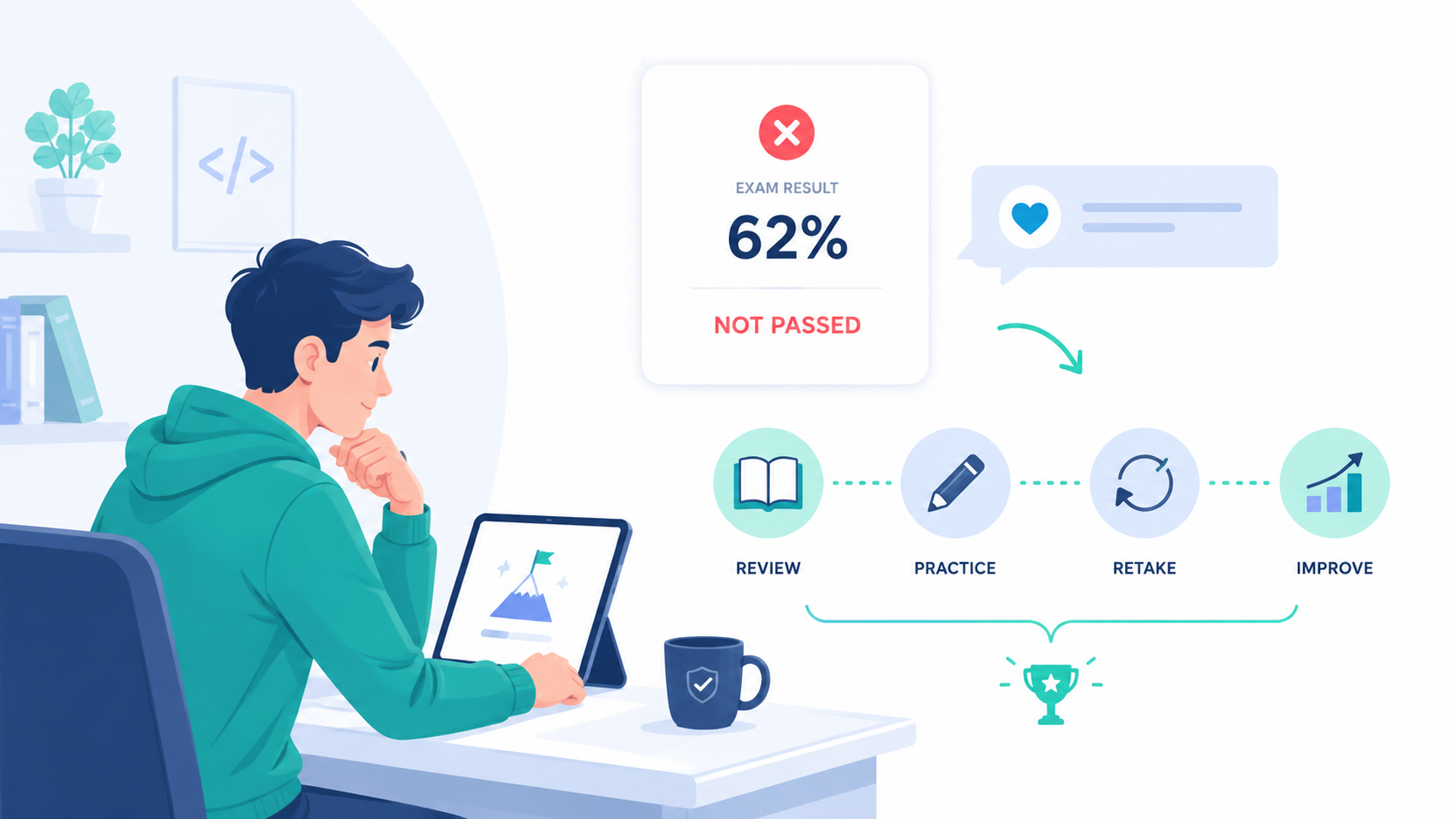
What Happens If You Do Not Reach the Passing Score?
An unsuccessful attempt does not mean you are incapable of earning the certification. It gives you information that can improve your next study plan.
Candidates typically receive a score report showing their result and objective areas associated with incorrectly answered questions. The report does not normally reveal every exact question or provide a complete answer key.
Use the report in five steps:
- Record your official score. Note the difference between your result and the required passing score.
- List the identified objective areas. Match them to the current exam blueprint.
- Group related weaknesses. Separate knowledge gaps from troubleshooting, scenario interpretation, and time-management problems.
- Choose targeted resources. Use focused reading, videos, labs, or practice questions for the weak areas.
- Retest with new questions. Confirm that you can apply the concepts without memorizing previous answers.
Before booking another attempt, check the current CompTIA retake rules and confirm that your exam code remains active.
How to Improve Your CompTIA Exam Score
A targeted revision plan is usually more effective than repeatedly studying every topic from the beginning.
- Download the current exam objectives. Treat them as your preparation checklist.
- Identify weak domains. Use practice results and your official score report.
- Complete timed practice exams. Simulate the real time limit and reduce interruptions.
- Review every incorrect answer. Understand both the correct choice and the distractors.
- Practise performance-based questions. Apply concepts in realistic technical scenarios.
- Build hands-on skills. Configure systems, use command-line tools, interpret logs, and troubleshoot problems.
- Create a focused revision plan. Allocate more time to weak domains without neglecting stronger ones.
- Retest under exam-like conditions. Use unfamiliar questions and measure consistency.
Example: CompTIA A+ Candidate
Maria averages 81% on A+ Core 1 practice tests but repeatedly misses printer troubleshooting, networking ports, and wireless configuration questions.
Instead of taking the same test again, she reviews those specific objectives, configures a small wireless network, practises printer scenarios, and completes a fresh timed exam. Her next result is more meaningful because it reflects improved understanding rather than answer memorization.
Example: CompTIA Security+ Candidate
Daniel scores 79% on Security+ practice tests. His strongest area is security concepts, but he struggles with incident response and selecting controls for business scenarios.
He builds a targeted plan around log analysis, containment steps, identity controls, and risk-based decision-making. He then completes scenario questions under time pressure before attempting another full exam.
Both candidates improve by treating practice scores as diagnostic tools rather than focusing only on the overall percentage.
Choosing the Right CompTIA Exam Preparation Method
Most candidates benefit from combining several preparation methods.
- Self-study provides flexibility but requires discipline and a structured schedule.
- Video training can make unfamiliar technical concepts easier to visualize.
- Study guides provide organized coverage and convenient reference material.
- Hands-on labs turn theoretical knowledge into practical skills.
- Practice exams help identify weaknesses, improve pacing, and build familiarity with question styles.
- Instructor-led training provides structure and access to guided explanations.
The best combination depends on your experience.
A beginner preparing for A+ may need videos, a study guide, hardware practice, and timed questions. An experienced system administrator preparing for Security+ may need less foundational instruction but more practice with governance, risk, and security scenarios.
Whatever method you choose, use the current objectives as your foundation. Avoid preparing with an outdated exam code simply because older resources are easier to find.
Frequently Asked Questions About CompTIA Passing Scores
What is the passing score for a CompTIA exam?
The passing score depends on the certification. Current scores range from 675 for A+ Core 1 to 750 for several security, cloud, and infrastructure exams.
What is the CompTIA A+ passing score?
The current A+ Core 1 exam, 220-1201, requires 675. The Core 2 exam, 220-1202, requires 700. Both use a 100–900 scale.
What is the CompTIA Network+ passing score?
The current Network+ N10-009 exam requires 720 on a 100–900 scale.
What is the CompTIA Security+ passing score?
The current Security+ SY0-701 exam requires 750 on a 100–900 scale.
Is a CompTIA passing score a percentage?
No. It is normally a scaled score. You cannot reliably convert it into the exact percentage of questions answered correctly.
Is 750 out of 900 equal to 83% on a CompTIA exam?
Not necessarily. Although 750 divided by 900 is approximately 83.3%, that calculation does not represent CompTIA’s undisclosed raw-to-scaled score conversion.
How many questions can you miss and still pass CompTIA?
There is no dependable exact number. Exam forms may contain different question totals and formats, and CompTIA does not publish a complete per-question scoring formula.
Are performance-based questions worth more points?
CompTIA does not publish a universal point value for every performance-based question. Do not build your exam strategy around an assumed weighting formula.
Do you receive a score report after a CompTIA exam?
Yes. Your report includes your result and can identify objective areas connected to questions you answered incorrectly. It does not provide a complete copy of the exam or every correct answer.
What practice-test score should you reach before taking the exam?
Focus on consistent results across multiple fresh tests, strong performance in every domain, effective time management, and the ability to explain your answers. No practice percentage guarantees an official passing result.
What happens if you fail a CompTIA exam?
Review your score report, identify weak objectives, complete targeted study and hands-on practice, and check the current retake policy before scheduling another attempt.
Can CompTIA passing scores change?
Yes. CompTIA may introduce a new exam code with updated objectives, formats, or requirements. Verify the current details before purchasing an exam voucher or beginning a study plan.
Final Thoughts on CompTIA Passing Scores
The most important point is that CompTIA passing scores vary by exam. A+ Core 1 requires 675, A+ Core 2 requires 700, Network+ requires 720, and Security+ requires 750 on their respective 100–900 scales.
These scores are not confirmed raw percentages. You also cannot calculate exactly how many questions you may miss because CompTIA does not publish the complete scoring formula.
Use practice exams to measure consistency, find weak domains, improve pacing, and practise applying technical knowledge. Targeted preparation is far more useful than concentrating on one percentage or repeatedly memorizing the same questions.
When you are ready to strengthen your preparation, explore the relevant Globalcerts CompTIA practice exams and training resources for your chosen certification. Select resources that match your current exam code and use your results to build a focused study plan.
Globalcerts is an independent training platform and is not affiliated with or endorsed by CompTIA. Certification names and trademarks belong to their respective owners. Always confirm current exam information before registering.