CompTIA Linux+ vs LPIC-1 vs RHCSA: Which Linux Certification Should You Choose in 2026?
Choosing a Linux certification can become confusing surprisingly quickly. CompTIA Linux+, LPIC-1, and Red Hat Certified System Administrator (RHCSA) all validate Linux skills, but they approach Linux administration from different directions.
That difference matters.
One certification provides broad, vendor-neutral coverage with a mix of conventional and performance-based questions. Another takes a distribution-neutral Linux-specialist approach across two exams. The third puts you directly into a practical Red Hat environment and expects you to complete administrative tasks rather than simply recognize the right answer.
So the question is not simply which credential is the “best.” The more useful question is: which certification matches your current Linux experience, career goals, preferred learning style, and the systems you expect to administer?
This CompTIA Linux+ vs LPIC-1 vs RHCSA comparison explains their current exam structures, skills, difficulty, hands-on requirements, career relevance, and certification paths. It also looks at which option may make more sense for beginners, system administrators, cybersecurity professionals, and people moving into cloud or DevOps roles.
Quick Answer: Linux+, LPIC-1, or RHCSA?
Here is the short version before we examine each certification in detail.
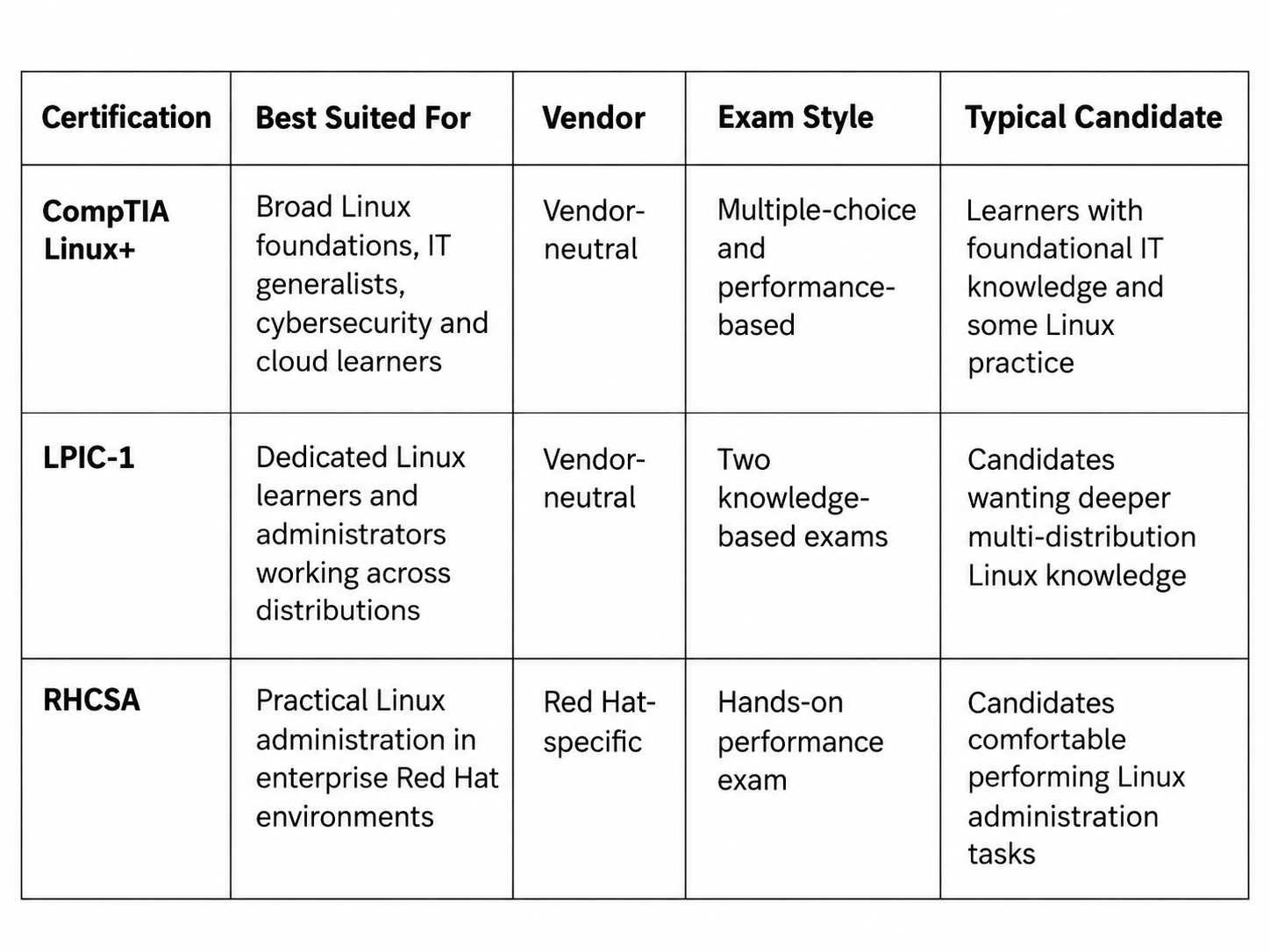
The current Linux+ exam is XK0-006, LPIC-1 requires 101-500 and 102-500, and RHCSA is earned through the EX200 performance-based exam.
If you want a broad entry into Linux that connects naturally with networking, security, cloud, and general IT, Linux+ may fit well.
If you want to build a dedicated vendor-neutral Linux certification path and work across multiple distributions, LPIC-1 deserves close consideration.
If your priority is proving that you can actually administer Linux systems—especially Red Hat Enterprise Linux (RHEL)—RHCSA offers a distinctly practical route.
What Is CompTIA Linux+?
CompTIA Linux+ is a vendor-neutral Linux certification from CompTIA. It is intended to validate skills used to configure, manage, secure, automate, and troubleshoot Linux environments without tying the candidate exclusively to one Linux distribution.
As of 2026, the current exam is CompTIA Linux+ V8, exam XK0-006. The exam contains a maximum of 90 questions, lasts 90 minutes, and uses both multiple-choice and performance-based questions. CompTIA recommends approximately 12 months of hands-on experience working with Linux servers, along with knowledge comparable to certifications such as A+, Network+, or Server+.
This combination makes Linux+ different from a purely theoretical exam. You still need to understand concepts, commands, configuration files, and troubleshooting logic, but performance-based items can also require you to work through practical scenarios.
[Internal Link: CompTIA Linux+ Certification Guide]
Skills Covered by CompTIA Linux+
The current XK0-006 objectives are organized into five areas:
- System Management
- Services and User Management
- Security
- Automation, Orchestration, and Scripting
- Troubleshooting
Candidates should be comfortable with topics such as Linux boot processes, filesystems, storage, users and groups, system services, networking, permissions, security controls, shell operations, automation, containers, scripting, and troubleshooting.
For example, studying Linux+ should involve more than memorizing what chmod does. You should be able to recognize why a user cannot access a file, inspect permissions and ownership, determine what needs to change, and understand the security consequences of that change.
The same principle applies to services. It is useful to know the purpose of systemctl, but stronger preparation means actually starting, stopping, enabling, inspecting, and troubleshooting services inside a Linux virtual machine.
Who Should Consider CompTIA Linux+?
CompTIA Linux+ may be a natural fit for:
- IT support professionals moving toward Linux administration
- Junior system administrators
- Cybersecurity learners
- Cloud professionals
- Network professionals who increasingly work with Linux
- Career changers who already understand basic IT concepts
- Candidates wanting a vendor-neutral Linux certification
- Learners who want Linux skills without immediately committing to one enterprise distribution
It can also fit well into a broader certification path because Linux knowledge intersects with networking, cloud computing, security operations, containers, automation, and infrastructure management.
What Is LPIC-1?
LPIC-1 is the first professional-level Linux certification in the Linux Professional Institute’s multi-level certification program.
Unlike a certification tied to a particular commercial Linux distribution, LPIC-1 focuses on administration skills that apply across Linux environments.
The current LPIC-1 version is 5.0, and candidates must pass two exams: 101-500 and 102-500. Each exam lasts 90 minutes and contains 60 multiple-choice and fill-in-the-blank questions. There are no formal prerequisites.
That two-exam structure is one of the biggest differences when comparing Linux+ vs LPIC-1.
Rather than covering everything in one certification exam, LPIC-1 divides the required knowledge across two tests.
Skills Covered by LPIC-1
Exam 101 focuses on areas including:
- System architecture
- Linux installation
- Package management
- GNU and Unix commands
- Devices
- Linux filesystems
- Filesystem hierarchy
Exam 102 covers areas including:
- Shells and shell scripting
- Administrative tasks
- Essential system services
- Networking fundamentals
- Security
- Interfaces and desktop environments
LPIC-1 expects candidates to understand tools and techniques used across distributions rather than becoming dependent on one vendor’s administration model.
For example, a candidate may need to understand package-management concepts used by different Linux distribution families rather than learning only one ecosystem.
Who Should Consider LPIC-1?
LPIC-1 may suit candidates who:
- Want a Linux-focused certification path
- Prefer vendor-neutral Linux administration
- Expect to encounter multiple distributions
- Already have basic command-line experience
- Want to continue toward higher LPI credentials
- Enjoy learning Linux internals, utilities, configuration, and administration in detail
It can be especially appealing to someone who wants Linux itself—not broader IT—to become a major part of their professional identity.
What Is RHCSA?
The Red Hat Certified System Administrator (RHCSA) takes a noticeably different approach.
RHCSA validates system administration abilities in Red Hat Enterprise Linux environments. The certification is earned by passing the EX200 Red Hat Certified System Administrator exam.
The current EX200 is based on Red Hat Enterprise Linux 10. Most importantly, it is a performance-based exam. Instead of primarily answering traditional multiple-choice questions, candidates perform real administration tasks in a working environment.
That changes how you need to study.
Knowing which command should work is not enough. You need to be comfortable actually using commands, changing configurations, managing systems, validating the results, and ensuring required configurations survive a reboot.
Skills Covered by RHCSA
Current RHCSA objectives include practical abilities involving:
- Shell and command-line tools
- Files and directories
- Users and groups
- Permissions
- Software management
- RPM repositories
- Services
- Storage
- Filesystems
- Networking
- Firewalls
- SSH
- SELinux
- Boot and system management
- Security administration
For example, RHCSA preparation may involve creating a user, assigning appropriate group membership, configuring privileged access, modifying storage, managing a service, adjusting firewall rules, and confirming that everything still works after a reboot.
That is fundamentally different from simply identifying the correct command from four possible answers.
Who Should Consider RHCSA?
RHCSA may fit candidates targeting:
- Linux system administration
- Red Hat Enterprise Linux environments
- Enterprise infrastructure
- Cloud operations
- DevOps
- Platform engineering
- Infrastructure support
- Roles involving substantial hands-on Linux administration
It is particularly relevant when you already know that RHEL or closely related enterprise Linux environments are important to your target role.
CompTIA Linux+ vs LPIC-1 vs RHCSA: Side-by-Side Comparison
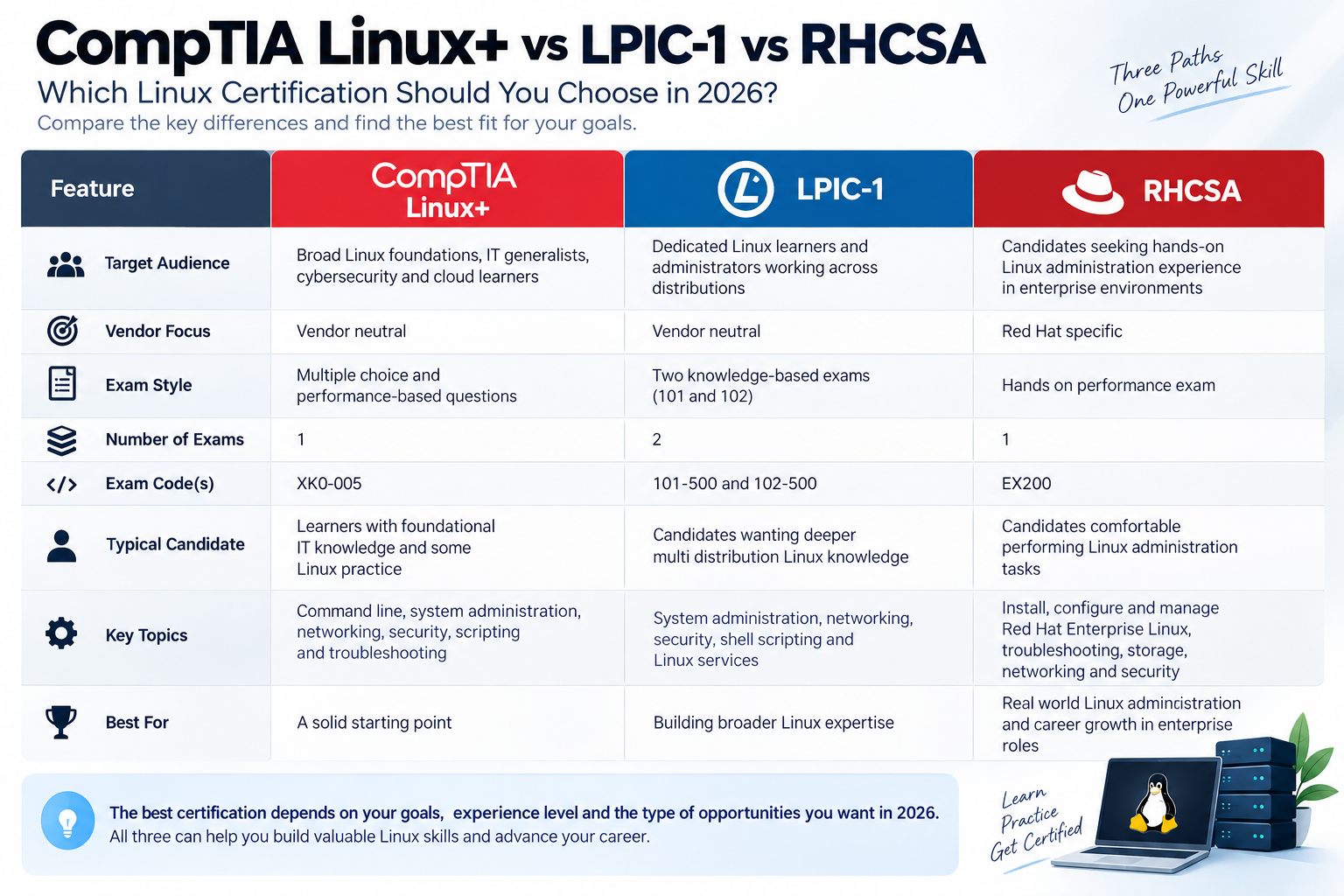
LPI currently lists LPIC-1 validity as five years. Red Hat certifications are current for three years, with updated renewal rules introduced in May 2026.
Linux+ vs LPIC-1: What Is the Difference?
The biggest difference in Linux+ vs LPIC-1 is not vendor neutrality. Both take a broadly vendor-neutral approach.
The differences are more about exam structure, certification ecosystem, and how Linux knowledge is organized.
Linux+ uses one exam covering Linux administration, services, security, automation, scripting, and troubleshooting.
LPIC-1 requires two exams. Its objectives place substantial emphasis on traditional Linux administration concepts and tools across distributions.
Linux+ may feel more connected to the wider IT ecosystem because CompTIA candidates often combine it with networking, cybersecurity, cloud, or infrastructure certifications.
LPIC-1 belongs to a Linux-centered progression. Candidates who want to continue can move into LPIC-2 and specialized LPIC-3 credentials.
Is LPIC-1 Harder Than Linux+?
There is no useful universal answer.
Someone with strong command-line knowledge may find LPIC-1’s detailed Linux questions comfortable but dislike having to prepare for two separate exams.
Another learner may prefer Linux+’s single-exam format but find performance-based scenarios more demanding.
Difficulty depends on:
- Your existing Linux experience
- Command-line confidence
- Familiarity with different distributions
- Ability to troubleshoot
- Comfort with performance-based questions
- How well your practical lab experience matches the objectives
The number of exams alone does not determine which certification will feel harder.
Linux+ vs RHCSA: What Is the Difference?
The Linux+ vs RHCSA comparison is much clearer because the certifications use very different testing philosophies.
Linux+ is vendor-neutral. RHCSA specifically validates skills used with Red Hat Enterprise Linux.
Linux+ combines conventional questions with performance-based items. RHCSA centers the exam around completing real administrative tasks.
This means RHCSA preparation generally needs to be lab-heavy from the beginning.
You should be able to sit at a terminal and perform tasks without needing a tutorial beside you.
Should a Beginner Take Linux+ or RHCSA First?
A beginner with general IT knowledge but limited Linux administration experience may find Linux+ easier to structure as an initial Linux certification goal because it provides broad exposure to multiple areas.
Someone who already knows basic Linux and is specifically pursuing a job involving RHEL may choose to work directly toward RHCSA.
Neither route removes the need for hands-on practice.
Even Linux+ candidates should spend significant time inside Linux rather than treating the exam as a memorization exercise.
[Internal Link: CompTIA Linux+ XK0-006 Study Guide]
LPIC-1 vs RHCSA: How Do They Compare?
LPIC-1 emphasizes portable Linux knowledge across distributions.
RHCSA emphasizes practical administration inside the Red Hat ecosystem.
LPIC-1 uses two conventional examinations. RHCSA requires candidates to complete practical tasks.
A candidate interested in managing Debian, Ubuntu, Red Hat-based systems, and other environments may appreciate LPIC-1’s cross-distribution perspective.
Someone working on enterprise RHEL servers may gain more directly applicable validation from RHCSA.
The certifications can also complement each other. Strong vendor-neutral knowledge can make it easier to understand why Linux systems behave as they do, while practical RHEL work develops confidence performing administrative tasks under real constraints.
Which Linux Certification Is Best for Beginners?
There is no single best Linux certification for every beginner.
The right choice depends on what type of beginner you are.
Complete Linux Beginners
If Linux itself is completely new, start by learning the operating system before worrying too much about an exam.
Install Linux in a virtual machine. Learn navigation, files, permissions, package management, processes, users, networking, and services.
After building that foundation, CompTIA Linux+ can provide a broad first certification target.
IT Support Professionals
Someone already working with operating systems, networking, user accounts, permissions, and troubleshooting may transition naturally toward Linux+.
Many of the underlying IT ideas will already feel familiar even when the Linux commands are new.
Aspiring Linux System Administrators
Both LPIC-1 and RHCSA become particularly interesting here.
LPIC-1 can build wide Linux knowledge across distributions.
RHCSA may be more directly aligned when your goal is practical enterprise Linux administration in the Red Hat ecosystem.
Cybersecurity Professionals
Linux+ can fit naturally because cybersecurity professionals regularly encounter Linux servers, command-line utilities, permissions, logs, services, networking, scripts, and security controls.
LPIC-1 can provide deeper Linux specialization.
RHCSA may make sense when security work involves hardening or administering RHEL environments.
Cloud and DevOps Learners
Any of the three can contribute.
Cloud workloads frequently run on Linux, and DevOps engineers need to understand services, permissions, shells, networking, automation, packages, processes, and troubleshooting.
Choose based on whether you want broad Linux knowledge, a Linux-specialist path, or practical Red Hat administration.
Professionals Working With Red Hat Enterprise Linux
If you already work with RHEL, RHCSA has an obvious advantage: its objectives and exam environment directly relate to that ecosystem.
Which Certification Is Best for Linux System Administrator Jobs?
A certification can support your development as a Linux administrator, but system administration requires more than passing an exam.
Employers may need people who can actually:
- Navigate systems from the command line
- Troubleshoot failed services
- Manage users and groups
- Configure permissions
- Work with storage and filesystems
- Diagnose networking problems
- Review logs
- Secure services
- Automate repetitive work
- Recover from configuration mistakes
That is why hands-on labs matter regardless of which certification you choose.
Create virtual machines. Break services intentionally. Repair permissions. Add storage. Configure SSH. Create users. Inspect logs. Write shell scripts. Practice until administrative tasks become familiar rather than theoretical.
Linux+ supports a broad administration foundation.
LPIC-1 develops distribution-neutral Linux knowledge.
RHCSA directly tests practical administration in RHEL.
A stronger portfolio combines certification study with demonstrable lab experience.
Which Linux Certification Is Best for Cybersecurity?
Linux appears throughout cybersecurity.
Security analysts encounter Linux servers and logs. Penetration testers use Linux-based toolsets. Security engineers harden systems. Cloud security professionals protect Linux workloads. Incident responders investigate processes, files, permissions, services, and network connections.
Linux+ can help establish broad knowledge of Linux security and administration.
LPIC-1 can provide additional depth across Linux environments.
RHCSA can be valuable when security responsibilities include practical administration or hardening of Red Hat systems.
But a Linux certification does not replace cybersecurity training.
Knowing Linux is one part of a larger skill set that may include networking, threat detection, vulnerability management, identity, cryptography, cloud security, incident response, and offensive or defensive security techniques.
Which Linux Certification Is Best for Cloud and DevOps?
Linux remains deeply connected to cloud and DevOps workflows.
Engineers frequently interact with:
- Linux virtual machines
- Containers
- Shell scripts
- Infrastructure tools
- Package managers
- SSH
- Services
- Networking
- Logs
- CI/CD environments
- Automation platforms
Linux+ gives candidates a broad base and currently includes dedicated coverage of automation, orchestration, and scripting.
LPIC-1 develops portable Linux knowledge that can transfer across different environments.
RHCSA is particularly relevant to enterprise environments using RHEL and can create a foundation for further Red Hat automation and engineering paths.
Your cloud provider matters less than many beginners expect. AWS, Azure, and other cloud platforms still require you to understand what is happening inside the Linux operating systems you deploy.
Which Certification Is More Hands-On?
Of the three, RHCSA is the most explicitly hands-on examination because Red Hat describes EX200 as a performance-based practical exam requiring candidates to perform real-world tasks.
Linux+ includes performance-based questions, but it also contains conventional multiple-choice questions.
LPIC-1 uses multiple-choice and fill-in-the-blank questions.
That difference should influence how you study.
For knowledge-focused exams, practice questions can help reveal gaps and improve recognition of commands and concepts.
For performance-based tasks, recognition is not enough.
Do this:
Create user → assign group → set permissions → configure service →
adjust firewall → reboot → verify everything still works
Repeating complete workflows is far more useful than memorizing isolated commands.
How Difficult Are Linux+, LPIC-1, and RHCSA?
All three become difficult when a candidate tries to substitute memorization for Linux experience.
Linux+ demands broad coverage and troubleshooting ability.
LPIC-1 requires candidates to prepare for two substantial bodies of Linux knowledge.
RHCSA puts greater pressure on the ability to execute tasks correctly in a practical environment.
Your own background will strongly influence difficulty.
Someone who has administered RHEL daily may be comfortable with RHCSA while finding obscure cross-distribution concepts less familiar.
A learner who has studied Linux extensively from books may perform well on knowledge questions but struggle when asked to configure a system under time pressure.
Hands-on practice reduces that gap.
[Internal Link: Linux Commands Study Guide]
Can You Earn More Than One Linux Certification?
Absolutely. These certifications are not mutually exclusive.
What matters is whether earning another certification contributes to your goals.
Path 1: Beginner / Vendor-Neutral
Linux fundamentals → CompTIA Linux+ → practical labs → cloud, security, or specialized Linux certifications
Path 2: Linux Specialist
Linux fundamentals → LPIC-1 → LPIC-2 → specialized LPIC-3 credentials
Path 3: Red Hat Administrator
Linux fundamentals → RHEL labs → RHCSA → higher Red Hat credentials
Path 4: Cybersecurity Professional
IT fundamentals → Linux+ or another Linux foundation → cybersecurity certification → Linux security labs
You do not need to collect every Linux certification.
For many professionals, one Linux credential plus substantial hands-on work is more useful than repeatedly studying overlapping beginner-level material.
Practical Examples: Which Certification Should These Learners Choose?
Example 1: Help Desk Technician Moving Into Linux Administration
Maria works on a service desk and understands TCP/IP, user accounts, permissions, and basic troubleshooting but has limited Linux experience.
A broad certification path such as Linux+ could help connect her existing IT knowledge with Linux administration.
She should also build a Linux lab and practice managing users, services, storage, networking, and permissions.
After gaining experience, she could decide whether deeper vendor-neutral study or RHCSA better matches her workplace.
Example 2: Beginner Interested in Cybersecurity
Daniel wants to work in security operations and has noticed that many security tools and servers run Linux.
Linux+ could give him a broad foundation covering administration, security, networking, troubleshooting, and automation.
LPIC-1 would also be reasonable if he wants a stronger Linux specialization.
His Linux certification should complement—not replace—networking and cybersecurity study.
Example 3: Junior Administrator Working in a Red Hat Environment
Aisha already supports several RHEL systems at work.
Because she can practice directly with technologies relevant to her job, RHCSA may align particularly well.
Preparing for the performance exam would also force her to become faster and more independent with everyday administration tasks.
Example 4: Cloud Engineer Who Wants Stronger Linux Skills
Chris deploys cloud workloads but often depends on colleagues when Linux problems appear.
Linux+ could provide broad operating-system knowledge, while LPIC-1 could offer a deeper multi-distribution route.
If his organization’s cloud infrastructure is heavily standardized on Red Hat technologies, RHCSA may become the more directly applicable target.
How to Choose the Right Linux Certification
Ask yourself these questions before paying for an exam.
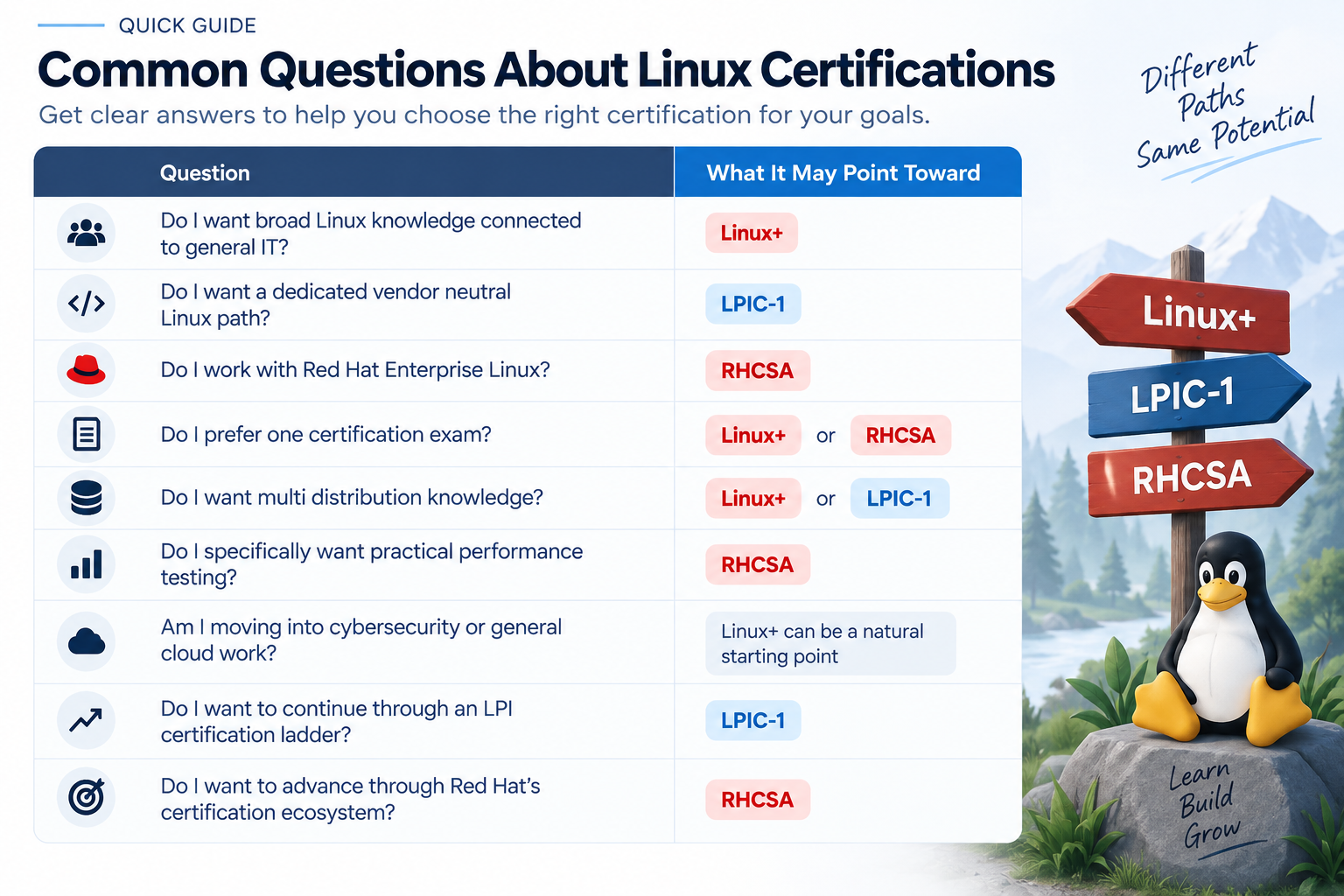
Also ask one final question:
How much Linux can I actually administer without instructions?
That answer may matter more than how many study guides you have completed.
Final Verdict: CompTIA Linux+ vs LPIC-1 vs RHCSA
The CompTIA Linux+ vs LPIC-1 vs RHCSA decision becomes easier once you stop looking for a universal winner.
CompTIA Linux+ may fit candidates who want broad, vendor-neutral Linux knowledge that connects naturally with networking, cybersecurity, cloud, automation, and general IT.
LPIC-1 may suit learners who want a dedicated Linux certification path, strong command-line knowledge, and skills that transfer across distributions.
RHCSA may suit candidates who want to prove practical Linux administration ability and expect to work extensively with Red Hat Enterprise Linux.
Whichever route you choose, treat certification as a structure for developing Linux ability—not as a replacement for it.
Build servers. Use the terminal. Break configurations. Read logs. Manage permissions. Troubleshoot services. Write scripts. Practice until Linux administration starts to feel routine.
For candidates who decide that CompTIA Linux+ fits their path, structured study should be paired with realistic exam-style practice. Working through current XK0-006 practice questions and performance-based scenarios can help identify weak objectives and make the exam format more familiar.
[Internal Link: CompTIA Linux+ Practice Exams]
Frequently Asked Questions About CompTIA Linux+, LPIC-1, and RHCSA
Is CompTIA Linux+ better than LPIC-1?
Not universally. Linux+ may fit candidates who want a broad Linux credential connected to wider IT disciplines. LPIC-1 may fit candidates who want a dedicated vendor-neutral Linux certification path across multiple distributions.
Is RHCSA harder than CompTIA Linux+?
They test candidates differently. RHCSA is strongly performance-based, so you must perform administration tasks successfully. Linux+ combines knowledge questions with performance-based items. Your hands-on experience will strongly affect which feels more difficult.
Which Linux certification is best for beginners?
For a beginner with foundational IT knowledge, Linux+ can provide a broad certification target. Someone completely new to Linux should first spend time learning Linux fundamentals and working in a lab before focusing heavily on certification.
Is CompTIA Linux+ worth getting in 2026?
It can be useful for candidates who want structured validation of vendor-neutral Linux administration, troubleshooting, security, and automation knowledge. Its value depends on how well it supports your career goals and whether you pair certification study with practical experience.
Can I take RHCSA with no Linux experience?
There is no reason you cannot begin studying toward it, but attempting a practical administration exam without substantial Linux practice would create a significant challenge. Red Hat itself provides training paths for learners with minimal previous Linux administration experience.
Is LPIC-1 good for Linux administrators?
Yes, particularly for candidates who want Linux knowledge that applies across distributions. LPIC-1 covers command-line tools, package management, filesystems, scripting, networking, services, security, and common administrative tasks.
Should I get Linux+ before RHCSA?
It is not mandatory. Linux+ can provide broad foundations before RHCSA, but someone already comfortable with Linux and targeting Red Hat systems may move directly toward RHCSA.
Can Linux+ help with cybersecurity careers?
It can strengthen the Linux foundation used in many cybersecurity roles. However, Linux+ should complement dedicated security knowledge rather than replace cybersecurity training.
Which Linux certification is best for DevOps?
The right choice depends on the environment. Linux+ provides broad Linux and automation coverage, LPIC-1 develops distribution-neutral Linux knowledge, and RHCSA is particularly relevant to Red Hat enterprise environments.
Can I earn Linux+, LPIC-1, and RHCSA?
Yes. There is no requirement to choose only one. However, earning all three is not automatically necessary. Choose additional certifications when they add new skills or align with the systems and roles you are pursuing.