
Is CompTIA Worth It in Japan? Certification Recognition, Jobs, and Career Value
Choosing an IT certification in Japan is not always straightforward. Candidates must consider exam costs, employer awareness, Japanese-language requirements, practical experience, and the visibility of national qualifications administered in Japan.
So, is CompTIA worth it in Japan? The short answer is yes—for the right candidate and career goal. CompTIA can be valuable for people pursuing IT support, networking, infrastructure, cloud, or cybersecurity positions, especially with multinational companies and internationally oriented teams.
However, CompTIA is not an automatic path to employment or a higher salary. Its value depends on the certification you choose, the jobs you target, your technical ability, your experience, and how effectively you demonstrate your skills.
This guide examines CompTIA recognition in Japan, relevant jobs, salary considerations, certification options, local alternatives, and how to decide whether the investment makes sense for your career.

Is CompTIA Worth It in Japan?
CompTIA is worth considering in Japan when it matches the technical requirements of your target role. Its certifications offer structured, vendor-neutral coverage of areas such as hardware, operating systems, networking, infrastructure, and security.
The credential is most useful when you need to:
- Establish foundational IT knowledge
- Support a career change into technology
- Strengthen an entry-level application
- Qualify for a role that lists CompTIA as preferred or desirable
- Prepare for more specialized vendor certifications
- Demonstrate internationally recognizable technical knowledge
- Complement hands-on experience, projects, or existing qualifications
CompTIA may be less valuable if the employers you are targeting primarily request Japanese national qualifications or if you expect certification alone to compensate for missing practical and communication skills.
CompTIA can strengthen your professional profile, but it is rarely enough by itself.
When CompTIA Is Most Valuable
CompTIA tends to offer the greatest career value when a candidate is applying for roles connected to the certification’s objectives.
For example, CompTIA A+ can help a career changer demonstrate knowledge relevant to desktop support and troubleshooting. Network+ may support applications for network support and infrastructure roles, while Security+ can establish a security foundation for junior cybersecurity or security-conscious infrastructure positions.
The certifications may be particularly useful when:
- You are applying to multinational organizations
- The employer supports international customers or systems
- Job advertisements mention CompTIA credentials
- You need an organized path for learning technical fundamentals
- You have limited formal IT education
- You can reinforce the credential with labs and projects
- You plan to progress into cloud, networking, or security specializations
For someone without professional IT experience, certification can provide evidence of commitment and foundational knowledge. For an experienced professional, it can formalize existing knowledge or help support a move into a related technical area.
When CompTIA May Offer Limited Value
CompTIA may deliver a weaker return when it does not align with the hiring environment or position.
Its value may be limited if:
- A job specifically requires a Japanese national IT qualification
- You select a certification unrelated to the role
- You lack the practical skills expected at interviews
- The position requires Japanese communication skills you do not yet possess
- You already hold more advanced, closely related credentials
- You expect the certification to produce an automatic promotion or raise
- Local employers in your target sector are unfamiliar with the credential
Review actual job descriptions before purchasing an exam voucher. If ten suitable positions consistently mention cloud platforms, scripting, and Japanese fluency but never request CompTIA, those other requirements may deserve priority.
Is CompTIA Recognized in Japan?
CompTIA is an international certification provider whose credentials are vendor-neutral. Its certifications are available to candidates in Japan and can be recognized by employers seeking standardized knowledge in IT support, networking, infrastructure, and cybersecurity.
However, recognition is not uniform across the Japanese employment market. A multinational technology company may understand Security+ immediately, while a smaller domestic employer may be more familiar with Japan’s Information Technology Engineers Examination system.
It is also important to distinguish between different meanings of “recognized”:
- An employer may know what CompTIA is.
- A hiring manager may view the certification positively.
- A job description may list it as preferred.
- A company may require it for a specific position.
- The certification may help demonstrate knowledge without being a formal requirement.
These are not the same. Recognition does not mean that every employer requires or strongly rewards the credential.
On a résumé, include the complete certification name and connect it to applicable skills. Instead of listing only “CompTIA Network+,” mention relevant abilities such as TCP/IP troubleshooting, network services, routing concepts, wireless security, and network operations.
CompTIA Recognition Among Japanese and International Employers
General patterns can help candidates evaluate CompTIA recognition in Japan, although individual organizations may differ.
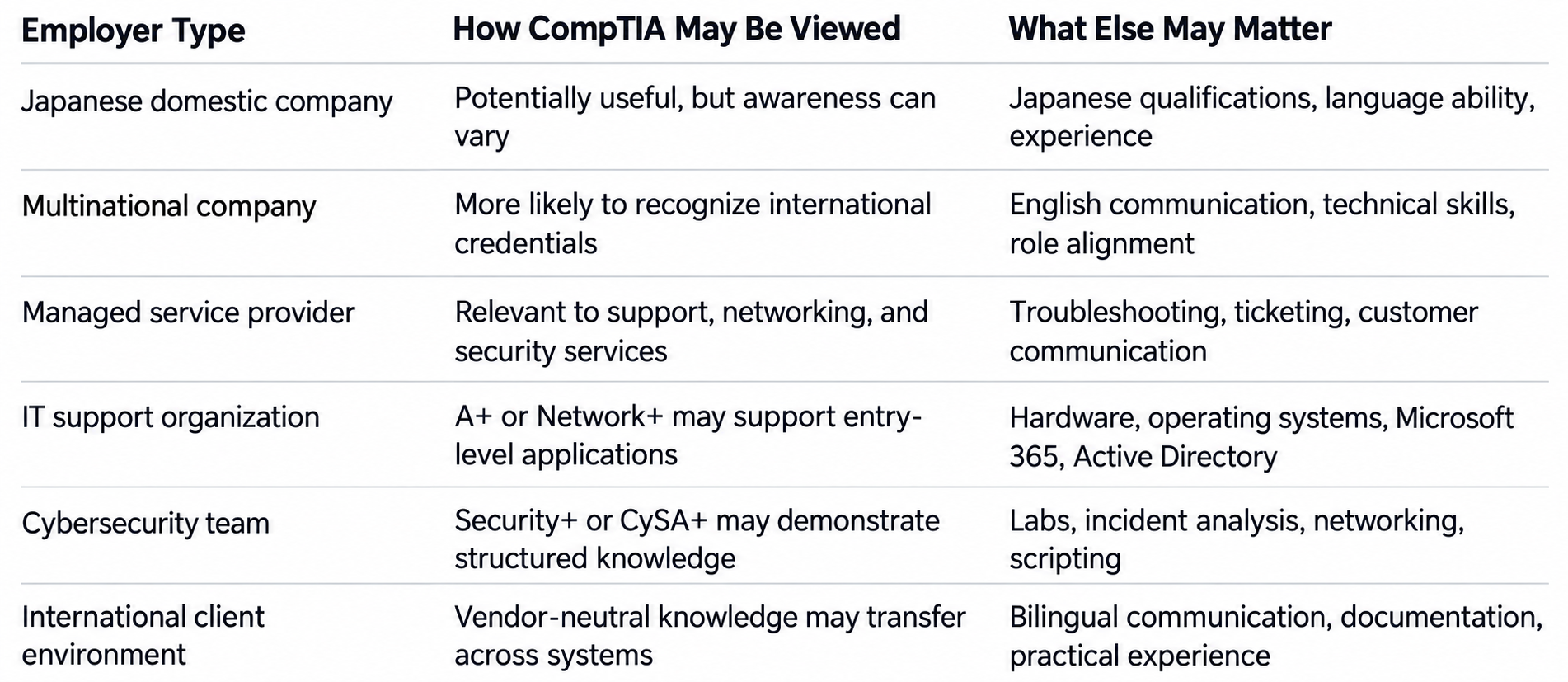
Candidates should treat these as tendencies—not universal hiring rules.
Does CompTIA資格 Mean Nothing in Japan?
The phrase CompTIA資格 意味ない, roughly expressing the idea that a CompTIA qualification is meaningless, reflects a genuine concern among some candidates. That opinion often comes from comparing CompTIA with nationally recognized Japanese IT examinations.
Some people question its value because:
- Japanese employers may be more familiar with national examinations
- CompTIA exams and preparation can be expensive
- Several certifications require continuing education or renewal
- Experienced candidates may gain little from an entry-level credential
- Some hiring managers prioritize workplace experience
- The selected certification may not match the applicant’s target role
Nevertheless, calling CompTIA meaningless is too broad. A certification’s value is determined by where and how it is used.
A+ may have limited value for an experienced security engineer but meaningful value for a career changer pursuing desktop support. Security+ may not replace hands-on security experience, but it can help an infrastructure professional demonstrate formal security knowledge.
The better question is not whether CompTIA has value everywhere. It is whether a particular CompTIA certification supports the requirements of your intended job.
What Jobs Can You Get With CompTIA in Japan?
There is no single category of “CompTIA jobs Japan.” Different certifications support different career areas, and employers usually evaluate the complete candidate rather than one credential.
Relevant positions may include:
- Help desk technician
- Desktop support technician
- IT support specialist
- Field service technician
- Technical support specialist
- Network support technician
- Junior network administrator
- Infrastructure support engineer
- Systems administrator
- Security operations center analyst
- Junior cybersecurity analyst
Certification may support an application for these positions, but it does not give the holder an automatic right to a particular title.
Entry-Level Opportunities
For beginners and career changers, help desk, desktop support, technical support, and field service positions can provide realistic entry points.
Employers may expect abilities beyond exam knowledge, including:
- Installing and troubleshooting operating systems
- Diagnosing hardware and connectivity problems
- Understanding TCP/IP and common network services
- Working with Microsoft 365
- Managing basic Active Directory tasks
- Recording incidents in ticketing systems
- Communicating clearly with users
- Following escalation procedures
- Applying basic security controls
- Using introductory PowerShell, Bash, or Python
A useful portfolio project could involve creating a small virtual lab with Windows and Linux systems, user accounts, shared resources, network troubleshooting tasks, and documented support tickets. This turns theoretical knowledge into evidence that can be discussed during an interview.
Opportunities for Foreign IT Professionals
CompTIA certification can be useful for foreign professionals targeting internationally oriented employers, but it does not remove other employment requirements.
Candidates should consider:
- The Japanese-language level required by the position
- Whether English is the working language
- Eligibility to work in Japan
- Whether the employer offers visa sponsorship
- Previous IT experience
- Evidence of hands-on technical ability
- Familiarity with Japanese workplace communication
- The employer’s customers and operating environment
A foreign applicant with Security+, a home lab, practical incident-analysis exercises, and strong English may appeal to a multinational security team. If the position also requires professional Japanese, however, certification will not replace that requirement.
CompTIA does not provide visa eligibility or guarantee employer sponsorship.
CompTIA Salary in Japan: What Can Certified Professionals Expect?
When researching CompTIA salary Japan, remember that employers pay for a role and a set of capabilities—not simply for possession of a certificate.
Two people with the same certification may receive substantially different compensation. One may be entering help desk work with no prior experience, while the other may have several years of infrastructure experience and use the certification to move into security operations.
Important salary factors include:
- Job title and responsibilities
- Years of relevant experience
- Tokyo or another employment location
- Japanese and English proficiency
- Technical specialization
- Employer size and type
- Shift, weekend, or on-call duties
- Cloud, scripting, and automation skills
- Additional professional certifications
- Leadership and customer-facing responsibilities
Published salary ranges also change over time and may represent base salary, total compensation, or recruiter estimates. Compare several current sources and focus on salaries for your intended occupation rather than searching for one universal “CompTIA salary.”
Can CompTIA Increase Your Salary?
A CompTIA certification does not automatically trigger a raise. It may support salary growth indirectly when it helps you:
- Qualify for a more technical position
- Move from general support into networking or security
- Meet an employer’s certification preference
- Strengthen a promotion discussion
- Demonstrate professional development
- Build knowledge required for additional responsibilities
For example, a support technician who earns Network+, develops troubleshooting experience, and begins handling network incidents may become a stronger candidate for a network support position. The role change—not the certificate alone—is what creates the potential for higher compensation.
Which CompTIA Certification Is Best for Working in Japan?
The best option depends on your present knowledge and target position.
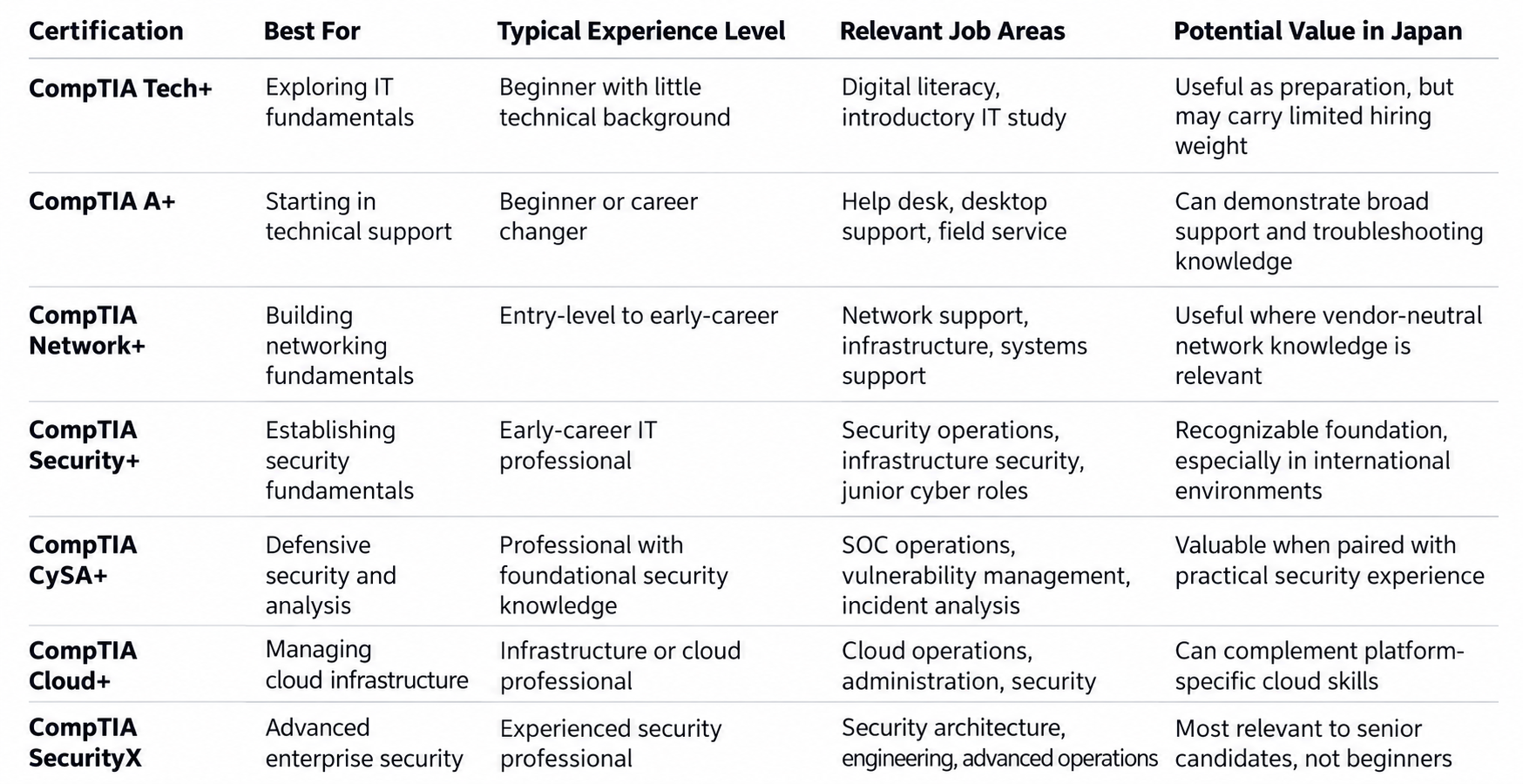
CompTIA A+ for IT Support Roles
CompTIA A+ covers hardware, operating systems, networking basics, troubleshooting, security, virtualization, and operational procedures. It is most appropriate for candidates targeting support-oriented positions.
In Japan, A+ can be useful when a job involves endpoint support, device deployment, user assistance, or desktop troubleshooting. Candidates should reinforce it with familiarity in Microsoft 365, Active Directory, ticketing platforms, and customer communication.
CompTIA Network+ for Networking and Infrastructure
CompTIA Network+ is suitable for candidates interested in network support, infrastructure operations, or systems administration. It addresses network concepts, implementation, operations, security, and troubleshooting.
A practical candidate might combine Network+ with packet analysis, subnetting exercises, router and switch labs, and basic cloud networking. For positions based heavily on one vendor’s equipment, an additional vendor-specific certification may be more directly aligned.
CompTIA Security+ for Cybersecurity Roles
CompTIA Security+ provides a broad foundation in security concepts, threats, vulnerabilities, architecture, operations, identity, risk, and cryptography.
It may support applications for junior security operations or infrastructure positions with security responsibilities. However, cybersecurity employers commonly expect networking knowledge, operating-system familiarity, incident investigation, log analysis, and practical lab work.
Security+ can establish a foundation; it does not make someone a fully qualified security analyst on its own.
CompTIA vs Japanese IT Certifications
Japan’s Information Technology Engineers Examination system includes national examinations administered by the Information-technology Promotion Agency. These credentials may be familiar to domestic employers and cover levels ranging from basic IT literacy to advanced professional knowledge.
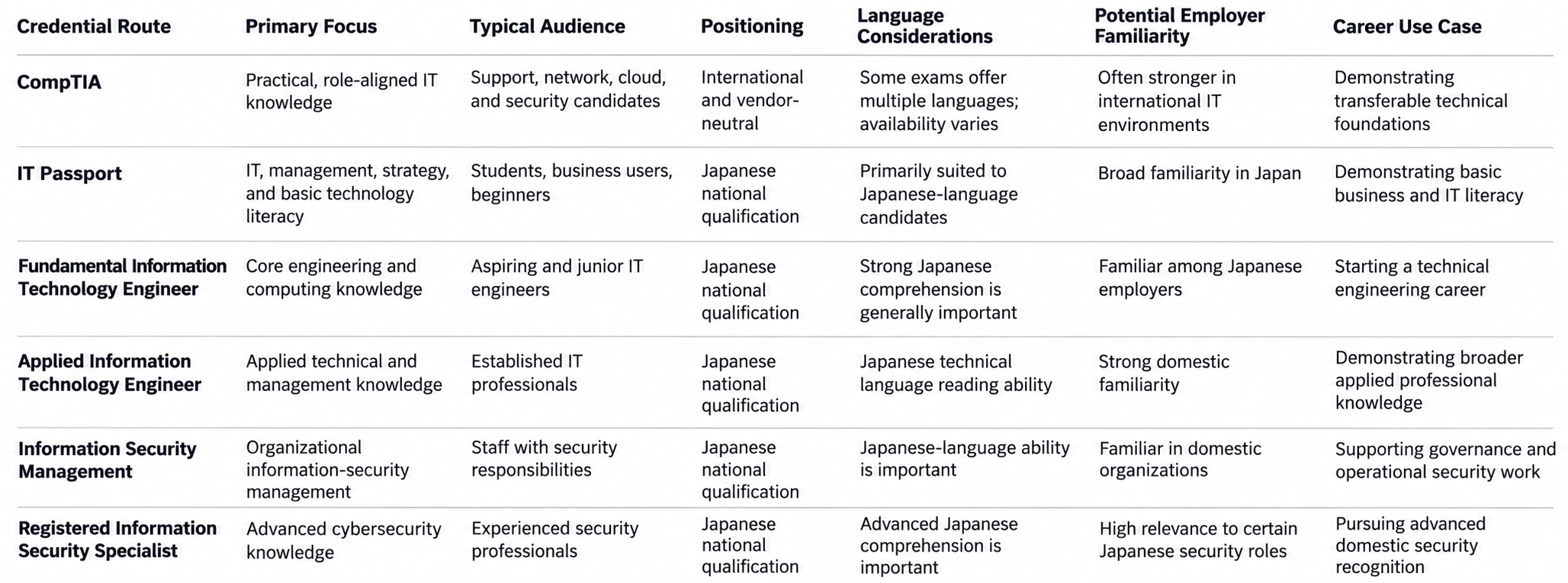
Neither route is universally better.
An international candidate targeting a multinational help desk may obtain more immediate value from A+ than from a general Japanese examination. A Japanese-speaking candidate pursuing a long-term career with domestic employers may find the Fundamental Information Technology Engineer Examination particularly relevant.
Some professionals may benefit from combining them. CompTIA can communicate internationally transferable technical knowledge, while a Japanese credential can demonstrate alignment with the domestic qualification system.
Cost Versus Career Value
Certification involves more than the exam voucher. A realistic budget should consider:
- Official or third-party study materials
- Practice examinations
- Hands-on lab access
- Potential retake costs
- Travel to a test center where applicable
- Renewal or continuing-education requirements
- Preparation time
- Time unavailable for other professional development
Avoid buying a certification simply because it is popular. Evaluate the return against a defined target.
Suppose you want a help desk role. Review current advertisements and record how frequently they request A+, operating-system support, Active Directory, customer service, and Japanese proficiency. If A+ aligns with several requirements and fills a clear weakness, the investment may be reasonable.
If the roles instead emphasize cloud administration and prior professional experience, spending the same time on a cloud lab and platform-specific credential may offer more value.
Practical Career Scenarios
1. Career Changer Seeking a First Help-Desk Position
A career changer with limited professional experience might begin with CompTIA A+. It provides a structured introduction to troubleshooting, hardware, operating systems, basic networking, and support procedures.
The candidate should also practice Microsoft 365 administration, Active Directory tasks, remote-support workflows, and ticket documentation. A small home lab can provide examples to discuss during interviews.
The certification may make the applicant’s foundational knowledge easier to evaluate. Its limitation is that it cannot replace customer-service ability, Japanese communication, or real troubleshooting practice.
2. Network-Support Professional Pursuing Infrastructure Roles
A support professional who already handles connectivity problems may choose Network+ to organize and validate networking knowledge.
Additional work should include subnetting, packet capture analysis, VLAN concepts, network diagrams, Linux administration, and cloud networking. Depending on the intended employer, a vendor-specific networking or cloud credential may also be appropriate.
Network+ can help connect existing experience to a recognized body of knowledge. It will not by itself qualify the candidate for advanced network engineering work.
3. Foreign Professional Targeting Multinational Cybersecurity Roles
A foreign applicant with general IT experience may pursue Security+ before applying for junior security operations positions.
The applicant should add log-analysis exercises, SIEM practice, incident-response scenarios, Windows and Linux administration, networking, and basic scripting. Japanese study may significantly expand the available job market, even where English-speaking roles exist.
Security+ can provide an internationally understandable security foundation. It does not guarantee sponsorship, satisfy every language requirement, or replace security operations experience.
How to Decide Whether CompTIA Is Right for You
Before registering for an exam, answer the following questions:
- What exact job titles are you targeting?
- Do current job descriptions mention CompTIA?
- Are the employers domestic, multinational, or internationally oriented?
- What level of Japanese is required?
- Which technical requirements do you already meet?
- Is the certification appropriate for your experience level?
- Can you afford the exam, materials, and a possible retake?
- How much study time can you commit?
- Will you complete hands-on labs?
- Would a Japanese or vendor-specific credential align more closely?
- Where should this certification lead within the next two to three years?
A Simple Decision Framework
Use the following framework:
- Pursue CompTIA now if it appears in suitable job descriptions, matches the role, and addresses a knowledge gap.
- Build practical experience first if you understand the theory but cannot yet perform common technical tasks.
- Choose a Japanese IT certification if your target employers consistently prefer national qualifications.
- Combine credentials if you need both international portability and domestic recognition.
- Select a different certification if your target jobs consistently require a specific cloud platform, security technology, or network vendor.
This prevents certification collecting without a clear employment strategy.
How to Get More Career Value From a CompTIA Certification
Passing the exam should be part of a wider career plan. To increase its usefulness:
- Complete hands-on labs related to the exam objectives.
- Build a portfolio with diagrams, troubleshooting notes, scripts, or security investigations.
- Practice explaining technical decisions in clear language.
- Customize your résumé for each position.
- Connect certification topics to measurable tasks and projects.
- Improve Japanese-language ability where the target role requires it.
- Prepare for scenario-based technical interviews.
- Use realistic practice exams to identify weak areas.
- Apply for roles that match the certification’s level.
- Continue building experience after passing.
A résumé statement such as “Completed Network+” is useful but limited. A stronger application explains how the candidate configured a segmented lab network, investigated DNS failures, captured traffic, and documented the resolution.
Final Verdict: Is CompTIA Worth It in Japan?
Is CompTIA worth it in Japan? Yes, when the certification matches the target role and is supported by practical ability.
It is most likely to benefit career changers, early-career professionals, infrastructure workers, and cybersecurity candidates applying to employers that recognize international credentials. A+, Network+, and Security+ can provide clear learning paths for support, networking, and security foundations.
Candidates focused on domestic Japanese employers should also investigate national examinations and language expectations. Experienced professionals should avoid choosing an entry-level credential that adds little to their existing profile.
The strongest strategy is to combine the right certification, hands-on work, language ability, and targeted applications.
Once you have selected an appropriate CompTIA path, Globalcerts practice exams can help you evaluate your knowledge, identify weak areas, and prepare around the current exam objectives. Use practice results as a study guide rather than relying on memorization alone.
Frequently Asked Questions
Is CompTIA Recognized in Japan?
Yes, CompTIA credentials are recognized by some employers in Japan, particularly multinational companies and internationally oriented IT teams. Awareness and hiring value vary by employer and position.
Is CompTIA Worth It for Getting an IT Job in Japan?
It can strengthen an application when it matches the job’s technical requirements. It works best alongside practical experience, labs, communication skills, and suitable Japanese proficiency.
Which CompTIA Certification Is Best for Beginners in Japan?
Tech+ can introduce complete beginners to IT concepts, while A+ is usually more directly relevant to entry-level technical-support roles. The better choice depends on your current knowledge and intended job.
Can CompTIA Help Foreigners Find IT Jobs in Japan?
It can provide an internationally recognizable way to demonstrate technical knowledge. It does not replace work authorization, sponsorship requirements, experience, or the language level specified by an employer.
Do Japanese Companies Accept CompTIA Certifications?
Some do, but acceptance and familiarity vary. Candidates should review individual job descriptions and research the requirements of the organizations they plan to approach.
Is CompTIA Security+ Useful in Japan?
Security+ can be useful for junior cybersecurity, infrastructure-security, and internationally oriented positions. Candidates should combine it with networking, system administration, log analysis, and hands-on security practice.
How Much Can Someone With a CompTIA Certification Earn in Japan?
There is no standard CompTIA salary. Compensation depends on the occupation, experience, location, language ability, specialization, employer, and responsibilities—not the certification alone.
Is CompTIA Better Than Japanese IT Certifications?
Neither is always better. CompTIA offers international, role-oriented credentials, while Japanese national examinations may have stronger familiarity among domestic employers. Combining both may be useful for some career paths.
Can I Take a CompTIA Exam in Japanese?
Japanese-language availability depends on the specific certification and exam version. Candidates should verify the available languages on the current exam page before purchasing a voucher or scheduling an appointment.
Does a CompTIA Certification Guarantee a Job in Japan?
No. CompTIA does not guarantee employment, a promotion, visa sponsorship, or a salary increase. It is one component of a professional profile that should also include practical skills, relevant experience, and effective communication.