
Which CompTIA Certification Is Best for Getting a Job in South Africa?
Choosing your first IT certification can be confusing, especially when CompTIA A+, CompTIA Network+, and CompTIA Security+ appear in job listings for very different roles. All three certifications can support an IT career, but they do not prepare you for exactly the same work.
For most complete beginners, CompTIA A+ is the most practical starting point because it builds the foundational knowledge required for help desk, technical support, and junior IT technician positions. CompTIA Network+ is better suited to people interested in networking and infrastructure, while CompTIA Security+ provides a foundation for cybersecurity-related roles.
Therefore, the best CompTIA certification for jobs in South Africa depends on your current experience, existing technical knowledge, and the type of job you want. Certification can strengthen your CV, but employers may also consider practical skills, communication ability, projects, education, and previous experience.
What Is the Best CompTIA Certification for Jobs in South Africa?
If you have little or no IT experience and want to enter the technology sector, CompTIA A+ is usually the best first certification. It covers the everyday skills needed to support computers, operating systems, users, networks, and common workplace technologies.
However, there are situations in which another certification may be more appropriate:
- Choose CompTIA A+ if you want to pursue IT support, help desk, desktop support, or junior technician roles.
- Choose CompTIA Network+ if you understand basic IT concepts and want to work with networks, infrastructure, or network operations.
- Choose CompTIA Security+ if you already have a reasonable understanding of IT and networking and want to build foundational cybersecurity knowledge.
Quick Answer
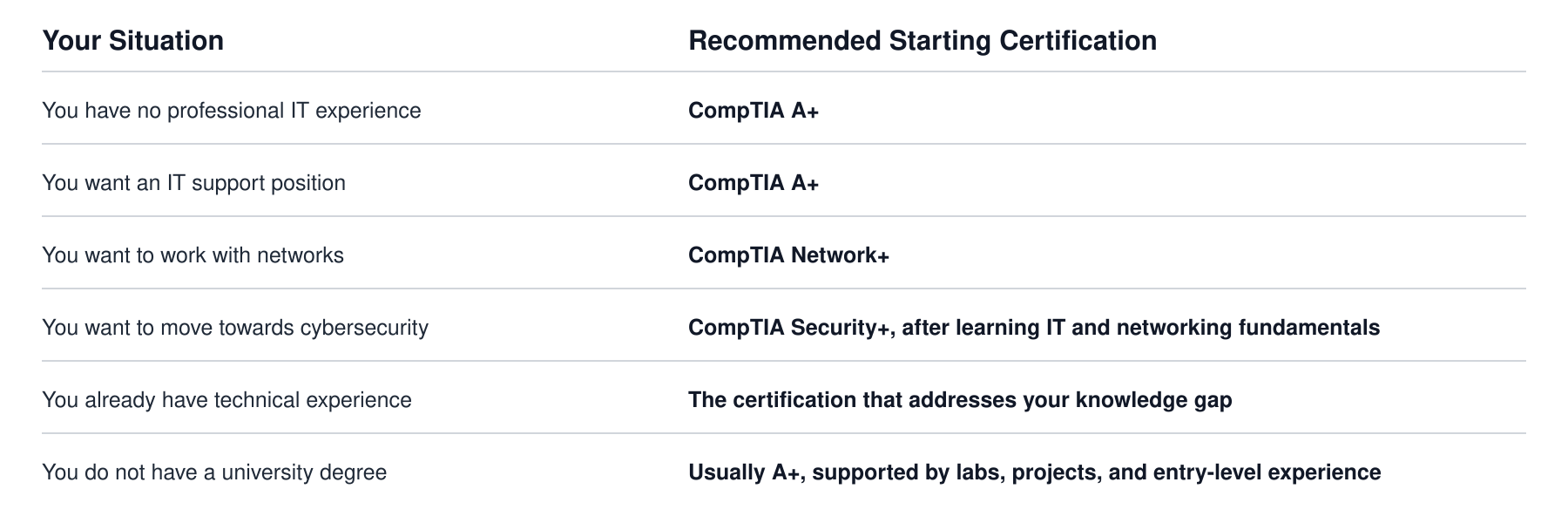
A certification should be treated as one part of your employment strategy. South African employers may also look for knowledge of Microsoft technologies, cloud platforms, ticketing systems, Active Directory, networking tools, and customer-service processes.
How CompTIA Certifications Fit Into the South African Job Market
CompTIA certifications teach vendor-neutral skills. Instead of concentrating exclusively on one manufacturer or platform, they cover concepts that can be applied across different hardware, operating systems, networks, and security environments.
This can be useful when applying for entry-level and junior positions because employers often use a mixture of technologies. The knowledge developed through certification study may help you understand job descriptions and communicate more confidently during technical interviews.
However, certification requirements vary between organisations. A job advertisement may describe a certification as:
- Required: Applicants are expected to hold the named certification.
- Preferred: The certification may strengthen an application but is not mandatory.
- Advantageous: The employer considers it beneficial alongside other experience or qualifications.
- Equivalent knowledge accepted: Candidates may demonstrate the same skills through experience, education, or another credential.
Before choosing among CompTIA certifications in South Africa, review current advertisements for the roles you want. Record the certifications, technologies, qualifications, and experience that appear repeatedly. This will help you make a decision based on real job requirements rather than general popularity.
Certification study becomes more valuable when combined with practical work. For example, a candidate studying A+ can practise diagnosing computer problems, installing operating systems, managing user accounts, configuring basic networks, and documenting support incidents.
CompTIA A+: Best for Entry-Level IT Support Jobs
What CompTIA A+ Covers
CompTIA A+ develops broad foundational knowledge across the main areas encountered by entry-level support professionals. Topics generally include:
- Computer hardware and peripheral devices
- Windows and other operating systems
- Software installation and configuration
- Mobile devices
- Basic networking
- Security fundamentals
- Cloud and virtualisation concepts
- Troubleshooting methods
- Operational procedures
- Customer and technical support
A+ is often described as an IT certification for beginners because it introduces several technical areas without expecting the learner to specialise immediately. It can help you understand how workplace devices and systems operate together.
Jobs You Can Pursue With CompTIA A+
Relevant CompTIA A+ jobs in South Africa may include:
- Help desk technician
- Service desk analyst
- Desktop support technician
- Junior IT technician
- Field support technician
- Technical support specialist
- IT support intern
- Junior hardware technician
Job titles are not standardised. One employer may use “service desk analyst” for a position that another organisation calls “IT support technician.” Read the responsibilities rather than relying only on the title.
Typical duties may include responding to support tickets, setting up user devices, resolving software problems, replacing hardware, resetting accounts, documenting incidents, and escalating complex issues.
Who Should Choose CompTIA A+?
A+ is particularly suitable for:
- Students considering their first technology role
- Recent school, college, or university graduates
- Career changers without professional IT experience
- Self-taught learners who need a structured foundation
- Customer-service professionals moving into technical support
- Junior technicians who want to formalise their knowledge
It can be a sensible option for someone pursuing CompTIA certification with no experience because the material begins with foundational concepts and develops practical troubleshooting knowledge.
Limitations to Consider
Passing A+ does not automatically qualify you for every support position. Some employers may expect knowledge of technologies that are outside the certification’s core scope.
To build a stronger profile, combine A+ study with:
- A small home lab
- Windows installation and administration practice
- Basic Active Directory exercises
- Hardware troubleshooting
- Ticket documentation
- Remote-support practice
- Customer-service and communication skills
The certification demonstrates knowledge, while practical work shows that you can apply it.
CompTIA Network+: Best for Networking and Infrastructure Roles
What CompTIA Network+ Covers
CompTIA Network+ concentrates on how devices and systems communicate. It develops knowledge of:
- Network models and protocols
- IP addressing and subnetting
- Switches, routers, and wireless technologies
- Network infrastructure
- Cloud and virtual networking
- Network operations
- Security concepts
- Monitoring and troubleshooting
- Common network tools
Network+ goes deeper into networking than A+. Learners are expected to understand how data travels, how network services operate, and how common connectivity problems can be investigated.
Jobs You Can Pursue With CompTIA Network+
Potential CompTIA Network+ jobs in South Africa include:
- Junior network technician
- Network support technician
- Junior network administrator
- Network operations centre technician
- Infrastructure support technician
- IT support technician with networking responsibilities
- Field network technician
Network+ can also support progression within technical support. Many support positions involve wireless connectivity, IP configuration, DNS, DHCP, VPNs, and network troubleshooting even when the job title does not include “network.”
Who Should Choose CompTIA Network+?
Network+ may be the better choice if you:
- Already understand computer hardware and operating systems
- Enjoy investigating connectivity problems
- Want to work with routers, switches, wireless networks, or infrastructure
- Are moving from general IT support into networking
- Need stronger networking knowledge before studying cybersecurity
For candidates comparing the best IT certification in South Africa, Network+ can provide a useful vendor-neutral foundation. However, some networking roles may also request vendor-specific skills or practical experience with particular network equipment.
Should You Take A+ Before Network+?
A+ is not always a formal prerequisite for Network+. If you already understand computers, operating systems, troubleshooting, and basic networks, you may be able to begin with Network+.
A complete beginner may benefit from studying A+ first because it supplies context for devices, operating systems, and support processes. Another option is to learn the relevant A+ concepts without necessarily taking the exam, then move to Network+.
The right choice depends on your knowledge—not simply on collecting certifications in a fixed order.
CompTIA Security+: Best for Entry-Level Cybersecurity Foundations
What CompTIA Security+ Covers
CompTIA Security+ introduces the principles used to protect systems, networks, applications, and information. Its subject areas include:
- Threats, vulnerabilities, and attacks
- Security controls
- Secure architecture
- Identity and access management
- Security operations
- Monitoring and incident response
- Risk management
- Governance and compliance
- Cryptography and data protection
Among commonly discussed cybersecurity certifications in South Africa, Security+ is a foundational credential. It covers a broad range of security concepts rather than training candidates for only one security product.
Jobs Related to CompTIA Security+
Roles that may value Security+ knowledge include:
- Junior security analyst
- SOC analyst
- Cybersecurity support technician
- Security operations trainee
- Junior information security assistant
- Systems or network support professional with security duties
Security+ can help demonstrate foundational knowledge, but it does not automatically qualify someone for a cybersecurity position. Even junior cybersecurity jobs may ask for networking knowledge, operating-system administration, log analysis, scripting, cloud familiarity, or prior IT support experience.
When researching CompTIA Security+ jobs in South Africa, pay attention to the complete skills list. Security+ may be only one part of the employer’s requirements.
Who Should Choose CompTIA Security+?
Security+ may suit:
- IT support professionals moving towards security
- Network technicians who want security knowledge
- Graduates with a technical or cybersecurity background
- Learners who already understand networking fundamentals
- Career changers who have completed practical IT and networking study
It is especially relevant when your long-term CompTIA career path leads towards security operations, incident response, systems security, or risk-related work.
Is Security+ a Good First Certification?
A motivated beginner can start with Security+, but it is not always the easiest first step. Security concepts make more sense when you understand the systems and networks being protected.
If terms such as ports, protocols, DNS, authentication, permissions, firewalls, and operating-system administration are unfamiliar, begin with A+ or Network+ material. You do not necessarily need to earn every preceding certification, but you should understand the foundational concepts.
CompTIA A+ vs Network+ vs Security+: Side-by-Side Comparison
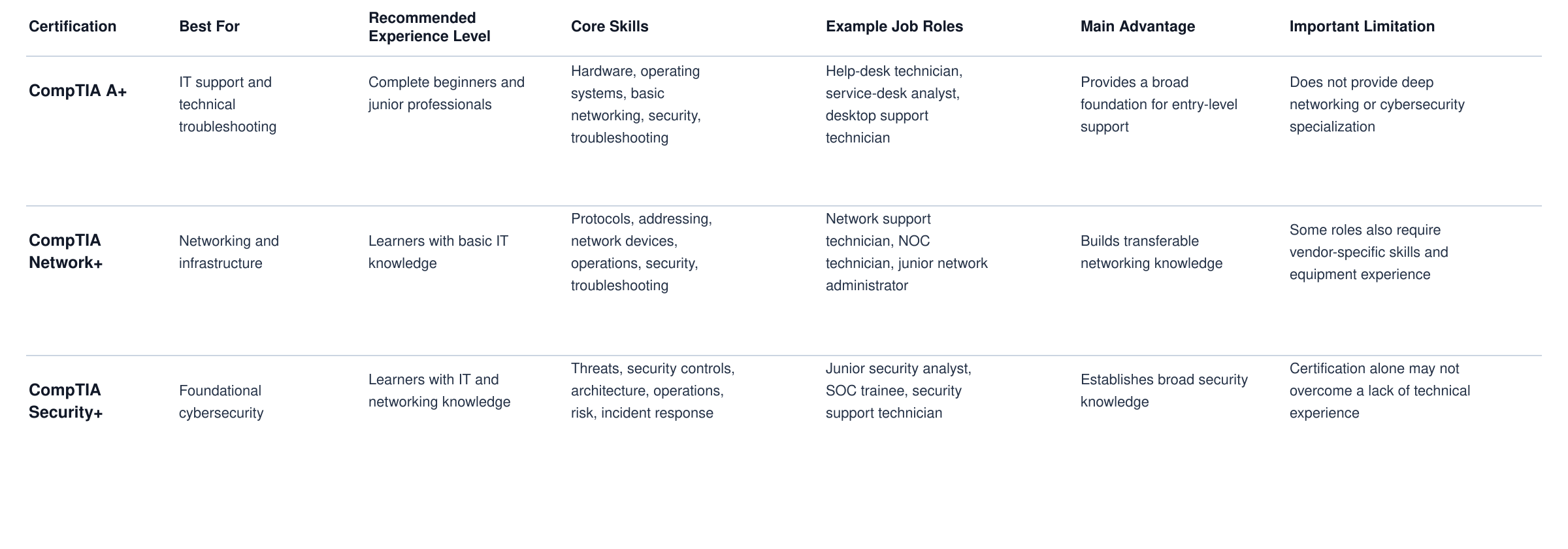
This CompTIA A+ vs Network+ vs Security+ comparison shows why no certification is universally better. A+ offers the broadest beginner foundation, while Network+ and Security+ align with more specialised goals.
Which Certification Should You Choose Based on Your Career Goal?
I Have No IT Experience
Start with CompTIA A+ or equivalent foundational study. Learn how computers, operating systems, networks, and user support work before moving into a specialist area.
Build a home lab using an available computer and virtual machines. Practise installing an operating system, creating user accounts, managing permissions, configuring network settings, and resolving common faults.
I Want an IT Support Job
A+ is generally the strongest initial choice for IT support jobs in South Africa because its objectives closely match common support responsibilities.
Pair the certification with customer-service experience, troubleshooting practice, ticket-writing skills, and familiarity with workplace technologies. Previous experience assisting customers can be relevant when applying for service desk work.
I Want to Work in Networking
Prioritise Network+ if you already possess basic IT knowledge. Practise IP addressing, subnetting, wireless configuration, network diagrams, packet analysis, and troubleshooting.
Complete beginners can start with A+ before Network+, but experienced learners may move directly to networking study.
I Want to Enter Cybersecurity
A progressive route could be:
A+ or equivalent knowledge → Network+ or equivalent knowledge → Security+
This sequence helps you understand devices first, communication between those devices second, and protection of those environments third.
It is a recommendation rather than a compulsory pathway. Someone with a technical degree, support experience, or strong networking knowledge may not need every certification.
I Already Have IT Experience
Do not automatically begin with A+. Compare the exam objectives against your existing knowledge and target role.
If you troubleshoot endpoints confidently but struggle with routing, protocols, and subnetting, choose Network+. If you already administer networks and want to develop security knowledge, Security+ may be more appropriate.
I Do Not Have a University Degree
It is possible to pursue CompTIA certification without a degree, but hiring requirements vary. Some organisations require formal qualifications, while others place greater emphasis on practical skills, experience, certifications, and interview performance.
Strengthen your profile through:
- Demonstrable lab projects
- Internships or learnerships
- Volunteer technical work
- Customer-service experience
- Clear project documentation
- A targeted CV
- Consistent applications for realistic junior roles
Recommended CompTIA Career Paths
These flexible pathways can help you plan your development:
- IT support path: A+ → Network+
- Networking path: A+ or equivalent knowledge → Network+
- Cybersecurity path: A+ or equivalent knowledge → Network+ → Security+
- Experienced professional path: Begin with the certification that addresses your target role or knowledge gap
These sequences are not mandatory. Studying relevant foundational material without sitting every exam can sometimes be more efficient, particularly if you already have experience.
Practical Examples
Scenario 1: A Recent School Graduate Seeking a Help Desk Job
Thabo has completed school but has no professional technology experience. He wants to apply for entry-level IT jobs in South Africa.
His most suitable starting certification is CompTIA A+ because it covers computers, operating systems, troubleshooting, and user support. Alongside his studies, he can create virtual machines, practise Windows administration, repair old computers, and document common support procedures.
After developing these skills, he could reasonably target internships, learnerships, help desk positions, and junior IT technician roles.
Scenario 2: A Support Technician Moving Into Networking
Naledi has worked on a service desk for one year. She resolves user problems confidently but wants to move into network operations.
CompTIA Network+ is the most relevant next step because she already possesses general support experience. She should practise subnetting, packet capture, router and switch configuration, network diagrams, and connectivity troubleshooting.
She could then target network support, infrastructure support, junior network technician, or NOC positions appropriate to her experience.
Scenario 3: A Career Changer Interested in Cybersecurity
Jason works in customer service and wants to become a cybersecurity analyst. He has begun studying Security+ but finds network terminology difficult.
Rather than relying on Security+ alone, he could first develop A+ and Network+ knowledge. He may then continue with Security+ while practising Linux, log analysis, network monitoring, access control, and basic incident investigation.
His first technology role may be service desk, technical support, or a security operations internship rather than an analyst position immediately. That experience can give him the technical context required for future cybersecurity jobs in South Africa.
How to Improve Your Chances of Getting Hired
Review Current Job Advertisements
Search for roles you would realistically apply for and identify recurring requirements. Compare job descriptions across employers because titles and expectations vary.
Build a Home Lab
You can use virtual machines and available hardware to practise:
- Installing operating systems
- Managing users and permissions
- Configuring IP addresses
- Testing connectivity
- Sharing resources
- Applying security settings
- Investigating system and network problems
Create Small Technical Projects
Useful beginner projects include:
- Producing a network diagram for a small business
- Building a troubleshooting checklist
- Configuring a virtual Windows and Linux environment
- Analysing a packet capture
- Documenting a simulated support incident
- Reviewing logs from a test system
Record the objective, configuration, problems encountered, and final result. This creates evidence that you have applied what you studied.
Develop Communication Skills
Support and cybersecurity professionals must explain problems clearly, ask useful questions, document actions, and communicate with non-technical users. Customer-service ability can be a meaningful advantage in entry-level support interviews.
Tailor Your CV
Adjust your CV for each application. Highlight the certification, labs, projects, technologies, and transferable experience most relevant to the advertised position.
Do not simply list certification names. Include practical examples demonstrating what you can configure, troubleshoot, or explain.
Apply Beyond Permanent Positions
Consider internships, learnerships, graduate programmes, temporary support roles, junior positions, and service desk opportunities. A first role can provide the experience needed to progress into networking or security.
Prepare for Technical Interviews
Practise explaining your troubleshooting process. Interviewers may be more interested in how you approach an unfamiliar problem than whether you can recite definitions.
Use Practice Exams Carefully
Practice exams can help reveal weak topics before the certification exam. Review incorrect answers, return to the relevant learning material, and repeat practical exercises instead of memorising answer patterns.
Common Mistakes to Avoid
- Choosing a certification only because it is popular: Select one that matches the roles you want.
- Expecting certification to guarantee employment: Employers evaluate the complete candidate.
- Applying only for cybersecurity roles without foundational experience: Support or networking work can provide a practical route into security.
- Ignoring labs: Technical knowledge becomes more convincing when you can demonstrate it.
- Collecting certifications without applicable skills: Focus on using what you learn.
- Sending the same CV everywhere: Align each application with the position.
- Ignoring communication skills: Technical roles frequently involve users, customers, colleagues, and documentation.
- Relying on outdated market information: Job requirements and salary expectations can change, so review current listings.
Final Verdict: Which CompTIA Certification Is Best?
For most beginners, CompTIA A+ is the best CompTIA certification for jobs in South Africa when the target is entry-level IT support. It provides the broadest introduction to the technologies and troubleshooting responsibilities commonly encountered in junior roles.
CompTIA Network+ is the better option for candidates focused on networking and infrastructure. CompTIA Security+ is the strongest of the three for foundational cybersecurity knowledge, although security candidates also need solid IT and networking skills.
Your next step should be simple: choose a realistic target role, review current job descriptions, compare your knowledge with the relevant exam objectives, and build practical projects while studying.
Once you have selected your certification, Globalcerts practice exams can help you check your understanding and identify subjects that require further study. Practice questions should support your learning—not replace the official exam objectives, structured study, or hands-on experience.
Frequently Asked Questions
Which CompTIA Certification Is Best for Beginners in South Africa?
CompTIA A+ is generally the most accessible option for beginners because it covers hardware, operating systems, networking basics, security fundamentals, and troubleshooting.
Can I Get a Job With CompTIA A+ in South Africa?
A+ can strengthen applications for help desk, service desk, desktop support, and junior technician roles. Employment is not guaranteed, and employers may also require practical skills, experience, education, or knowledge of specific technologies.
Is CompTIA Network+ Worth It in South Africa?
Network+ may be valuable if your target roles involve infrastructure, connectivity, network support, or administration. Review current job listings to determine how often it appears alongside other required skills.
Is CompTIA Security+ Enough to Get a Cybersecurity Job?
Security+ alone may not be enough. Cybersecurity employers may also expect networking, operating-system, cloud, scripting, monitoring, or practical security experience.
Should I Take A+ Before Network+ and Security+?
Not necessarily. A+ can help complete beginners, but candidates with equivalent knowledge or experience may begin with Network+ or Security+. Use the exam objectives to identify any foundational gaps.
Can I Get a CompTIA-Related Job Without a University Degree?
Some employers accept certifications, practical ability, and relevant experience without a degree, while others require formal qualifications. Projects, labs, internships, learnerships, and a targeted CV can strengthen your profile.
Which CompTIA Certification Has the Best Career Potential?
There is no universal answer. A+ supports entry into IT, Network+ develops infrastructure knowledge, and Security+ supports a cybersecurity pathway. The best potential comes from matching your certification to a realistic role and continuing to build experience.
How Long Does It Take to Prepare for a CompTIA Certification?
Preparation time depends on the certification, your previous knowledge, weekly study schedule, and practical experience. Create a plan based on the exam objectives and move forward when you can explain and apply the material consistently.
Do South African Employers Recognise CompTIA Certifications?
Some South African employers require, prefer, or value CompTIA certifications, while others prioritise different qualifications and platforms. Check current advertisements in your target location and sector before deciding.
What Practical Skills Should I Learn Alongside CompTIA Certification?
Develop operating-system administration, troubleshooting, networking, security, documentation, and communication skills. Build labs and small projects that allow you to demonstrate these abilities during applications and interviews.