

CompTIA Job Board Guide for IT Certification Jobs
Earning or pursuing a CompTIA certification gives you a recognized way to demonstrate technical knowledge. The harder question is often what comes next: Where do you find employers that value it, and which roles should you search for?
There is no single CompTIA job board containing every suitable vacancy. A productive search combines major employment platforms, technology-focused boards, employer career pages, government and contractor portals, and local resources. You also need the right job titles and skill keywords because many relevant listings never include “CompTIA” in their titles.
This guide explains where to look, how to interpret certification requirements, and how to strengthen your application with practical evidence—even when you have limited professional IT experience.

What Is a CompTIA Job Board?
People searching for a CompTIA job board may be looking for several different resources:
An official or specialized career resource for technology professionals
A general employment platform containing CompTIA jobs
A technology or cybersecurity job board
An individual employer’s career page
A government or defense contractor employment portal
Each source covers a different part of the market. General platforms offer volume, while specialist boards can make technical roles easier to find. Employer pages sometimes publish openings before they spread widely, and regional resources can reveal opportunities that national searches miss.
Read the wording of each listing carefully. A certification may be required, preferred, recommended, or accepted alongside equivalent experience. These phrases do not mean the same thing and can change whether applying is worthwhile.
Where to Find CompTIA-Certified Jobs
General Employment Platforms
Major employment platforms are useful for broad searches, location filters, salary filters where available, and job alerts. Search both the certification and the role—for example, “CompTIA A+ help desk”—then run a second search for “help desk technician” without the certification name. The second search may find employers that value A+ skills without explicitly mentioning the credential.
Technology and Cybersecurity Job Boards
Specialist boards can produce more focused results for IT support, networking, cloud, Linux, and cybersecurity work. They are especially useful once you know your target function, such as security operations or network support. Smaller boards may have fewer vacancies, so use them alongside larger platforms rather than relying on one source.
Employer Career Pages
Build a list of organizations that regularly employ technical staff: managed service providers, schools, hospitals, financial institutions, software companies, data centers, telecommunications providers, and large businesses with internal IT teams. Visit their career pages regularly and create alerts where possible.
Search for departments and responsibilities, not only credentials. An employer may advertise a service desk analyst or desktop support technician role that aligns closely with A+ even when the certification is absent from the listing.
Government and Defense Contractor Job Portals
CompTIA Security+ frequently appears in government, regulated-industry, and defense contractor listings because some roles must meet defined workforce or contract requirements. That does not make every Security+ holder eligible. A position may also require citizenship, prior experience, background screening, or an active security clearance.
Treat each condition separately. Never imply that you hold a clearance when you do not, and do not assume that a certification substitutes for all other eligibility requirements.
Local and Regional Job Resources
For CompTIA jobs near me, check local recruiters, workforce-development programs, college career centers, professional associations, community technology groups, and regional employment sites. Local and hybrid roles may attract fewer applicants than fully remote openings. Conversations at meetups or career events can also help you learn which job titles local employers actually use.
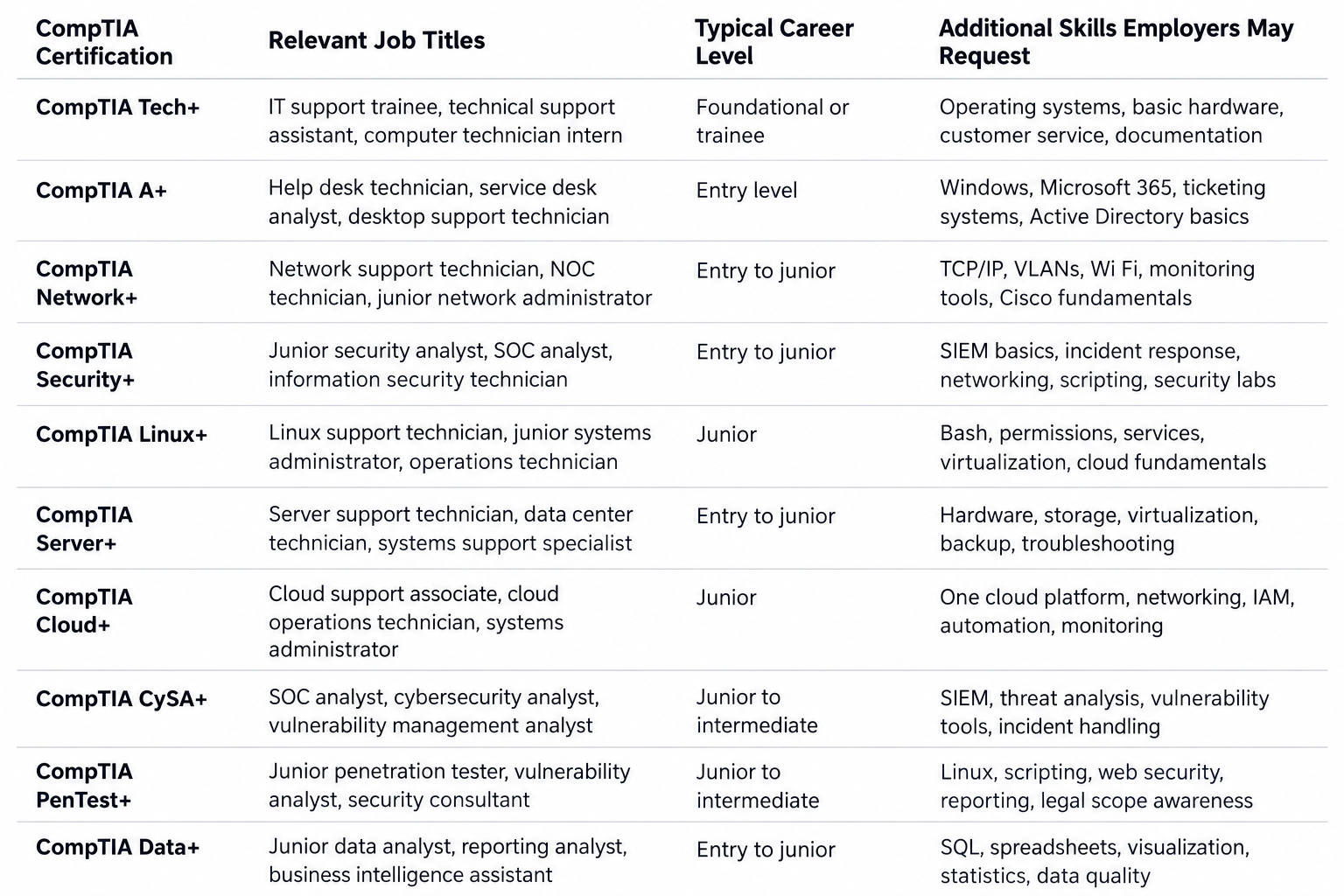
Best Job Titles to Search for by CompTIA Certification
The table below offers starting points, not automatic qualification. Job titles and requirements vary by employer, and some roles require experience or additional credentials.
How to Search a CompTIA Job Board Effectively
Step 1: Search by Certification Name and Exam-Relevant Skills
Start with combinations such as:
“CompTIA A+ help desk”
“Network+ network technician”
“Security+ junior cybersecurity analyst”
“Linux+ systems administrator”
“CySA+ security operations center analyst”
Then replace the certification with skills you practiced, such as ticketing, TCP/IP, Active Directory, SIEM, or Linux administration.
Step 2: Search by Job Title
Many employers describe the right skills without using “CompTIA.” Search common variations, including help desk, service desk, technical support, and desktop support. For cybersecurity, try both abbreviations and full terms, such as SOC analyst and security operations center analyst.
Step 3: Use Location, Experience, and Work-Arrangement Filters
Filter results by location, entry level, internship, contract, or full time. Compare on-site, hybrid, and remote options. Remote searches widen your reach but usually attract more applicants, so keeping local and hybrid alerts can improve the relevance of your results.
Step 4: Search for Required, Preferred, and Equivalent Credentials
Try phrases such as “Security+ required,” “A+ preferred,” and “certification or equivalent experience.” Required credentials are usually screening conditions. Preferred credentials strengthen an application but may not be mandatory.
Step 5: Create Focused Job Alerts
Create separate alerts for each role, certification, location, and work arrangement. One broad alert for “IT” can bury useful openings. A better set might include “A+ help desk—local,” “desktop support—hybrid,” and “technical support—remote.”
Step 6: Review the Full Job Description
Before applying, identify the essential requirements, preferred qualifications, daily responsibilities, schedule, compensation information, and application instructions. Look for repeated skills; they usually reveal what matters most. Save a copy because listings can change or disappear before an interview.
Practical CompTIA Job Search Examples
1. A Beginner With CompTIA A+
Starting point: Maya has CompTIA A+, retail customer-service experience, and a home lab where she installed Windows and replaced components.
Useful searches: “A+ help desk,” “entry-level desktop support,” and “service desk trainee.”
Suitable roles: Help desk technician, IT support specialist, and desktop support technician.
Evidence to highlight: Troubleshooting conversations with customers, documenting fixes, Windows installation, hardware upgrades, and basic account support.
Next action: Create two résumé versions—one for help desk work and one for hands-on desktop support—and set local and hybrid alerts.
2. A Career Changer With Network+
Starting point: Daniel earned Network+ after working in building operations. He has configured a small virtual network and documented a connectivity troubleshooting process.
Useful searches: “Network+ NOC technician,” “junior network support,” and “network operations trainee.”
Suitable roles: NOC technician, network support technician, and field support technician.
Evidence to highlight: TCP/IP troubleshooting, diagrams, VLAN concepts, monitoring practice, incident escalation, and transferable experience following operational procedures.
Next action: Publish a sanitized network diagram and short troubleshooting write-up in a basic portfolio.
3. A Security+ Candidate With Lab Experience
Starting point: Priya has Security+ and a home lab but no paid cybersecurity experience. She has reviewed sample logs, written an incident summary, and practiced basic SIEM queries.
Useful searches: “Security+ junior security analyst,” “SOC analyst I,” and “cybersecurity support technician.”
Suitable roles: Junior security analyst, SOC analyst I, and security-focused IT support specialist.
Evidence to highlight: Alert triage, log analysis, incident documentation, networking knowledge, and clearly defined lab exercises.
Next action: Apply to roles that match her current evidence while continuing hands-on practice and considering adjacent support positions with security duties.
How to Read Certification Requirements in Job Listings
Certification required: The employer treats the credential as a condition. If you are still studying, apply only when the listing allows completion later.
Certification preferred: It is an advantage, not necessarily a firm requirement. Consider applying if you meet most core responsibilities.
Earn within a specified period: You may be hired on the condition that you pass within a stated timeframe. Confirm the deadline and any reimbursement terms.
Certification or equivalent experience: Relevant work may substitute for the credential, or the credential may help offset limited experience. Explain your closest evidence.
Multiple certifications accepted: The employer may list alternatives because several credentials cover the needed baseline. You generally need one accepted option, but verify the wording.
Job descriptions often describe an ideal candidate. If you meet the essential requirements and most preferred ones, a focused application may still be reasonable. Do not ignore legal, licensing, clearance, location, or work-authorization conditions.

Can You Find CompTIA Jobs With No Experience?
Yes, some entry-level IT jobs accept candidates without previous paid IT employment, but certification alone rarely carries the entire application. Your goal is to provide other evidence that you can troubleshoot, learn, communicate, and document your work.
Useful evidence includes:
Home labs and troubleshooting projects
Volunteer technical support
Internships or apprenticeships
Customer-service experience
Documentation samples
Basic networking, Linux, cloud, or security projects
Transferable communication and problem-solving skills
Translate non-IT work into relevant evidence. A retail employee may have diagnosed customer problems, followed escalation procedures, documented incidents, and explained solutions calmly. A warehouse worker may have used inventory systems, followed change controls, and resolved device issues. State what you did and the result without inflating it into technical experience you did not have.
How to Build a Certification-Focused IT Résumé
Place a Certifications section near the top when the credential is important to the role. Use the full certification name, issuing organization, and earned date or active status accurately. If you are preparing, write “CompTIA Network+ — In progress, exam scheduled for [month/year]” only when a date is genuinely scheduled.
Add a Projects section that describes what you configured, tested, documented, or fixed. Match your language to the vacancy’s skills, but do not copy its sentences word for word. Tailor your résumé for different CompTIA careers: an A+ support résumé should emphasize users and troubleshooting, while a Security+ résumé should emphasize logs, controls, and incident thinking.
Quantify real details where possible: devices configured, tickets handled, lab systems built, or time saved. Never invent measurements.
Entry-level résumé bullet:
Built a three-machine virtual lab, configured user permissions and network settings, and documented five common Windows connectivity fixes.
How to Improve Your Chances of Getting an Interview
Apply to focused roles that fit your current skills instead of every IT vacancy.
Tailor your summary, skills, and strongest evidence to each position.
Build a small portfolio containing diagrams, lab notes, scripts, or troubleshooting reports.
Practice both technical questions and behavioral examples using a clear situation-action-result structure.
Speak with local IT professionals and ask about teams, tools, and job-title terminology.
Follow file-format, form, and cover-letter instructions carefully.
Track the role, employer, date, résumé version, status, and follow-up action.
Continue hands-on practice while searching so your examples remain current.
Common CompTIA Job Search Mistakes
Avoid searching only for the certification name. Relevant IT certification jobs may list the underlying skills instead. Do not limit yourself to remote work or overlook local and hybrid opportunities.
Other common mistakes include treating every preferred qualification as mandatory, claiming skills without examples, and sending the same résumé everywhere. Certification is useful evidence, not a job guarantee. Finally, focus most of your effort on roles reasonably close to your current level. A few stretch applications are fine, but consistently targeting senior roles can drain time from realistic opportunities.
How Certification Practice Supports Your Career Search
Realistic practice questions and technical scenarios can reinforce terminology, troubleshooting logic, and the ability to explain why one solution fits better than another. Those habits can also make interview preparation more structured.
Practice exams should complement—not replace—home labs, projects, documentation, and review of the official exam objectives. If you are preparing for a target credential, explore the relevant CompTIA practice exams on Globalcerts and use your results to identify topics that need more study and hands-on practice.
Frequently Asked Questions
Does CompTIA Have a Job Board?
CompTIA provides career-related resources, but no single board contains every certification-friendly opening. Combine specialized resources, major job platforms, employer pages, and targeted searches.
What Jobs Can I Get With CompTIA A+?
Common starting points include help desk technician, service desk analyst, desktop support technician, and IT support specialist. Hiring still depends on the employer’s skills, experience, and location requirements.
Which CompTIA Certification Is Best for Getting a Job?
The right certification depends on the role. A+ aligns with support, Network+ with networking foundations, Security+ with security fundamentals, and Linux+ with Linux administration. Start from a target job, then select the credential that supports it.
Can I Get a CompTIA Job With No Experience?
Some employers hire entry-level candidates without paid IT experience. Certification is stronger when paired with labs, projects, customer service, volunteer work, or other proof of practical and transferable skills.
What Keywords Should I Use to Find CompTIA Jobs?
Combine a certification with titles and skills, such as “A+ desktop support,” “Network+ NOC technician,” “Security+ SOC analyst,” or “Linux+ junior administrator.” Also search titles without “CompTIA.”
Are There Remote CompTIA Jobs?
Yes, especially in technical support, cloud operations, and some security functions. Availability depends on location and employer policy, and remote openings often receive strong competition.
Do Employers Recognize CompTIA Certifications?
Many employers list CompTIA credentials as required or preferred, but recognition varies by role and organization. Always check the full vacancy and support your credential with relevant skills.
Should I Apply If CompTIA Certification Is Only Preferred?
Usually, yes, if you meet the essential responsibilities and most core requirements. A preferred credential can strengthen your application, but it is not normally an absolute condition.
Should I Apply While My Certification Is in Progress?
You can apply when the credential is preferred or the employer allows it to be earned later. State your status honestly and include an exam date only if it is scheduled.
How Often Should I Check Entry-Level IT Job Boards?
Use alerts for daily discovery, then review and apply on a consistent schedule. Quality matters more than rushing: read each listing and tailor your application before submitting it.
Final CompTIA Job Search Checklist
Choose a certification that supports your target role.
List several related job-title variations.
Create focused certification, role, location, and remote-work alerts.
Tailor your résumé to the essential skills in each vacancy.
Prepare practical projects or documentation samples.
Practice technical and behavioral interview questions.
Read certification, location, clearance, and eligibility requirements carefully.
Track every application and appropriate follow-up.
Continue hands-on practice throughout your search.
Conclusion
An effective CompTIA job board strategy is broader than typing a certification name into one search box. Combine targeted queries with relevant job titles, specialist and general resources, employer career pages, local opportunities, and carefully configured alerts.
Your certification can show a useful knowledge baseline, but employers also need evidence that you can apply it. Build projects, document your work, tailor every serious application, and follow up consistently. When you are still preparing for your chosen credential, use Globalcerts CompTIA practice exams to identify knowledge gaps alongside official objectives and hands-on practice.