
CompTIA Tech Jobs Report 2026: Hiring Trends, In-Demand Roles, and Skills
The CompTIA jobs report 2026 presents a technology labor market with both encouraging opportunities and real competition. CompTIA’s latest complete monthly analysis, released August 7 and covering July 2026, found nearly 603,000 active technology job postings in the United States. Employers added almost 260,000 new postings during the month, while the unemployment rate for technology occupations edged down to 2.8%.
The picture is not uniformly positive. Technology companies added approximately 3,700 jobs, but employment in technology occupations across all industries decreased by about 26,000 workers during July. These monthly movements show why one number cannot define the entire market.
The direct answer is that IT remains a viable career field in 2026, but hiring is selective and increasingly skills-based. Demand is particularly visible in software, systems engineering, support, data, cloud infrastructure, cybersecurity, and AI-enabled work. Candidates are best positioned when they combine relevant certifications with hands-on evidence, professional skills, and a focused job-search strategy.

What Is the CompTIA Tech Jobs Report?
The CompTIA Tech Jobs Report is a recurring analysis of the U.S. technology workforce. CompTIA generally publishes an update alongside the monthly U.S. jobs report. It combines employment information from the U.S. Bureau of Labor Statistics with job-posting data from Lightcast.
The report examines several separate indicators. This distinction matters because a technology company and a technology occupation are not the same thing.
Technology-sector employment counts workers employed by companies whose primary business is technology. This workforce includes technical and nontechnical employees.
Technology occupations count people doing technical work across every industry, including finance, healthcare, manufacturing, government, retail, and education.
A hospital cybersecurity analyst belongs to a technology occupation even though the employer is a healthcare organization. A human resources specialist at a software company belongs to the technology sector even though the role itself is not technical.
Job seekers should therefore look at employment changes, unemployment, new postings, active postings, industries, locations, and specific occupations together. A decline in one monthly measure can occur alongside strong hiring demand in particular specialties.
Important Terms Used in Technology Employment Reports
Active job postings: All advertisements still open during the measured period, including new listings and postings carried over from earlier months.
New job postings: Vacancies first added during the latest month. They indicate recent hiring intent, but not every posting becomes a hire.
Technology occupations: Technical roles across every industry, such as software developer, data analyst, or network administrator.
Technology-sector employment: Employment within technology companies, including both technical and business roles.
Unemployment rate: The share of people in a labor force who are without work and actively seeking a job.
Month-over-month change: Movement compared with the previous month. It may be volatile and should not automatically be treated as a lasting trend.
Year-over-year trend: Change compared with the same period one year earlier, often useful for reducing the effect of seasonal fluctuations.
CompTIA Jobs Report 2026: Key Findings
The latest available monthly data provides a snapshot of July 2026, while CompTIA’s annual workforce study supplies a longer-term forecast.
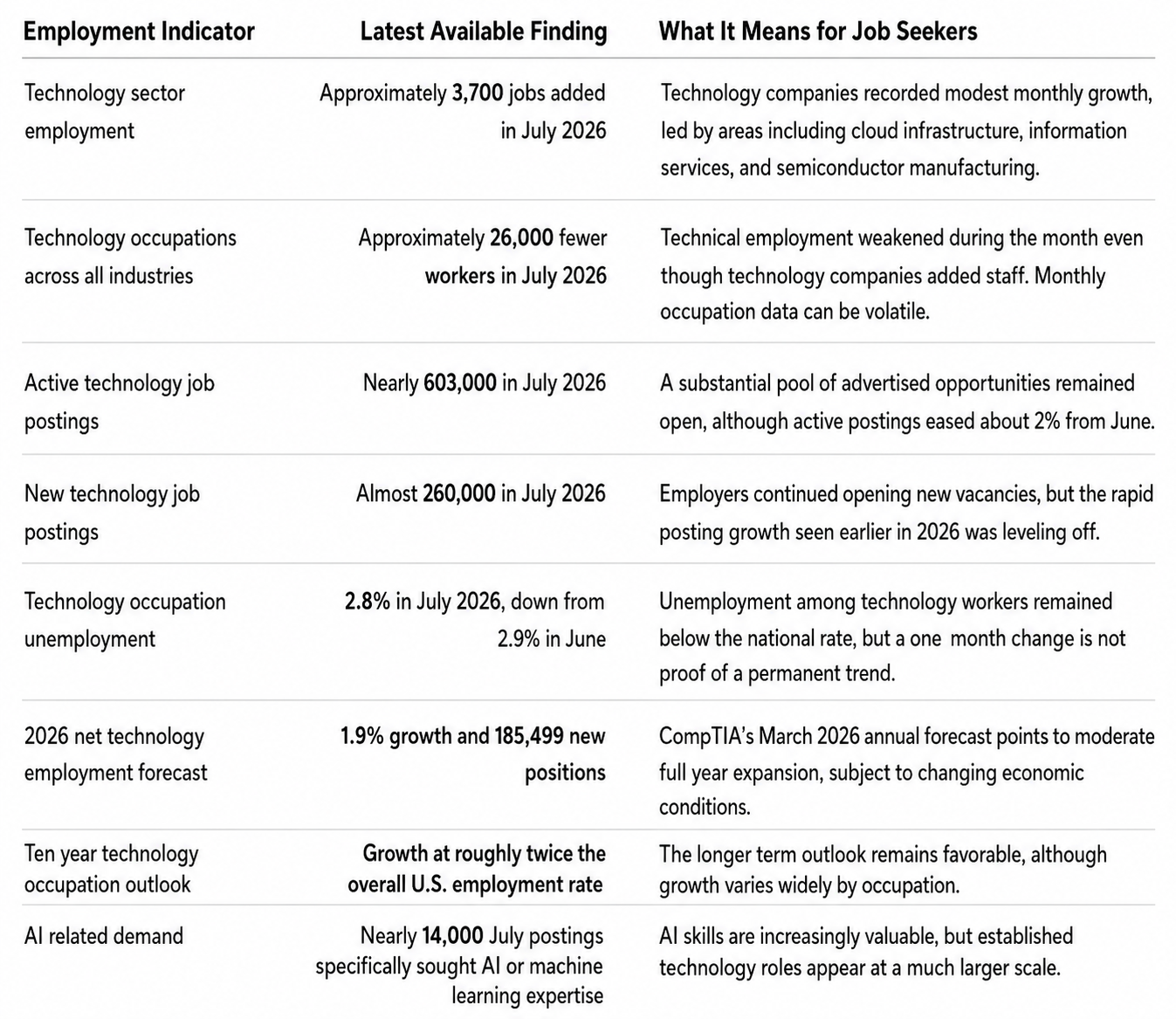
These figures measure different things. The 3,700-job gain and 26,000-worker decrease are monthly employment estimates. The 603,000 active postings represent open hiring demand, while the nearly 260,000 new postings show activity added during July. The 1.9% figure is a forecast for the full year, not a confirmed employment gain.
Is the Technology Job Market Growing in 2026?
The fairest assessment of the IT job market 2026 is that it is expanding in some areas while moderating or contracting in others. In July, cloud infrastructure, data processing and hosting, information services, and semiconductor manufacturing supported job growth inside the technology sector. Employers across professional services, manufacturing, administrative services, information, finance, and insurance also generated significant demand for technical talent.
At the same time, active postings slipped 2% from June, and technology occupations across the economy recorded a monthly decrease. This is not a simple boom. Employers are prioritizing roles tied to operations, revenue, security, infrastructure, data, and AI implementation while scrutinizing headcount and experience more carefully.
National totals can also hide local conditions. A role may be difficult to find in one city yet active in another because of data centers, government contracts, financial employers, manufacturers, or regional technology clusters. On-site requirements and security clearances can narrow the candidate pool, while fully remote vacancies may attract applicants nationally.
What Is Happening to the Tech Unemployment Rate?
The technology occupation unemployment rate reached 2.8% in July 2026, its third consecutive monthly decline and its lowest level of the year to that point. The national unemployment rate was 4.1% in July.
That comparison is encouraging, but it needs context. Occupational unemployment estimates can move sharply from month to month, and a low aggregate rate does not mean every beginner will find work quickly. It can coexist with layoffs, lengthy searches, skill mismatches, and intense competition for remote or entry-level positions. Treat it as one indicator of labor-market conditions, not a personal hiring guarantee.
Most In-Demand IT Jobs in 2026
CompTIA’s July data recorded 46,082 postings for software developers, 34,454 for systems engineers, 24,370 for technical support specialists, and 18,809 for data analysts. Cybersecurity, cloud, infrastructure, networking, and AI-related capabilities also remain important as organizations modernize systems and manage risk.
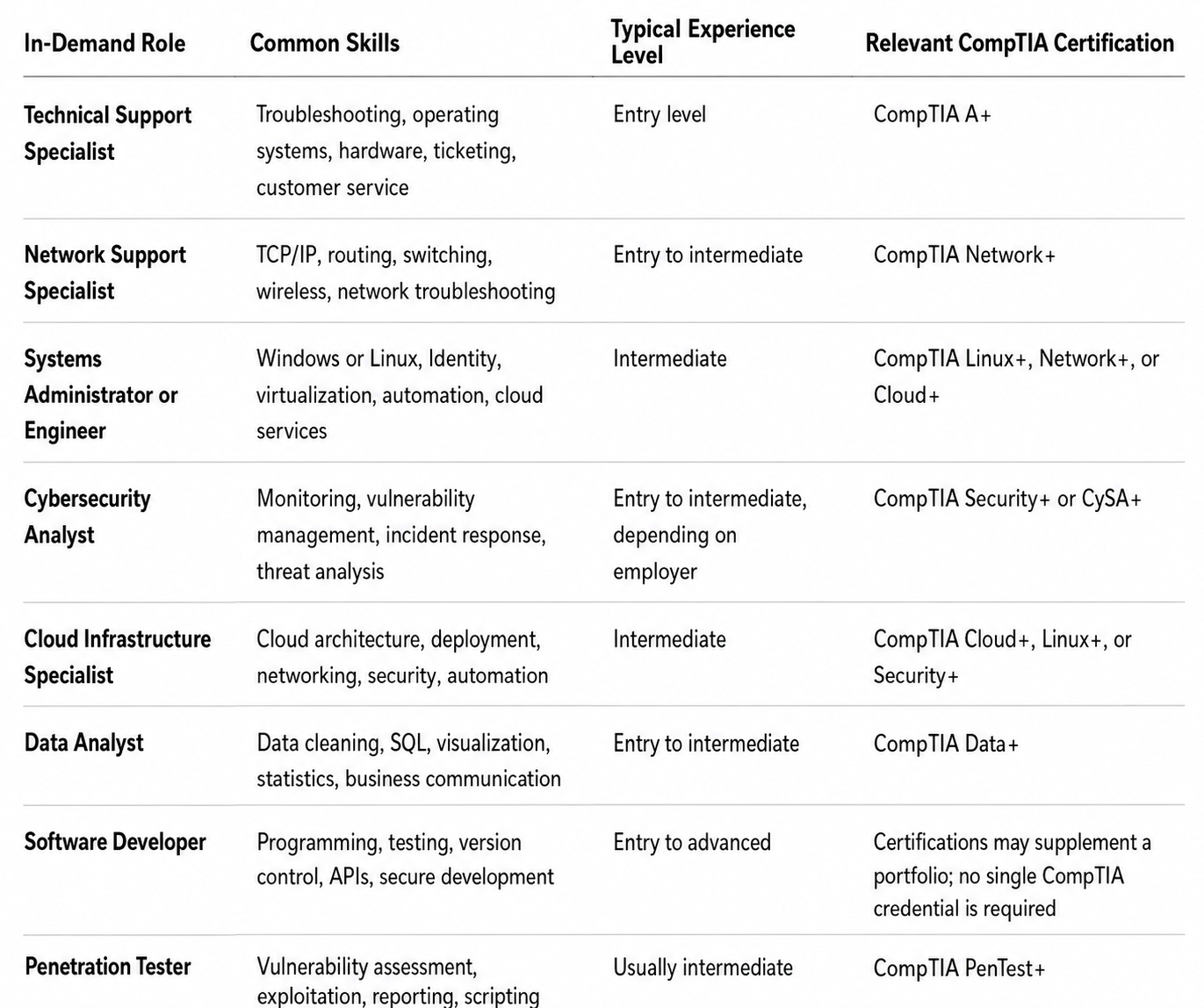
Software developers and engineers build and maintain applications, services, and integrations. Employers need them for digital products, internal automation, modernization, and AI-enabled features. A code portfolio and knowledge of testing, version control, APIs, databases, and secure development usually matter more than certification alone.
Cybersecurity professionals protect systems, identities, networks, applications, and data. Entry paths may begin in technical support, networking, or security operations, while engineering and penetration-testing positions usually expect deeper experience. Knowledge of incident response, access control, vulnerability management, and risk is widely useful.
Cloud and systems professionals keep infrastructure reliable, secure, and scalable. They work with operating systems, virtualization, identity services, networking, automation, monitoring, and cloud platforms. Junior roles exist, but systems engineer and cloud architect titles generally require prior operational experience.
Data and analytics professionals turn raw information into useful reports, models, and decisions. Common requirements include spreadsheets, SQL, visualization, data quality, and communication with business teams. AI and machine learning can extend this path, but dedicated AI engineering positions often require programming, mathematics, data engineering, or production deployment experience.
Technical support remains one of the most realistic entry points. Support professionals diagnose user, device, application, account, and connectivity problems. Strong service, documentation, and escalation habits can help candidates transfer into systems, cloud, networking, or security work.
Skills Employers Are Looking for in 2026
Employers increasingly want a combination of technical competence and the ability to apply it in a business environment.
Technical Skills in Demand
Cybersecurity operations: Alert triage, log analysis, incident handling, vulnerability remediation, and security controls.
Cloud platforms: Provisioning, access management, monitoring, cost awareness, backup, and hybrid-cloud fundamentals.
Networking: IP addressing, DNS, routing, switching, wireless connectivity, firewalls, and troubleshooting.
Linux administration: Command-line operations, permissions, services, storage, networking, and scripting.
Data analysis: SQL, data preparation, visualization, statistics, and interpretation.
Scripting and automation: Python, PowerShell, Bash, APIs, workflow automation, and version control.
AI tools: Safe prompting, workflow integration, output evaluation, data awareness, and responsible use.
Technical support: Methodical diagnosis, endpoint administration, ticketing, remote support, and escalation.
Identity and access management: Authentication, authorization, least privilege, multifactor authentication, and lifecycle management.
Risk management: Identifying threats, assessing business impact, documenting controls, and supporting compliance.
Professional Skills That Strengthen an IT Application
Technical knowledge is more valuable when a candidate can communicate clearly, solve ambiguous problems, document work, assist customers, collaborate across teams, adapt to new tools, and understand business priorities.
For example, a retail employee moving into IT can describe how they diagnosed point-of-sale problems, explained solutions calmly, documented recurring errors, and escalated incidents. A home lab can then show the technical side: configuring user accounts, permissions, backups, and a small network.
A second candidate might build a cloud-hosted test application, write a short architecture diagram, document security decisions, and record how they resolved a failed deployment. That project demonstrates cloud skills, troubleshooting, communication, and accountability—not merely completion of a tutorial.
How AI Is Changing Technology Hiring
AI is changing tasks and skill requirements more clearly than it is replacing every technology occupation. In July 2026, nearly 14,000 postings specifically requested AI or machine-learning expertise. CompTIA’s broader annual study found more than 275,000 active postings in January 2026 that referenced some level of AI skill, including both dedicated AI roles and existing jobs that required AI fluency.
Organizations still need people to connect AI tools to reliable infrastructure, clean data, secure access, governance, and measurable business processes. This sustains demand for cloud, cybersecurity, data, networking, software, and risk-management skills. Routine activities may become faster or partially automated, but human judgment remains essential for validating output, protecting sensitive information, and accepting responsibility for decisions.
Consider a technical support specialist using an approved AI assistant to summarize a ticket and suggest diagnostic steps. The specialist must still confirm device details, protect customer data, test the recommendation, recognize unsafe advice, and document the verified resolution. AI fluency improves the workflow; foundational IT knowledge determines whether the result is trustworthy.
What the Report Means for Entry-Level IT Job Seekers
Beginners can still enter technology in 2026, especially through help desk, desktop support, field service, technical support, data-center technician, and junior network or operations roles. However, a certification by itself may not distinguish a candidate in a crowded applicant pool.
Hands-on evidence can close part of that gap. Build a small home lab, troubleshoot virtual machines, configure a network, document a cloud exercise, analyze sample logs, or create a ticket-resolution case study. Describe what you built, the problem encountered, the steps taken, and the result.
Transferable experience also counts. Customer service demonstrates communication and de-escalation. Warehousing may show process discipline and inventory control. Healthcare work can establish privacy awareness. Tailor each résumé so these skills connect directly to the vacancy instead of sending the same generic application everywhere.
Location matters. Government and defense positions may require citizenship or a security clearance. Data-center, field-service, and hardware roles often require on-site availability. Remote jobs are accessible across a wider area but can attract far more applicants.
Reality Check
Your first search may take time, and the first role may not carry your preferred title or salary. Some “entry-level” advertisements still request experience. Apply when you meet most—not necessarily every—requirement, but keep building proof of ability. Certification, labs, networking, tailored applications, and interview practice work best as a combined strategy.
Which CompTIA Certifications Align With In-Demand Jobs?
Choose a certification because it supports a target role, not simply because it is popular.
CompTIA A+
CompTIA A+ aligns with help desk, desktop support, field service, and entry-level IT operations. It covers hardware, operating systems, troubleshooting, security, networking, and professional procedures. Pair it with practical device, user-account, and ticketing exercises.
CompTIA Network+
CompTIA Network+ supports infrastructure, network support, and troubleshooting paths. It can help candidates understand connectivity before moving into cloud, systems, or security roles. Practice subnetting, traffic analysis, wireless configuration, and failure diagnosis.
CompTIA Security+
CompTIA Security+ establishes baseline knowledge across threats, controls, architecture, operations, governance, and risk. Employers sometimes request it for security administration or government-related roles, but most cybersecurity jobs also require technical experience and hands-on analytical ability.
CompTIA CySA+
CompTIA CySA+ connects to security monitoring, vulnerability management, incident detection, and analyst work. It is generally more suitable after candidates have developed foundational networking, security, and systems knowledge.
CompTIA PenTest+
CompTIA PenTest+ supports vulnerability assessment and penetration-testing development. Offensive-security roles usually require substantial lab practice, clear reporting, scripting, and an understanding of how to operate within authorization and scope.
CompTIA Cloud+ and Linux+
CompTIA Cloud+ applies to cloud infrastructure, deployment, operations, security, and troubleshooting. CompTIA Linux+ supports Linux administration, cloud environments, DevOps support, and hybrid infrastructure. Both become stronger when paired with projects that demonstrate command-line, automation, monitoring, and recovery skills.
Once you have matched a credential to your intended role, use Globalcerts practice exams to check your understanding against the exam objectives. The results can help you identify weak domains and direct your remaining study time more effectively.
How to Respond to 2026 Technology Hiring Trends
Step 1: Select a Target Role
Choose a specific title—such as technical support specialist, junior network administrator, or cybersecurity analyst—instead of preparing vaguely for “IT.” A target makes your skill and certification decisions easier.
Step 2: Review Real Job Descriptions
Analyze 20 to 30 current vacancies in your location. Track repeated tools, skills, certifications, experience levels, work arrangements, and education requirements. Separate common requirements from items that appear only once.
Step 3: Choose a Relevant Certification
Map the repeated requirements to a credential. A+ may fit support, Network+ infrastructure, and Security+ security foundations. Avoid collecting unrelated certifications without practical application.
Step 4: Build Hands-On Experience
Create home-lab troubleshooting scenarios, virtual networks, cloud exercises, Linux administration tasks, or security investigations. Use free tiers and simulations carefully, and document the objective, configuration, problem, and outcome.
Step 5: Prepare for the Certification Exam
Study the current official exam objectives, use structured learning materials, and reinforce them with practice questions and scenario-based exercises. Review explanations rather than memorizing answer positions.
Step 6: Build a Job-Search Portfolio
Publish concise project summaries, diagrams, sanitized screenshots, configuration notes, and lessons learned. A GitHub repository can suit scripts or code, while a PDF case study may be better for support or infrastructure projects.
Step 7: Apply Strategically
Tailor your résumé to each role, prepare stories that demonstrate troubleshooting and collaboration, connect professionally with local employers, and track applications. If interviews are scarce, review your targeting and résumé. If interviews do not convert, improve your technical explanations and examples.
For example, a customer-service representative targeting desktop support could earn CompTIA A+, build a Windows and Linux virtual lab, document five troubleshooting cases, and rewrite their résumé around communication, ticket ownership, and problem resolution. They could then apply to support roles matching those demonstrated skills while continuing to practice interviews and expand the lab.
Is an IT Career Still Worth Pursuing in 2026?
Yes—for people who enjoy solving technical problems and are willing to keep learning, an IT career remains worth considering in 2026. CompTIA’s annual forecast points to moderate growth, and its July data shows hundreds of thousands of active postings. Technology is also embedded across industries rather than confined to technology companies.
The decision should still be personal and evidence-based. Demand varies by specialty, location, experience, and economic conditions. Competition may be stronger in popular entry-level and fully remote roles. Cybersecurity, cloud, AI, networking, data, software, and support remain important business functions, but candidates need to show how they can contribute.
Certifications can provide structure and validate knowledge. Practical projects, professional skills, and targeted applications convert that knowledge into credible evidence for an employer.
Frequently Asked Questions
What is the CompTIA Tech Jobs Report?
The CompTIA Tech Jobs Report is a recurring analysis of U.S. technology employment. It uses federal labor data and job-posting information to track technology-sector jobs, technology occupations across industries, unemployment, and employer hiring demand. Because each metric measures something different, the report is most useful when its findings are considered together rather than reduced to one headline.
What does the CompTIA jobs report 2026 say about hiring?
The latest complete report, released August 7 for July 2026, shows mixed but resilient demand. Technology-sector employers added about 3,700 jobs, while technology occupations across all industries decreased by approximately 26,000. Nearly 603,000 active postings remained open, almost 260,000 new postings appeared, and technology occupation unemployment edged down to 2.8%.
Which IT jobs are most in demand in 2026?
July posting data showed strong volume for software developers, systems engineers, technical support specialists, and data analysts. Cybersecurity, cloud infrastructure, networking, and AI-related skills also remain important. The best opportunity depends on local employers, experience, and specialization, so candidates should verify demand through current vacancies in their region.
Can I get an IT job with only a CompTIA certification?
It is possible, particularly in some support roles, but certification alone does not guarantee employment. Employers may also evaluate troubleshooting ability, communication, projects, prior work experience, location, education, and interview performance. Pair certification study with labs and documented examples that show you can apply the material.
Which CompTIA certification is best for getting a job?
There is no single best credential for every job. CompTIA A+ commonly supports technical support, Network+ supports infrastructure, and Security+ supports security foundations. CySA+, PenTest+, Cloud+, and Linux+ fit more specialized paths. Start with a target role and choose the certification most closely aligned with its recurring requirements.
Is CompTIA A+ enough for an entry-level IT position?
CompTIA A+ can establish a useful foundation for help desk, desktop support, and field-service roles. It becomes more persuasive when paired with hands-on troubleshooting, user support examples, a home lab, and a tailored résumé. Some employers will also require experience, specific platforms, education, or on-site availability.
Are cybersecurity jobs still in demand?
Yes, organizations continue to need professionals who can protect identities, endpoints, networks, cloud systems, applications, and data. However, many cybersecurity positions are not truly beginner-level. Building experience in support, networking, or systems administration can provide the technical foundation employers expect from security analysts and engineers.
How is AI affecting entry-level technology jobs?
AI is automating parts of documentation, ticket summarization, code assistance, and initial analysis while adding expectations around AI fluency and verification. Beginners still need networking, operating-system, security, and troubleshooting fundamentals. Employers benefit from people who can use approved AI tools productively without trusting outputs blindly or exposing sensitive data.
Can I get a CompTIA-related job with no experience?
Yes, but you should create evidence that reduces the employer’s risk. Target realistic roles, earn a relevant certification, complete labs, document projects, practice explaining your decisions, and translate transferable skills from previous work. Internships, volunteering, apprenticeships, contract assignments, and on-site support positions can also provide an initial foothold.
How should I prepare for a CompTIA certification exam?
Begin with the current official exam objectives and use them as a checklist. Combine structured study with labs, recall practice, and scenario-based questions. Review why every answer is correct or incorrect, revisit weak domains, and practice managing time. Readiness comes from understanding and application rather than memorizing isolated questions.
Final Thoughts
The CompTIA jobs report 2026 supports a balanced tech employment outlook: employer demand remains substantial, unemployment among technology workers was relatively low in July, and long-term projections point toward growth, yet monthly employment was uneven and hiring momentum had begun to moderate.
Conditions differ by role, industry, experience level, location, and work arrangement. Select a target position, study real job descriptions, identify the recurring skills, and choose a certification that supports that path. Then reinforce your knowledge with practical work you can explain to an employer.
When you are ready to measure your exam preparation, use Globalcerts CompTIA practice exams to test your understanding, locate weak objectives, and build a more focused study plan. Practice cannot guarantee a job or a passing score, but it can help you prepare with clearer evidence of what you know and what still needs attention.