CompTIA vs. NIST Incident Response Lifecycle: What Security+ Candidates Should Know
Incident response can become confusing when different study resources present different lists. One source may teach seven CompTIA incident response steps, while another describes three or four NIST incident response phases.
Are these sources contradicting each other? Usually, no.
CompTIA and NIST cover many of the same operational activities, but they organize and label them differently. CompTIA presents a sequence that helps Security+ candidates recognize what should happen next during an incident. Current NIST guidance connects incident response to broader cybersecurity risk management.
Understanding both models helps you answer scenario-based questions without relying only on memorization. It also gives you a clearer view of how incident response works inside an organization.

What Is the Incident Response Lifecycle?
An incident response lifecycle is a repeatable process for handling cybersecurity incidents from initial preparation through recovery and organizational improvement.
A security incident might involve:
- A ransomware infection
- A compromised user account
- Unauthorized access to sensitive data
- Malware on an employee endpoint
- A denial-of-service attack
- A successful phishing campaign
Without a defined process, responders may act too quickly, overlook evidence, disconnect the wrong systems, or restore operations before removing the threat.
A structured lifecycle helps an organization:
- Prepare people, tools, and procedures
- Recognize suspicious activity
- Determine what happened
- Limit the incident’s impact
- Remove malicious components
- Restore normal operations
- Use what was learned to improve future responses
Although lifecycle diagrams often appear linear, real incidents do not always follow a perfect one-way path. Responders may return to analysis after discovering another affected system or repeat containment when an attacker finds a new route into the environment.
Why Incident Response Matters for Security+ Candidates
Incident response is part of the security operations knowledge tested by CompTIA Security+. Candidates may encounter questions that describe an incident and ask for the best next action.
The question may not name a lifecycle stage directly. Instead, it may include clues such as:
- “An analyst has confirmed that a workstation is infected.”
- “The malicious process has been removed.”
- “The organization wants to prevent a similar incident.”
- “A suspicious login alert has appeared in the SIEM.”
- “The response team needs to limit lateral movement.”
To choose the correct answer, identify what has already happened and what must happen next. Memorizing the order helps, but understanding the purpose of each activity is more useful.
What Are the CompTIA Incident Response Steps?
For the current Security+ SY0-701 objectives, candidates should recognize the following CompTIA incident response steps:
- Preparation
- Detection
- Analysis
- Containment
- Eradication
- Recovery
- Lessons learned
These terms describe incident-response activities in a practical sequence. Some activities may overlap during a real investigation, but exam questions often rely on the logical order.
Preparation
Preparation happens before an incident occurs. Its purpose is to ensure that the organization has the people, technology, authority, and procedures required to respond.
Practical actions include:
- Creating an incident response plan
- Defining roles and escalation paths
- Preparing communication templates
- Configuring logging and monitoring
- Maintaining forensic tools
- Running tabletop exercises
- Establishing evidence-handling procedures
An exam question mentioning response plans, contact lists, training, communication procedures, or preconfigured tools is likely describing preparation.
Preparation differs from detection because no active incident has been discovered yet. The organization is building its response capability.
Detection
Detection is the recognition of an event that may indicate a security incident.
Detection sources can include:
- SIEM alerts
- Endpoint detection notifications
- Intrusion detection systems
- Antivirus warnings
- Cloud security alerts
- User reports
- Unusual authentication activity
Suppose a SIEM generates an alert after a user account signs in from two distant locations within several minutes. That alert represents detection, not confirmation that an incident occurred.
Detection differs from analysis because detection identifies a potential problem, while analysis investigates whether the activity is malicious and determines its scope.
Analysis
During analysis, responders examine available evidence to understand what happened, how serious it is, and which systems or accounts are affected.
Common actions include:
- Reviewing logs and alerts
- Examining suspicious files
- Building an incident timeline
- Identifying indicators of compromise
- Determining the initial attack vector
- Preserving volatile and nonvolatile evidence
- Assigning an incident category or priority
A Security+ scenario asking an analyst to correlate logs, inspect a suspicious process, or determine the extent of an attack points to analysis.
Analysis follows detection because an alert must be investigated before the team knows how to respond. It precedes containment because responders need enough information to limit the threat without causing unnecessary disruption.
Containment
Containment limits the spread and impact of a confirmed or strongly suspected incident.
Containment actions may include:
- Isolating an infected endpoint
- Disabling a compromised account
- Blocking a malicious IP address
- Segmenting affected systems
- Revoking active sessions
- Applying a temporary firewall rule
If malware is moving laterally between workstations, disconnecting the infected devices from the network is containment.
Containment is not the same as eradication. Isolation prevents the threat from spreading, but it does not necessarily remove malware, attacker persistence, or the original vulnerability.
Eradication
Eradication removes the threat and addresses the conditions that allowed it to remain in the environment.
Actions can include:
- Deleting malicious files
- Removing persistence mechanisms
- Reimaging compromised devices
- Closing unauthorized accounts
- Patching an exploited vulnerability
- Resetting compromised credentials
- Removing malicious scheduled tasks
An isolated computer can still contain malware. Eradication occurs when the malicious components are removed from that computer.
This stage follows containment because responders generally limit the incident before performing cleanup. It comes before recovery because restoring an unsafe system could reintroduce the threat.
Recovery
Recovery returns affected systems and services to normal operation in a controlled manner.
Recovery may involve:
- Restoring data from a clean backup
- Rebuilding a production server
- Reconnecting an endpoint to the network
- Testing system functionality
- Monitoring for recurring indicators
- Confirming that business services are available
A recovered system should be clean, functional, and monitored. Teams may restore systems gradually to reduce the risk of another disruption.
Recovery differs from eradication because eradication removes the threat, while recovery restores trusted operations.
Lessons Learned
Lessons learned examines the response after the immediate incident has been handled.
The team may discuss:
- What happened and why
- Which controls succeeded or failed
- Whether escalation occurred quickly enough
- What evidence was difficult to obtain
- How communication could improve
- Which policies, tools, or procedures need changes
The outcome may include updated playbooks, new monitoring rules, additional training, or changes to technical controls.
A question mentioning an after-action report, post-incident meeting, process update, or prevention of recurrence is pointing to lessons learned. This activity is not optional housekeeping; it turns incident experience into measurable improvement.
What Are the NIST Incident Response Phases?
NIST SP 800-61 provides incident-response recommendations for organizations. However, its lifecycle structure changed significantly between Revision 2 and Revision 3.
NIST SP 800-61 Revision 3, finalized in April 2025, supersedes Revision 2 and aligns incident response with the NIST Cybersecurity Framework 2.0. The current model identifies three core incident-response functions:
- Detect
- Respond
- Recover
It also shows Govern, Identify, and Protect as broader preparation activities that support incident response. Continuous improvement connects lessons from incidents back into all six Cybersecurity Framework functions. NIST Incident Response Project
How NIST Groups Incident-Response Activities
Current NIST guidance uses broad functions rather than treating every operational task as a separate phase.
- Detect covers finding and examining possible cybersecurity incidents.
- Respond includes managing the incident, analyzing it, communicating, containing it, and removing the threat.
- Recover covers restoring affected assets and communicating recovery progress.
Preparation is supported through:
- Govern, which establishes policy, authority, risk strategy, and oversight
- Identify, which helps the organization understand assets, risks, vulnerabilities, and improvement needs
- Protect, which applies safeguards and supports organizational resilience
This does not mean preparation disappeared. NIST now places it within organization-wide cybersecurity risk management rather than presenting it only as the first incident-handling phase.
Why Different Sources Show Different Numbers of NIST Phases
Older study materials often use the four-phase model from NIST SP 800-61 Revision 2:
- Preparation
- Detection and Analysis
- Containment, Eradication, and Recovery
- Post-Incident Activity
Revision 2 grouped several actions into combined phases. For example, containment, eradication, and recovery appeared together even though each activity served a different purpose.
Revision 3 replaced that model with a lifecycle centered on Detect, Respond, and Recover, supported by Govern, Identify, and Protect and connected through continuous improvement. NIST formally identifies Revision 3 as the replacement for Revision 2. NIST SP 800-61 Revision 3
Therefore, a source might show:
- Three core lifecycle functions from Revision 3
- Six Cybersecurity Framework functions
- Four phases from the superseded Revision 2
- A longer operational sequence that separates individual response activities
Before memorizing a diagram, check which publication, revision, or exam objective it represents.
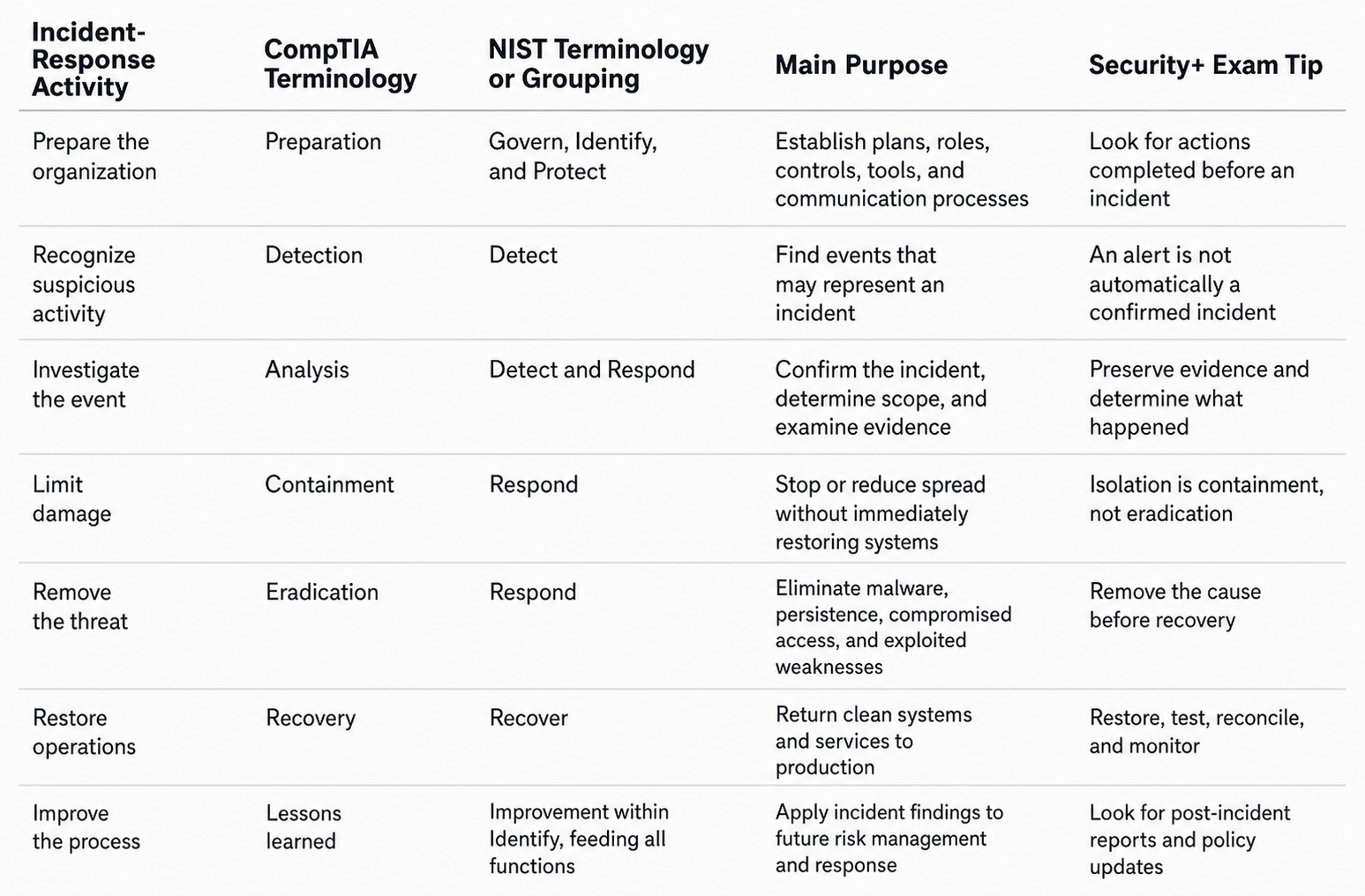
CompTIA vs. NIST Incident Response Lifecycle
The following incident response framework comparison maps the practical CompTIA sequence to current NIST groupings.
Key Similarities
Both approaches recognize the need to:
- Prepare before incidents occur
- Detect suspicious activity
- Investigate and confirm incidents
- Contain harmful activity
- Remove threats
- Restore affected services
- Communicate with relevant parties
- Improve processes based on experience
The technical work does not fundamentally change because the headings are different. Isolating an infected laptop remains a containment action whether a resource labels it Containment or places it inside Respond.
Key Differences
The primary differences involve structure and purpose.
CompTIA terminology is exam-oriented and activity-focused. It gives candidates a detailed sequence for deciding what should happen during a scenario.
Current NIST terminology is risk-management focused. Revision 3 places incident response within the broader Cybersecurity Framework and uses the high-level functions Detect, Respond, and Recover.
CompTIA separates detection from analysis and containment from eradication. NIST can place several of those actions under a broader function.
NIST also treats preparation as organization-wide work supported by Govern, Identify, and Protect, while the CompTIA sequence presents Preparation as the opening incident-response step.
Which Model Should Security+ Candidates Memorize?
For the Security+ incident response process, prioritize the terminology in the current CompTIA exam objectives:
Preparation → Detection → Analysis → Containment → Eradication → Recovery → Lessons learned
Then learn how those actions fit into NIST:
- Preparation is supported by Govern, Identify, and Protect.
- Detection and some analysis fit under Detect.
- Analysis, containment, and eradication primarily fit under Respond.
- Recovery fits under Recover.
- Lessons learned supports continuous improvement.
This approach helps you answer CompTIA questions while still recognizing NIST terminology in workplace documents and study materials.
Practical Incident Response Example
Imagine that an employee opens a phishing attachment. Several minutes later, an endpoint security tool reports ransomware activity and rapid file encryption.
How CompTIA Would Describe the Response
Preparation: Before the attack, the company created a ransomware playbook, configured endpoint monitoring, maintained clean backups, and assigned response roles.
Detection: The endpoint tool identifies suspicious encryption behavior and sends an alert.
Analysis: Analysts inspect the alert, verify ransomware activity, identify the affected user and device, preserve relevant evidence, and search for similar indicators elsewhere.
Containment: The team isolates the endpoint, disables the compromised account, and blocks known malicious infrastructure.
Eradication: Responders remove malicious persistence, reimage the endpoint, reset affected credentials, and correct the weakness used during the attack.
Recovery: The endpoint is restored from a trusted source, tested, monitored, and returned to the employee.
Lessons learned: The organization reviews why the attachment reached the user, adjusts email controls, updates its playbook, and adds a detection rule for related activity.
How NIST Would Organize the Same Response
Under current NIST incident response phases, the organization’s policies, backups, training, and protective controls are supported by Govern, Identify, and Protect.
The endpoint alert and initial investigation fall under Detect. Incident management, analysis, communication, isolation, account disabling, and threat removal fall under Respond. System restoration, validation, and return to service fall under Recover.
Findings from every part of the incident feed continuous improvement, which may influence future governance, asset knowledge, protection, detection, response, and recovery work.
The actions are largely the same. The organizational labels are different.
Common Security+ Exam Mistakes
Confusing Containment with Eradication
Disconnecting an infected device limits the threat but does not remove it.
Avoid the mistake: Ask whether the action stops the spread or removes the cause. Stopping spread is containment; removing the cause is eradication.
Recovering Before Removing the Threat
Restoring data while attacker persistence remains can lead to another compromise.
Avoid the mistake: Confirm that eradication has occurred before choosing a recovery action.
Skipping Evidence Preservation
Immediately wiping a system may destroy information needed to determine the attack vector, scope, or impact.
Avoid the mistake: Consider whether volatile data, logs, disk images, or other evidence must be collected before major changes are made.
Treating Lessons Learned as Optional
Closing the ticket without reviewing the response wastes an opportunity to correct weak controls and procedures.
Avoid the mistake: Associate after-action reports, policy changes, and playbook updates with lessons learned.
Choosing an Action from the Wrong Stage
Several answer choices may be technically useful, but only one may be appropriate at that point in the lifecycle.
Avoid the mistake: Identify the latest completed activity, then choose the action that logically follows it.
Mixing NIST and CompTIA Labels
A question may describe an activity using CompTIA terminology while an explanation uses a broader NIST function.
Avoid the mistake: Focus on the purpose of the action before matching it to a label.
How to Study Incident Response for the Security+ Exam
Start by learning the order and purpose of the seven CompTIA activities. For each one, write down:
- Its objective
- One practical action
- A clue commonly found in scenarios
- How it differs from the next stage
A simple mnemonic for the first letters is:
Prepare, Detect, Analyze, Contain, Eradicate, Recover, Learn.
You can also study commonly confused pairs:
- Detection versus analysis
- Analysis versus containment
- Containment versus eradication
- Eradication versus recovery
- Recovery versus lessons learned
When practicing scenario-based questions, do not stop after checking the correct answer. Explain why each incorrect option belongs to another lifecycle stage. This builds the reasoning needed when several choices appear plausible.
Finally, create two diagrams: one for the CompTIA incident response steps and another for NIST SP 800-61 Revision 3. Connect activities with arrows so you can see how a detailed CompTIA step maps to a broader NIST function.
Planning for Security+ Training and Exam Costs
Certification costs can vary by location, eligibility, provider, and current policy. Before purchasing an exam, compare authorized training options and verify voucher terms directly with the seller.
Students may search for a CompTIA Security+ student discount or a broader CompTIA student discount. Other candidates may look for a legitimate CompTIA exam voucher discount through authorized partners.
If you are planning a longer certification path, you may also compare options for a CompTIA Network+ voucher or search for CompTIA A+ voucher student eligibility information.
Always verify:
- Whether the voucher is valid in your country
- Which exam version it covers
- Its expiration date
- Whether student eligibility is required
- Whether retakes are included
- Whether the seller is authorized
Prices, eligibility rules, and availability can change, so confirm the current conditions before paying.
Frequently Asked Questions
What are the CompTIA incident response steps in order?
The order is Preparation, Detection, Analysis, Containment, Eradication, Recovery, and Lessons learned. Candidates should understand both the sequence and the purpose of each activity.
How many NIST incident response phases are there?
Current NIST SP 800-61 Revision 3 centers incident response on three functions: Detect, Respond, and Recover. Govern, Identify, and Protect support preparation, while continuous improvement connects findings back into cybersecurity risk management.
Older resources may show four phases because Revision 2 used Preparation; Detection and Analysis; Containment, Eradication, and Recovery; and Post-Incident Activity.
Why do CompTIA and NIST use different incident-response terminology?
They serve different learning and organizational purposes. CompTIA separates operational activities into a detailed exam-friendly sequence. Current NIST guidance connects incident response to broader cybersecurity risk-management functions.
Is the incident response lifecycle included in Security+?
Yes. Security+ SY0-701 candidates are expected to recognize appropriate incident-response activities and apply them to scenarios. Questions may test sequence, evidence handling, communication, containment, recovery, or post-incident improvement.
What is the difference between containment and eradication?
Containment limits the incident’s spread or impact. Eradication removes the threat and its persistence. Isolating an infected server is containment; removing the malware and correcting the exploited weakness are eradication.
What happens during lessons learned?
The response team reviews the incident, identifies gaps, documents findings, and updates controls, training, policies, or playbooks. The goal is to improve future prevention and response.
Should Security+ candidates study NIST SP 800-61?
Yes, but candidates should separate current NIST terminology from the specific sequence used in CompTIA objectives. Understanding both helps when study resources, workplace procedures, or scenario questions use different labels.
Are student discounts available for the CompTIA Security+ exam?
Student purchasing options may be available depending on location, eligibility, and current CompTIA policies. Verify the latest CompTIA Security+ student discount requirements and voucher conditions before purchasing.
Final Thoughts
The central difference is organization, not the underlying security work.
CompTIA separates the response process into Preparation, Detection, Analysis, Containment, Eradication, Recovery, and Lessons learned. Current NIST guidance groups incident response into Detect, Respond, and Recover, supported by broader preparation and continuous improvement activities.
For Security+, learn the CompTIA sequence first. More importantly, understand why each activity occurs and how it differs from the stages around it. That understanding will help you recognize lifecycle clues when a question describes an incident without naming the stage.
Globalcerts training resources and scenario-based CompTIA Security+ practice questions can help you apply the lifecycle to realistic situations. Use them to practice choosing the right response at the right time—not merely recalling a list.