Best CompTIA Security+ Games and Interactive Quizzes for SY0-701
Preparing for Security+ can become repetitive when you are reviewing acronyms, attacks, protocols, security controls, and incident-response steps for the tenth time. CompTIA Security+ games can help by turning some of that repetition into short, interactive challenges.
Games and quizzes can improve recall, reveal weak topics, and make study sessions easier to start. However, they should support—not replace—a complete CompTIA Security+ SY0-701 study plan.
This guide explains the most useful Security+ game formats, how they connect to the exam domains, when to use quizzes instead of full practice exams, and how to build an effective game-based review routine. You will also find a seven-day study framework, practical examples, and a checklist for evaluating quiz quality.
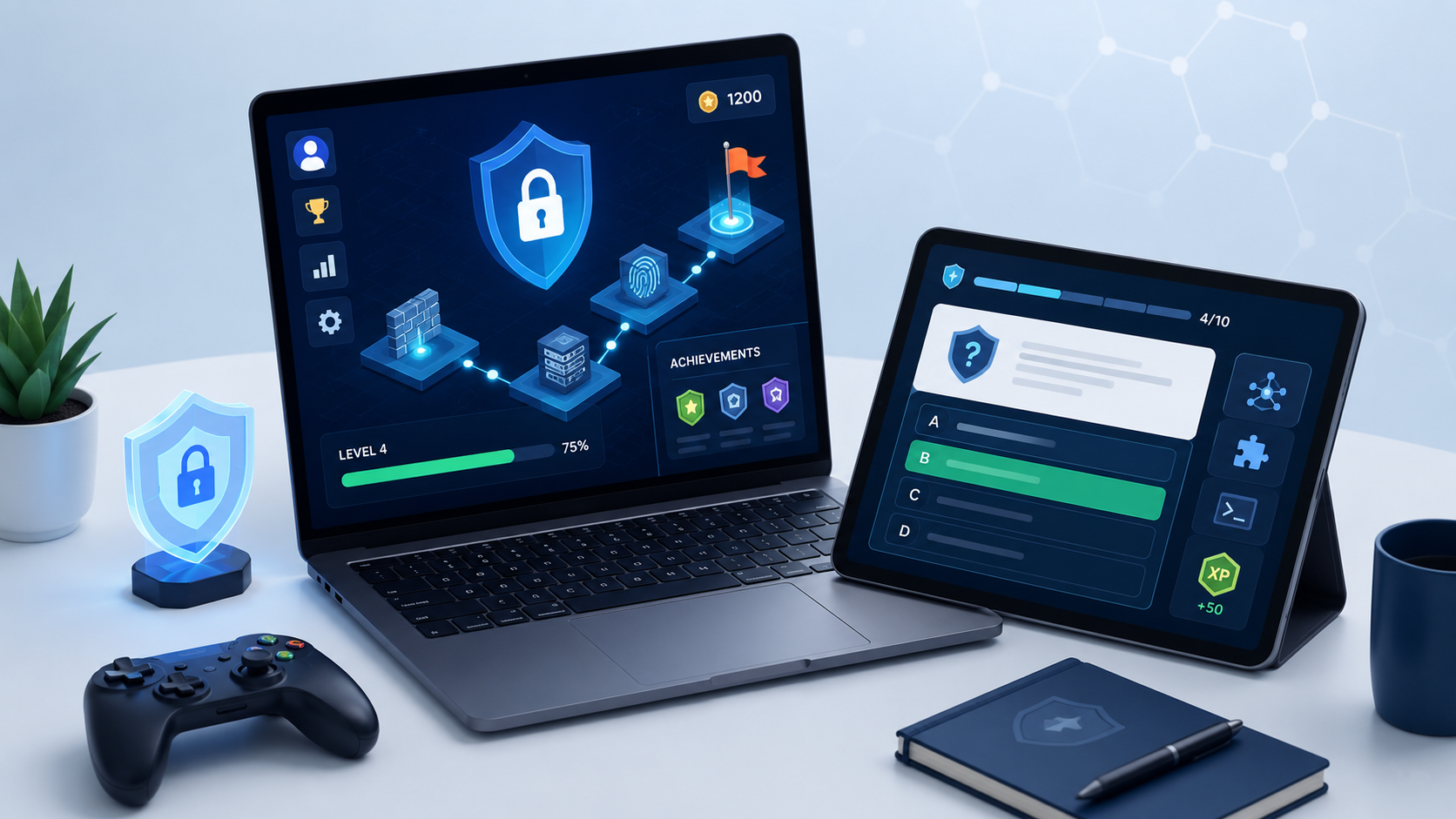
What Are CompTIA Security+ Games?
Security+ study games are interactive activities that help learners review cybersecurity concepts through matching, recall, timed questions, scenarios, simulations, or hands-on tasks.
Unlike passive reading, these activities require you to make a choice, retrieve information, analyze evidence, or apply a concept. That makes them useful for reinforcing material you have already studied.
Matching Games
Matching games ask you to connect two related items, such as:
- A security term and its definition
- An attack and its mitigation
- A protocol and its purpose
- A control and its category
- An acronym and its full meaning
For example, a learner might match SSH with secure remote administration, DNS with name resolution, and HTTPS with encrypted web communication.
This format is helpful for early review, but you should go beyond matching names. After each answer, explain why the connection matters in a real environment.
Timed Security Quizzes
Timed quizzes help you practice retrieving information under pressure. They can also reveal topics that take too long to process.
Suppose you answer access-control questions quickly but regularly hesitate on cryptography. That pattern suggests cryptography needs additional review.
Speed is useful, but careful reasoning matters more than answering quickly. Do not train yourself to select the first familiar-looking option without analyzing the situation.
Scenario-Based Challenges
Scenario-based activities ask you to apply security knowledge rather than repeat a definition.
For example:
An employee receives a message that appears to come from the company’s payroll department. The message asks the employee to sign in through an unfamiliar link. What should the employee do first?
A useful challenge would ask the learner to recognize the phishing indicators and choose an appropriate reporting or verification action.
The goal is not to copy real exam questions. It is to practice connecting indicators, risks, controls, and response actions.
Flashcard and Memory Games
Flashcards work well for acronyms, basic definitions, command purposes, and protocol recognition. They become less effective when learners memorize the wording without understanding the concept.
Use flashcards with active recall: attempt to explain the answer before revealing it. Review difficult cards more frequently and familiar cards less often. This is a simple form of spaced repetition.
A strong flashcard should also include context. Instead of asking only what DLP stands for, ask what problem data loss prevention is intended to address.
Cybersecurity Simulations and Mini Labs
Mini labs require more active participation than standard Security+ quiz games. A learner may review log entries, identify suspicious behavior, configure permissions, inspect a simple access-control problem, or analyze an incident timeline.
These activities help connect theory to action. For example, reading about failed login attempts is useful, but examining a short log and identifying a possible password attack builds stronger practical understanding.
Best Types of CompTIA Security+ Games for SY0-701
The most useful SY0-701 games focus on a specific learning goal. Select the format based on the concept you need to review.
Acronym and Terminology Games
Security+ includes many abbreviations that can overwhelm beginners. Matching and recall games can help, but avoid memorizing terms as isolated labels.
Connect each acronym to its purpose:
- MFA: Requires more than one authentication factor
- SSO: Allows access to multiple services through one authentication process
- DLP: Helps detect or prevent unauthorized data exposure
- EDR: Supports endpoint monitoring, detection, and response
- SIEM: Collects and analyzes security-related event data
- PKI: Supports certificates, keys, and digital trust
- IAM: Manages identities and access
After matching a term, create a short scenario showing where it would be used.
Ports and Protocols Games
Ports and protocols games can strengthen the networking knowledge needed for security scenarios. Useful activities include matching protocols with their functions, identifying secure alternatives, and choosing protocols for specific administrative tasks.
Examples may include HTTPS, SSH, DNS, RDP, LDAP, and SNMP.
Do not spend all your time memorizing an exhaustive list of numbers. You should also understand whether a protocol is encrypted, what service it supports, and why an organization might restrict or monitor it.
Threat and Attack Identification Games
Threat-identification activities present indicators and ask you to identify the likely attack. Topics may include phishing, malware, password attacks, social engineering, injection attacks, on-path attacks, and denial-of-service events.
For example, unexpected account lockouts across many users may indicate a password attack. A fake support call requesting an MFA code may indicate social engineering.
Focus on evidence and context, not just attack names.
Security Controls Matching Games
Control-matching games help learners distinguish between control purposes and categories.
A security camera may be a detective physical control. Security awareness training may be an administrative preventive control. Restoring a system from a clean backup may be part of a corrective control.
A stronger activity asks you to identify both the control category and the problem it addresses.
Incident Response Sequence Games
Sequence games ask learners to arrange incident-response actions in a logical order.
These activities are useful, but simply memorizing a sequence is not enough. You should understand why containment may occur before full eradication and why lessons learned happen after recovery.
Try describing the purpose of each stage in one sentence after completing the sequence.
Governance, Risk, and Compliance Quizzes
Interactive quizzes can make policy, privacy, risk, awareness, and compliance topics easier to review.
For example, a quiz might ask whether a situation should be addressed through a technical safeguard, a policy update, risk acceptance, risk transfer, or employee training.
These topics are not less important because they are less technical. They influence how security decisions are approved, documented, measured, and maintained.
How Security+ Games Support the SY0-701 Exam Domains
Different game formats can reinforce different SY0-701 knowledge areas.
General Security Concepts
Use matching games for security controls, authentication factors, cryptographic concepts, and zero-trust principles. Short quizzes can test whether you understand why a control is used rather than whether you recognize its name.
Threats, Vulnerabilities, and Mitigations
Attack-identification games can present indicators, while mitigation challenges ask you to select a suitable response. You might match a vulnerable configuration with hardening, patching, segmentation, or access-control improvements.
Security Architecture
Diagram-based activities can help learners review network segmentation, cloud environments, resilience, secure design, and architecture decisions.
For example, a scenario might ask where to place a security control to separate public services from an internal network.
Security Operations
Log-analysis exercises, alert-triage challenges, incident-response scenarios, hardening activities, and access-management quizzes are useful for this domain.
Even a short activity that asks you to distinguish normal behavior from a suspicious event can build analytical habits.
Security Program Management and Oversight
Use quizzes for risk treatment, policy purposes, privacy responsibilities, awareness programs, audits, and compliance concepts.
Scenario-based questions are particularly valuable because program-management decisions often depend on business context.
Comparison of Security+ Study Game Formats
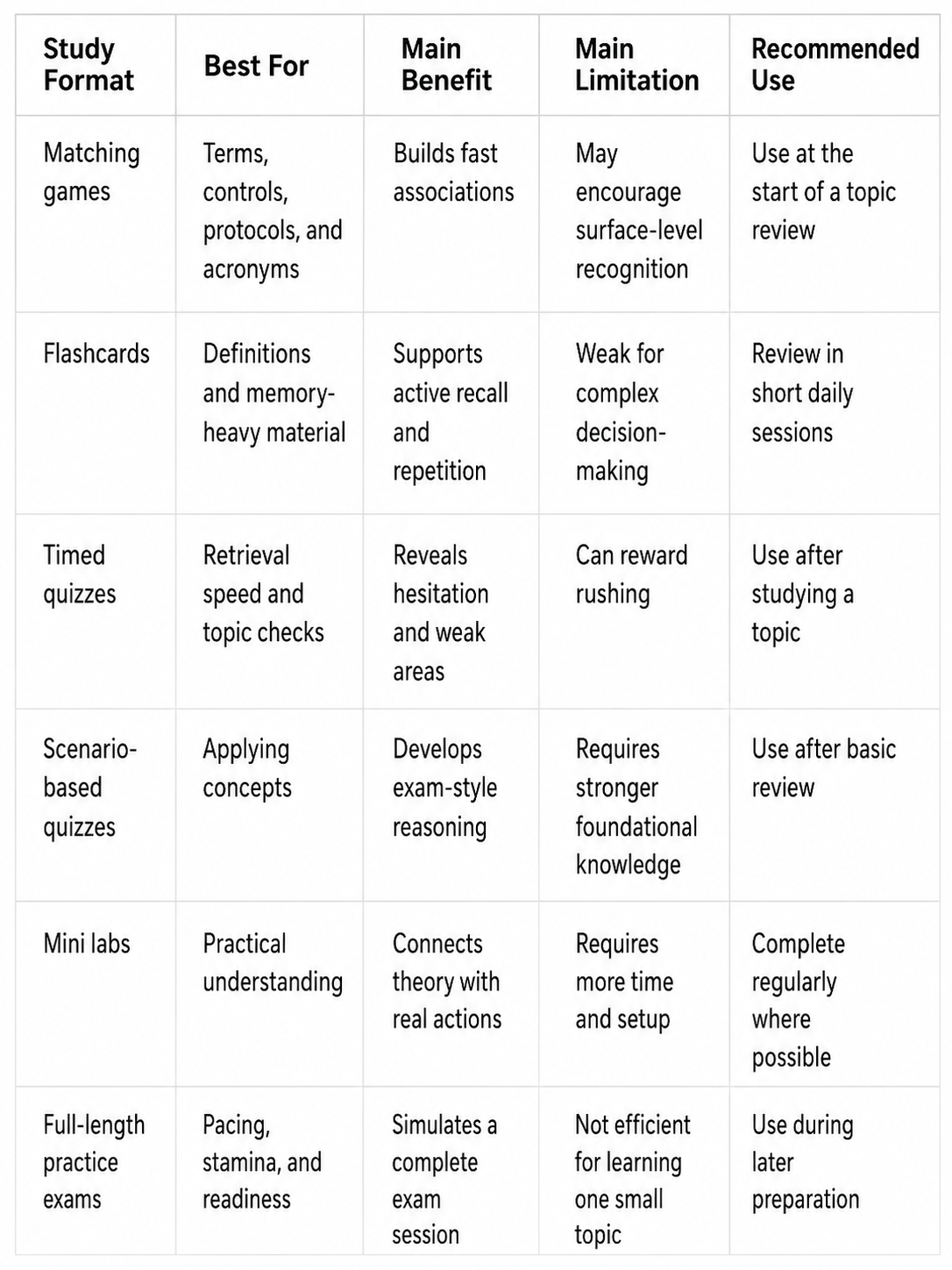
A balanced approach works better than relying on one format. You can use matching games for terminology, scenarios for application, and full practice exams for final readiness checks.
Ready to identify a weak area? Try a short Security+ practice quiz, review every explanation, and write down the concepts that require additional study.
Are CompTIA Security+ Games Enough to Pass SY0-701?
No, games alone are usually not enough to pass SY0-701.
Games are useful for repetition, recall, motivation, and weak-topic practice, but complete preparation also requires:
- A structured review of the exam objectives
- Clear explanations of security concepts
- Scenario-based practice
- Performance-based question preparation
- Full-length timed exams
- Review of incorrect answers
- Hands-on exposure where possible
Games work particularly well during short daily review sessions or when studying memorization-heavy material. They are less effective when used as a substitute for deeper learning.
Treat interactive study as one layer of preparation rather than a shortcut.
Security+ Games vs. Practice Quizzes vs. Practice Exams
A game usually focuses on fast recognition, matching, memory, or a limited challenge.
A short topic quiz checks your understanding of one concept, such as authentication or malware.
A domain-based quiz covers a broader knowledge area and helps identify patterns across related topics.
A full practice exam tests pacing, concentration, stamina, and readiness across multiple domains.
A performance-based activity asks you to complete or analyze a practical task, such as reviewing a configuration, organizing an incident response, or interpreting technical information.
Consider a learner studying network security. The learner might use a matching game to review protocols, complete a domain quiz to test architecture concepts, and take a timed practice exam later to evaluate overall progress.
Choose the format based on your immediate goal. Do not take a full exam when you only need to review one weak topic.
How to Use Security+ Study Games Effectively
Start With One Exam Domain
Choose one domain or topic rather than jumping between unrelated activities. A focused session makes it easier to identify what you understand and what requires further study.
For example, spend one session on identity and access management instead of switching randomly between cryptography, malware, governance, and networking.
Record Every Missed Concept
Maintain a mistake log containing:
- The missed concept
- Why your answer was wrong
- The correct reasoning
- The related exam objective
- A date for reviewing it again
For example, if you confuse a detective control with a preventive control, record the distinction and create one example of each.
Explain Answers in Your Own Words
Recognizing an answer is not the same as understanding it.
After answering, explain the reasoning without repeating the provided explanation. A useful test is whether you could teach the concept to another beginner in two or three sentences.
Repeat Weak Topics Over Time
Do not repeat a difficult topic ten times in one sitting and then ignore it.
Review it again after a day, several days, and a week. Spreading the reviews gives your brain repeated opportunities to retrieve the information.
Move From Games to Scenario Questions
Begin with recognition-based activities, then progress to application.
You might first use a flashcard to learn that MFA combines authentication factors. Next, answer a scenario asking which authentication change would reduce the risk of compromised passwords.
Finish With Timed Practice Exams
Full exams help evaluate pacing, stamina, and overall readiness.
Take them after you have completed topic-level study. Review every incorrect answer and investigate correct answers that were based on guessing.
A 7-Day Security+ Game-Based Study Plan
This seven-day schedule is a review framework, not a complete preparation program for someone starting from zero. Repeat it across several weeks while rotating through different domains.
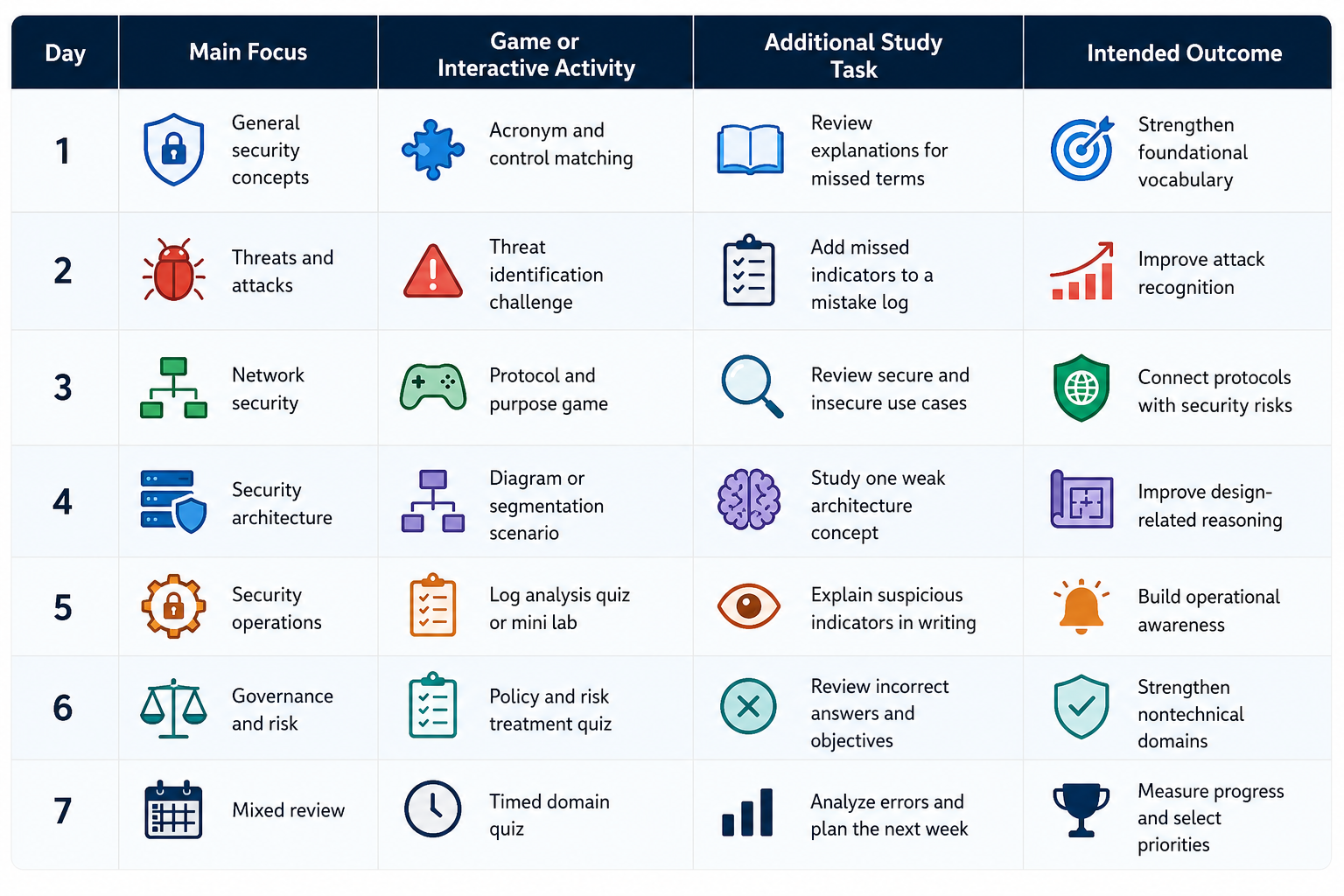
Each session can take approximately 60 to 90 minutes. Divide the time among interactive review, concept study, question practice, and mistake-log updates.
Use the results from each week to choose your next Security+ quiz set. Spend more time on weak domains instead of repeating material you already know well.
Common Mistakes When Using Security+ Quiz Games
Memorizing the Correct Option
Remembering that “option B” was correct does not build transferable knowledge. Explain why the answer works and why the alternatives fail.
Repeating the Same Easy Questions
Scores become misleading when you have memorized the question set. Rotate activities and look for fresh scenarios that test the same concept differently.
Ignoring Explanations
The explanation is often more valuable than the score. It shows the reasoning you should apply to future situations.
Avoiding Weak Domains
Learners often repeat enjoyable topics while avoiding difficult ones. Use quiz results to direct your study toward the areas that produce the most errors.
Using Outdated Exam Content
Check that activities align with SY0-701. Older material may still teach useful concepts, but its organization, terminology, and emphasis may not match your current objectives.
Treating Games as a Complete Study Plan
Games cannot replace structured lessons, labs, scenario practice, and full exams. Use them to reinforce learning rather than define your entire preparation strategy.
How to Choose High-Quality Security+ Practice Quizzes
Look for activities that provide:
- Alignment with SY0-701
- Clear answer explanations
- Original and realistic scenarios
- Coverage across multiple domains
- Questions that test reasoning
- Progress tracking
- Weak-topic identification
- A useful range of difficulty
- Fresh question sets
- Mobile-friendly formatting
- Transparent educational positioning
Avoid resources that claim to contain real exam questions, provide unexplained answers, rely on outdated objectives, contain frequent errors, or promise guaranteed results.
Quality matters more than the number of questions completed. Ten carefully reviewed questions can provide more value than one hundred questions answered without analysis.
Who Benefits Most From Cybersecurity Games for Beginners?
Interactive learning can be especially helpful for:
- Visual learners
- Beginners overwhelmed by terminology
- Career changers
- Learners with limited study time
- Candidates struggling with motivation
- Students reviewing in short daily sessions
A game can make it easier to begin studying when a long chapter feels intimidating. It also gives immediate feedback, which helps learners decide what to review next.
However, no single method works for everyone. Some candidates learn more effectively through textbooks, instructor-led lessons, structured videos, practical labs, or detailed written notes.
Use games when they help you engage with the material, not because they are presented as a universal solution.
Build a Balanced Security+ Study Plan
A beginner might divide study time among concept learning, interactive review, quizzes, scenarios, hands-on tasks, practice exams, and mistake analysis.
A practical weekly routine could include:
- Two sessions for learning or reviewing concepts
- Short flashcard or matching sessions on several days
- Two topic-based quizzes
- One scenario-focused session
- One mini lab or hands-on task
- One timed practice session
- A weekly review of the mistake log
This is a flexible example rather than a scientifically fixed formula. Adjust it according to your experience, available time, and quiz results.
The important principle is progression: learn the concept, retrieve it, apply it, test it, and review your mistakes.
Frequently Asked Questions About CompTIA Security+ Games
Are there free CompTIA Security+ games?
Yes, free CompTIA Security+ games and interactive activities may be available in several formats, including flashcards, matching exercises, short quizzes, and learner-created review activities. Before relying on a free resource, check whether it matches SY0-701 and includes accurate explanations. A free game can be useful for quick review, but price does not determine quality. Evaluate the questions, reasoning, domain coverage, and update status. Avoid any resource claiming to provide leaked or real exam questions.
Can Security+ games help me pass SY0-701?
Yes, Security+ games can support your SY0-701 preparation by improving recall, increasing repetition, and helping you identify weak topics. They are particularly useful for acronyms, protocols, controls, attack indicators, and short concept reviews. However, games should not be your only preparation method. You also need structured content review, scenario-based questions, performance-based practice, timed exams, and careful analysis of incorrect answers. Games help reinforce knowledge, but deeper understanding is necessary for applying concepts in unfamiliar situations.
What are the best Security+ games for beginners?
The best Security+ games for beginners are simple activities with clear explanations and a narrow learning goal. Acronym matching, protocol-purpose games, control-category exercises, flashcards, and short untimed quizzes are good starting points. After building foundational knowledge, beginners should progress to attack-identification challenges and short scenarios. Choose activities aligned with SY0-701 and avoid overly difficult timed games at the beginning. The goal should be understanding and improvement, not collecting high scores as quickly as possible.
Are quiz games useful for memorizing ports and protocols?
Yes, quiz games can help you remember common ports, protocols, functions, and secure alternatives. Matching and recall activities are particularly useful for repeated exposure. However, do not stop at memorizing a number or abbreviation. Learn what the protocol does, whether it protects data in transit, where it may appear, and what risks are associated with improper use. Scenario-based questions should follow memory games so that you can practice selecting the correct protocol or control in context.
How often should I use Security+ study games?
Use Security+ study games regularly in short, focused sessions. Ten to twenty minutes of interactive review several times per week may be more useful than one long session followed by no repetition. The right frequency depends on your study schedule and weak areas. Review difficult concepts more frequently and reduce repetition when you can explain and apply them confidently. Combine game sessions with reading, videos, labs, practice questions, and mistake-log review to prevent your preparation from becoming too narrow.
Are Security+ practice quizzes the same as practice exams?
No, Security+ practice quizzes and practice exams serve different purposes. A quiz usually covers one topic, objective, or domain and may contain a limited number of questions. A practice exam is longer and is intended to evaluate pacing, concentration, stamina, and knowledge across multiple areas. Use quizzes while learning and correcting weak topics. Use full practice exams later to assess broader readiness. Both formats are useful, but a high score on a short familiar quiz should not be treated as proof of exam readiness.
Can games prepare me for Security+ performance-based questions?
Games can build some of the knowledge needed for performance-based questions, but basic matching and flashcard activities are not enough by themselves. Performance-based tasks may require you to analyze information, organize steps, interpret configurations, or apply several concepts together. Scenario games, simulations, diagram activities, log-analysis exercises, and mini labs provide better preparation. Progress from simple recognition tasks to activities that require decisions and explanations. The closer the activity is to practical problem-solving, the more useful it becomes.
How do I know whether a Security+ quiz is updated for SY0-701?
Check whether the quiz clearly states that it aligns with CompTIA Security+ SY0-701 and whether its topics reflect the current exam objectives. Review the terminology, domain organization, question explanations, and examples. Outdated material may heavily emphasize topics that are no longer organized in the same way or may omit newer areas of focus. A trustworthy quiz should explain its educational purpose and avoid claims about real exam content. When uncertain, compare its topic coverage with your current SY0-701 objective checklist.
Final Verdict: Are CompTIA Security+ Games Worth Using?
CompTIA Security+ games are worth using when they align with SY0-701, reinforce genuine understanding, provide useful explanations, target weak areas, and lead into more realistic practice.
They can make repetitive review more engaging and help you retrieve information faster. They can also reveal whether you genuinely understand a topic or merely recognize familiar wording.
However, games are a supplement rather than a shortcut.
Choose one weak SY0-701 topic, complete a short interactive review, take a related quiz, and study every incorrect answer. Then progress to scenario-based questions, practical activities, and full-length timed exams.
For structured preparation, use the platform’s CompTIA Security+ SY0-701 practice quizzes, realistic practice questions, detailed answer explanations, and exam-preparation resources to identify weaknesses and strengthen your reasoning before exam day.