CompTIA A+ vs Google IT Support Certificate: Which Is Better for IT Jobs in 2026?
Choosing your first IT credential can be confusing. Search for the best beginner IT certification, and two options appear repeatedly: CompTIA A+ and the Google IT Support Professional Certificate.
Both cover foundational IT support skills. Both are designed for people entering technology careers. However, they are not the same type of credential, and they do not serve exactly the same purpose.
CompTIA A+ is generally the stronger standalone option for job seekers who want an exam-based certification that employers may specifically request for help desk and technical support roles. The Google IT Support Certificate is often the better learning experience for complete beginners who want structured lessons, guided exercises, and flexible online training.
For some learners, the most logical path is to complete the Google program first and then prepare for CompTIA A+. For others, going directly to A+ is faster and more cost-effective.
This comparison explains the differences in cost, difficulty, employer recognition, practical skills, completion time, and long-term career value.
CompTIA A+ vs Google IT Support Certificate: Quick Comparison
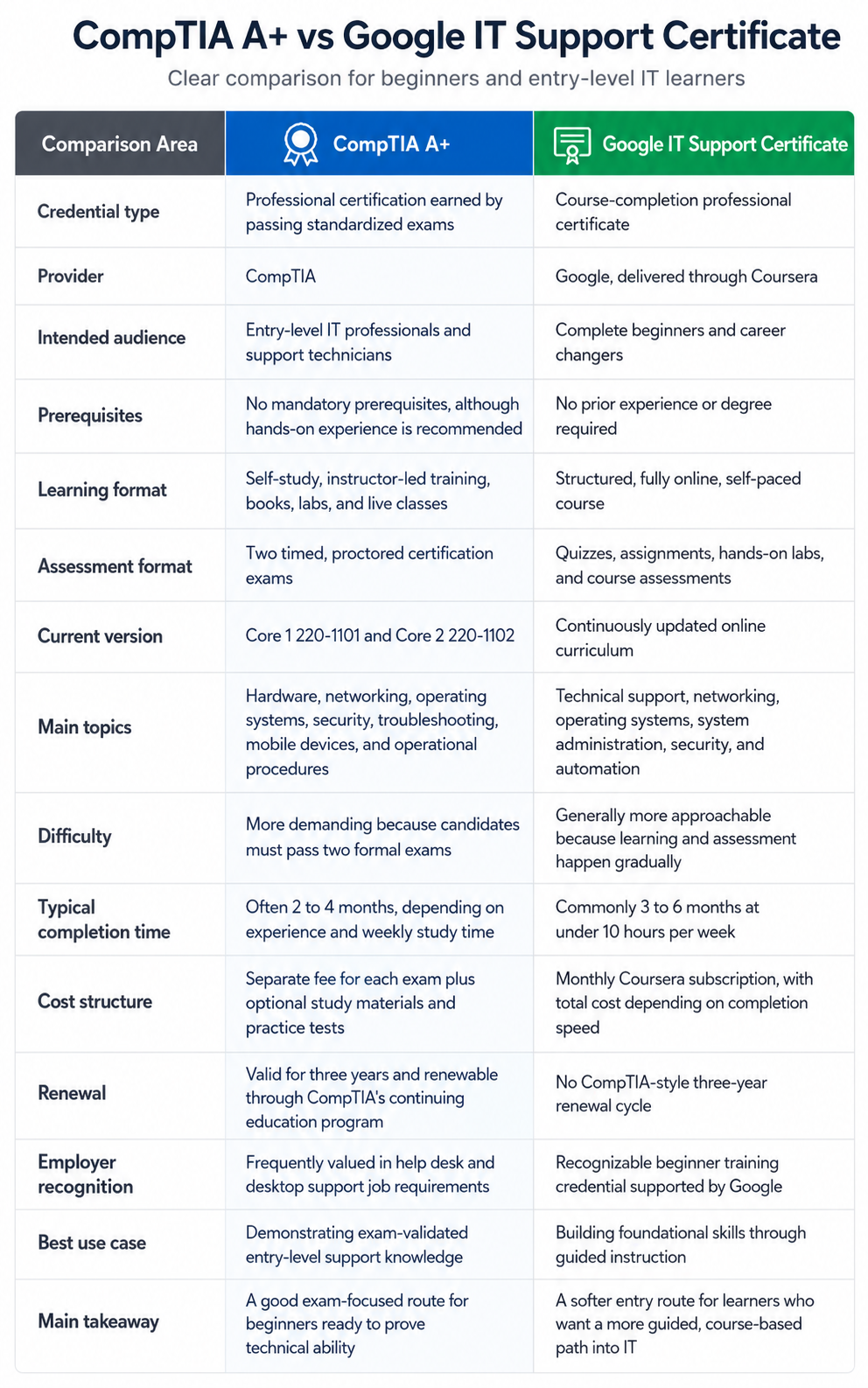
The biggest difference is the way each credential is earned. CompTIA A+ certifies that you passed two standardized, proctored examinations. The Google certificate confirms that you completed a structured training program and its assessments.
The current A+ series requires Core 1 220-1201 and Core 2 220-1202. Each exam allows up to 90 questions in 90 minutes and includes multiple-choice and performance-based questions. Google’s program is fully online, requires no previous experience, and is designed to be completed in approximately three to six months at a part-time pace.
What Is CompTIA A+?
CompTIA A+ is a vendor-neutral professional IT certification focused on the skills needed to support computers, operating systems, networks, mobile devices, users, and common business technologies.
“Vendor-neutral” means the certification is not limited to one company’s products. Candidates study technologies from multiple hardware, software, networking, cloud, and operating-system environments.
How CompTIA A+ Works
To become A+ certified in 2026, candidates must pass two exams from the same series:
- Core 1: 220-1201
- Core 2: 220-1202
Each exam can contain a maximum of 90 questions and lasts 90 minutes. Question formats include traditional multiple-choice questions and performance-based questions, often called PBQs. A PBQ asks the candidate to apply knowledge to a simulated technical situation rather than simply recognize a definition.
The passing score is 675 on a 100–900 scale for Core 1 and 700 on the same scale for Core 2.
Candidates do not have to buy an official CompTIA training course. They can prepare with books, video lessons, practice exams, home labs, instructor-led classes, or a combination of resources.
Skills Covered by CompTIA A+
The current exams cover a broad range of entry-level support responsibilities, including:
- Computer components, storage, memory, processors, and peripherals
- Laptops, mobile devices, accessories, and connectivity
- Wired and wireless networking fundamentals
- Windows, macOS, Linux, and mobile operating systems
- Software installation, configuration, and troubleshooting
- Malware prevention and basic security controls
- Cloud computing and virtualization concepts
- Hardware and network troubleshooting
- Documentation, change management, safety, and professional communication
- Basic scripting, remote support, and operational procedures
Core 1 emphasizes mobile devices, networking, hardware, virtualization, cloud concepts, and hardware or network troubleshooting. Core 2 focuses on operating systems, security, software troubleshooting, and operational procedures.
Who Should Choose CompTIA A+?
A+ is particularly suitable for people who:
- Want to apply for help desk, desktop support, field technician, or IT support positions
- Already understand basic computer concepts
- Prefer independent study
- Are comfortable preparing for formal exams
- Want a credential that may appear directly in job descriptions
- Plan to continue with Network+, Security+, or another technical certification
- Need a vendor-neutral foundation covering multiple technologies
It can also be useful for career changers who have developed informal technical experience by repairing computers, managing home networks, supporting coworkers, or building home labs.
Advantages and Disadvantages of CompTIA A+
Advantages
- Exam-based professional certification
- Broad coverage of common support technologies
- Vendor-neutral curriculum
- Frequently relevant to help desk and desktop support work
- Provides a foundation for Network+, Security+, and other certifications
- Includes troubleshooting scenarios and performance-based questions
- Can demonstrate commitment to an IT career
Disadvantages
- Requires passing two separate exams
- Exam and retake costs can be substantial
- The range of objectives may feel overwhelming
- Formal testing creates pressure for some beginners
- Certification preparation does not automatically provide enough hands-on practice
- The credential must be renewed if the holder wants to keep it active
What Is the Google IT Support Certificate?
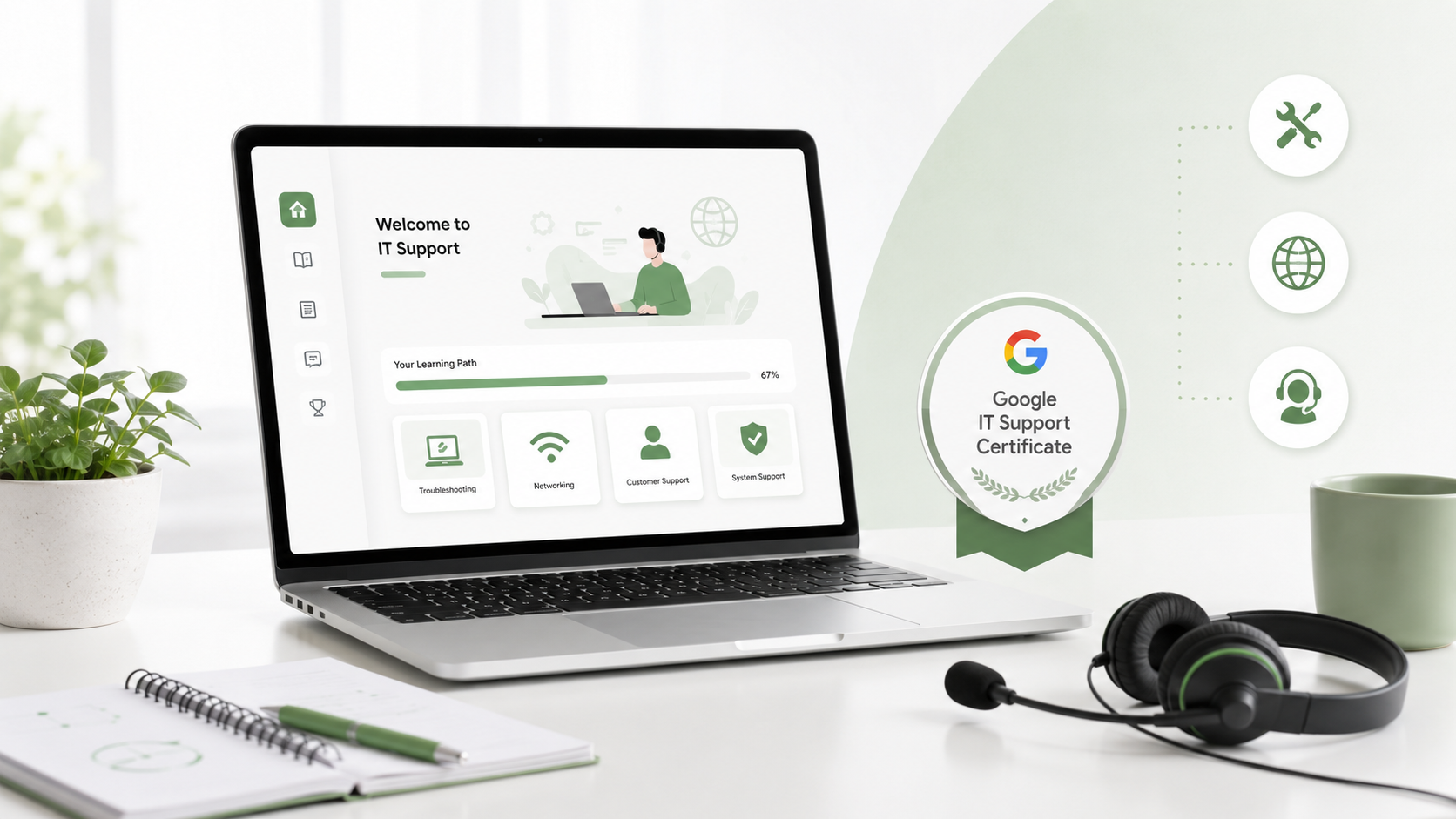
The Google IT Support Professional Certificate is an online training program developed by Google and delivered through Coursera.
It is designed for learners who have little or no previous IT experience. Rather than preparing students for one externally proctored certification exam, the program teaches the material through videos, readings, demonstrations, quizzes, assignments, and hands-on activities.
How the Google IT Support Certificate Works
Learners subscribe to the program through Coursera and complete its courses at their own pace. There are no required in-person classes, degree requirements, or previous technical qualifications.
The program uses gradual assessments throughout the learning process. This allows students to study a topic, practice it, receive feedback, and continue to the next unit without facing one high-stakes final certification exam.
Google describes the program as fully online and suitable for completion in approximately three to six months with fewer than 10 hours of study per week.
Skills Covered by the Google IT Support Certificate
The curriculum includes:
- Technical support fundamentals
- Computer hardware and software
- Troubleshooting processes
- Customer service and user support
- Computer networking
- Operating systems
- Linux fundamentals
- System administration
- IT infrastructure services
- Security fundamentals
- Support documentation
- Basic automation and AI-assisted IT support concepts
Google’s current program also includes practical activities involving troubleshooting, customer care, support documentation, scripting-related tasks, and evaluating infrastructure for potential vulnerabilities.
Who Should Choose the Google IT Support Certificate?
The program is a strong option for people who:
- Are completely new to information technology
- Need lessons organized in a logical sequence
- Learn better through videos, demonstrations, and assignments
- Want flexible, self-paced training
- Are uncertain whether an IT support career is right for them
- Need foundational instruction before preparing for certification exams
- Prefer smaller assessments instead of two high-stakes tests
- Want to build confidence before pursuing CompTIA A+
Advantages and Disadvantages of the Google IT Support Certificate
Advantages
- No previous experience or degree required
- Structured beginner-friendly curriculum
- Fully online and self-paced
- Includes quizzes, assignments, and hands-on activities
- Covers both technical and customer-support skills
- Lower initial cost than purchasing two A+ exams
- Can provide a foundation for later certification study
- Developed by a widely recognized technology company
Disadvantages
- It is a course-completion certificate rather than an independent certification exam
- Total cost increases when a learner takes longer to finish
- It may appear less frequently than A+ in certification requirements
- Completing the program does not automatically prove readiness for A+ PBQs
- Some learners may still need additional hardware and troubleshooting practice
- It does not guarantee a job or replace relevant experience
Google IT Support vs CompTIA A+: Detailed Comparison
Which Is More Beginner-Friendly?
The Google IT Support Certificate is generally more beginner-friendly because it teaches the material through a guided program.
A learner with no technical experience can begin with introductory lessons, complete activities, review mistakes, and progress gradually. CompTIA A+, by comparison, tells candidates what knowledge and skills will be tested but does not require one particular training path.
Consider a hypothetical learner who has never installed an operating system or opened a desktop computer. The Google program provides a clearer starting point. The same learner could prepare directly for A+, but would need to select suitable courses, labs, books, and practice tests independently.
For someone who already troubleshoots computers and understands basic networking, the additional guided structure may be unnecessary.
Which Is Harder?
CompTIA A+ is usually harder to earn.
The difficulty comes from:
- Passing two separate exams
- Remembering a broad range of technical details
- Solving scenario-based questions under time pressure
- Completing performance-based tasks
- Distinguishing between several technically possible answers
- Paying for another attempt after an unsuccessful exam
The Google certificate can still be challenging, especially for someone learning networking, Linux, and system administration for the first time. However, its assessments are distributed throughout the program rather than concentrated into two proctored exams.
Difficulty also depends on previous experience, study consistency, and comfort with formal testing.
Which Costs More?
In most cases, CompTIA A+ costs more upfront.
Current U.S. retail listings in July 2026 show an A+ exam voucher at approximately $274 per exam. Because candidates need both Core 1 and Core 2, the standard exam cost is approximately $548 before study materials or retakes. Prices can vary by country, taxes, discounts, academic eligibility, authorized reseller, and bundle.
Additional A+ expenses may include:
- Study guides
- Video courses
- Practice exams
- Lab subscriptions
- Retake protection
- A replacement voucher after a failed attempt
- Continuing education or renewal activities
In the United States and Canada, Coursera currently lists the Google IT Support Certificate at $49 per month after a seven-day trial. A learner finishing in three months might pay approximately $147, while a six-month learner might pay approximately $294. Regional pricing can differ; for example, Google currently lists a lower monthly subscription price for learners in the Philippines.
These examples are estimates. Learners should check the current price shown in their country before enrolling or buying an exam voucher.
Which Takes Longer to Complete?
There is no universal completion time.
A possible schedule might look like this:
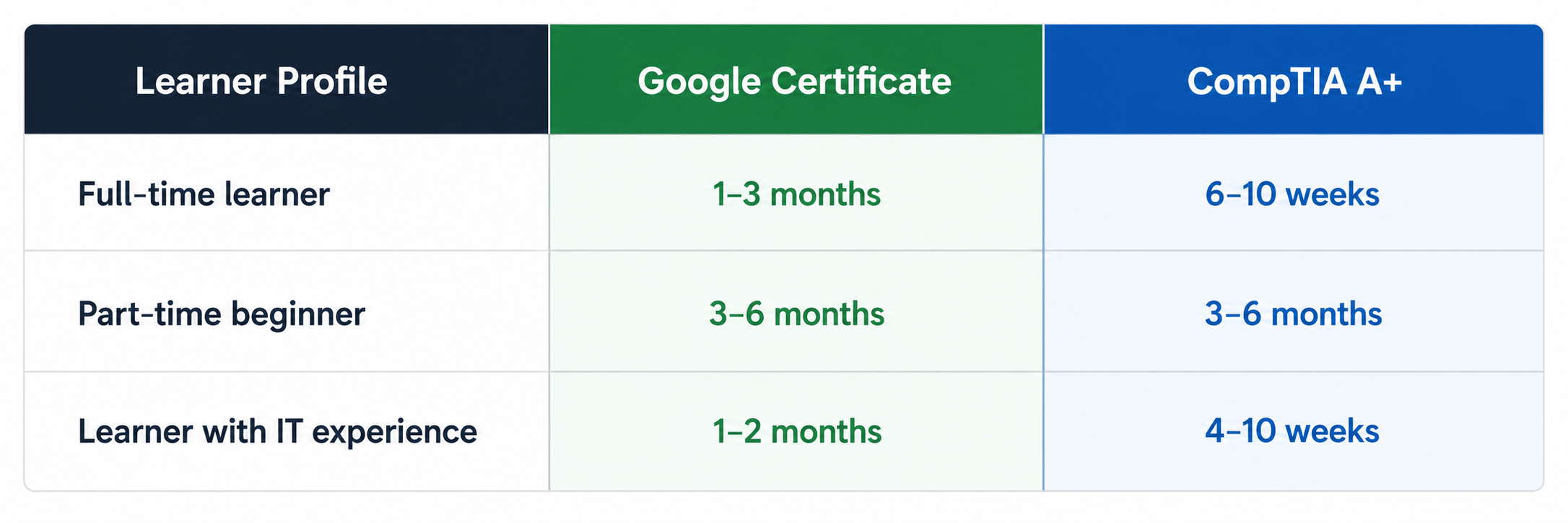
These are hypothetical timelines, not guarantees.
A learner studying five to ten hours per week may need several months for either option. A person with professional support experience could move quickly through the Google assessments or prepare directly for A+.
The Google program has a financial incentive for finishing efficiently because it uses monthly subscription pricing. A+ does not charge by study month, but candidates should not schedule an exam before they are ready simply to finish sooner.
Which Teaches More Practical Skills?
The Google certificate provides more built-in guided learning activities, while A+ preparation can provide more or less practical experience depending on the resources selected.
A learner could study for A+ entirely through videos and memorization, which would leave major practical gaps. Another learner could build a strong home lab, install operating systems, configure virtual machines, replace components, troubleshoot Wi-Fi, practice command-line tools, and work through realistic PBQs.
Neither credential should replace real troubleshooting practice.
Useful beginner projects include:
- Installing Windows or Linux in a virtual machine
- Creating local user accounts and permissions
- Configuring IP addresses and DNS settings
- Connecting and securing a wireless router
- Practicing ticket documentation
- Troubleshooting a deliberately misconfigured device
- Identifying computer components
- Using remote-support and system-administration tools
Which Has Better Employer Recognition?
CompTIA A+ generally has stronger recognition as a standalone professional certification for traditional IT support roles.
Current help desk and support postings continue to name CompTIA A+ as a preferred or helpful certification. These listings also show that employers value Windows support, Microsoft 365, Active Directory, networking, documentation, ticketing tools, and customer service.
The Google certificate is still recognizable. Google states that graduates can access career resources and an employer network containing more than 150 participating companies. However, participation in an employer consortium does not mean every employer accepts the certificate as a substitute for certification, experience, or other requirements.
The most accurate approach is to review actual job advertisements in your location. Search for positions such as:
- Help desk technician
- Service desk analyst
- Desktop support technician
- IT support specialist
- Technical support representative
- Field service technician
Record the technologies, certifications, experience, and customer-service skills that appear repeatedly.
Which Is Better for Help Desk and IT Support Jobs?
For someone specifically targeting help desk or desktop support positions, CompTIA A+ is usually the better standalone credential.
Its current objectives closely match common entry-level support tasks: configuring devices, troubleshooting hardware and software, supporting operating systems, applying basic security, resolving network problems, documenting incidents, and communicating with users.
However, A+ alone is not enough to make someone job-ready.
Hiring decisions can also depend on:
- Communication ability
- Customer-service experience
- Troubleshooting logic
- Familiarity with ticketing systems
- Windows and Microsoft 365 skills
- Active Directory or identity-management knowledge
- Home-lab projects
- Resume quality
- Interview performance
- Previous work experience
Which Is Better for Career Changers?
A complete beginner who feels overwhelmed by technical terminology may benefit more from the Google certificate.
A career changer who already understands computers and wants to begin applying for jobs soon may receive more value from focusing directly on A+ objectives, practice questions, labs, and resume preparation.
Previous non-IT experience can also matter. Customer service, retail, administration, healthcare, education, and hospitality can all provide transferable skills. Help desk professionals must listen carefully, ask clear questions, document problems, manage frustrated users, and explain technical steps in simple language.
Which Provides Better Long-Term Value?
A+ offers stronger value when it becomes the first step in a larger certification path:
CompTIA A+ → CompTIA Network+ → CompTIA Security+
This sequence can build progressively deeper knowledge of support, networking, and cybersecurity.
The Google certificate offers long-term value when it helps a beginner develop enough confidence and knowledge to continue into:
Google IT Support Certificate → CompTIA A+
Either route can eventually lead from entry-level support into:
- Systems administration
- Network administration
- Cloud support
- Endpoint management
- Cybersecurity
- IT operations
- Technical account support
The best long-term credential is the one that supports a clear career plan rather than simply adding another badge to a resume.
Does the Google IT Support Certificate Prepare You for CompTIA A+?
The Google certificate can provide a useful foundation for A+, but it should not be treated as complete A+ exam preparation.
The two programs overlap in areas such as:
- Operating systems
- Networking fundamentals
- Troubleshooting
- Security
- Hardware basics
- Technical support
- System administration
Additional A+ preparation may still be needed for:
- Detailed hardware identification
- Ports, connectors, cables, and standards
- Printer technologies
- Mobile-device troubleshooting
- CompTIA-specific terminology
- Exact exam objectives
- Performance-based questions
- Timed test strategy
- Scenario questions asking for the best, first, or next action
A practical transition plan is:
- Download the current 220-1201 and 220-1202 exam objectives.
- Mark the objectives already covered in the Google program.
- Identify missing hardware, networking, security, and operational topics.
- Complete hands-on labs for both Core 1 and Core 2.
- Practice performance-based questions.
- Take a diagnostic test for each core.
- Review every incorrect answer and identify the underlying knowledge gap.
- Complete timed practice exams before scheduling the real tests.
Completing the Google certificate means you have studied relevant foundational material. It does not automatically mean you are ready to pass both A+ exams.
Should You Take CompTIA A+, the Google Certificate, or Both?
Choose CompTIA A+ If…
Choose A+ when you:
- Want an exam-based professional certification
- Are applying for help desk or desktop support jobs
- See A+ requested in local job descriptions
- Already understand basic IT concepts
- Can organize your own study plan
- Are comfortable taking formal exams
- Plan to pursue Network+ or Security+
- Have enough budget for two exam attempts
Choose the Google IT Support Certificate If…
Choose the Google program when you:
- Have little or no technical experience
- Need guided beginner training
- Prefer videos, readings, quizzes, and assignments
- Want to explore IT before paying for certification exams
- Learn better through structured coursework
- Are uncomfortable beginning with independent exam preparation
- Want flexible monthly access
- Need to build foundational confidence
Consider Taking Both If…
Taking both may be worthwhile when you need structured learning first but ultimately want an exam-based credential.
A sensible sequence is:
- Complete the Google IT Support Certificate.
- Compare your knowledge with the current A+ objectives.
- Fill the remaining gaps through labs and targeted study.
- Practice timed questions and PBQs.
- Pass Core 1 and Core 2.
- Begin applying for jobs while continuing hands-on practice.
This path requires more time and money, but it can reduce the confusion many complete beginners experience when starting directly with A+.
Skip One or Both If…
You may not need either credential if you:
- Already have substantial professional IT support experience
- Hold a more advanced relevant certification
- Have a technical degree and strong practical experience
- Are pursuing a specialized path unrelated to IT support
- Already qualify for the positions you are targeting
- Need a vendor-specific credential such as Microsoft, Cisco, AWS, or another platform certification
Do not collect beginner credentials without checking whether they support your actual target role.
Practical Examples
Example 1: Complete Beginner With No IT Experience
A learner has never installed an operating system, configured a network, or used Linux.
Recommended path: Begin with the Google IT Support Certificate, complete hands-on activities, and build a small home lab. After completing the program, compare the learner’s knowledge with the current A+ objectives.
This path provides structure without immediately committing several hundred dollars to two certification exams.
Example 2: Career Changer Applying for Help Desk Jobs Soon
A customer-service professional has repaired personal computers, configured home routers, and helped coworkers solve software problems.
Recommended path: Prepare directly for CompTIA A+ while creating a resume that connects customer-service experience with technical troubleshooting.
The learner should review local job listings, practice PBQs, and build projects involving Windows, Microsoft 365, networking, ticket documentation, and user support.
Example 3: Learner Planning to Enter Cybersecurity
A learner wants to become a cybersecurity analyst but has limited knowledge of operating systems and networks.
Recommended path: Build IT fundamentals first through A+, the Google program, or a focused equivalent curriculum. Then continue into networking, security, and hands-on defensive labs.
A possible progression is:
IT fundamentals → CompTIA A+ → Network+ → Security+ → cybersecurity labs
A+ is not a cybersecurity certification, but troubleshooting, operating systems, hardware, permissions, networking, and security fundamentals can make later cybersecurity topics easier to understand.
How to Choose the Right Beginner IT Certification
Use this checklist before enrolling or buying an exam voucher.
- Assess your current knowledge. Can you explain IP addressing, RAM, storage, operating systems, malware prevention, and basic troubleshooting?
- Identify your preferred learning style. Do you need guided lessons, or can you follow exam objectives independently?
- Set a realistic budget. Include exams, subscriptions, study materials, labs, and possible retakes.
- Estimate your weekly study time. A five-hour weekly schedule creates a different timeline from a 20-hour schedule.
- Review local job descriptions. Note which certifications and technologies employers actually mention.
- Evaluate your comfort with exams. Formal testing may require additional practice with timing and PBQs.
- Consider your long-term path. Decide whether you are moving toward support, networking, cloud, systems administration, or cybersecurity.
- Take a diagnostic quiz. Use the results to identify whether you need complete beginner training or targeted exam preparation.
Do not choose a credential only because it is popular. Choose the option that closes the gap between your current abilities and the requirements of your target job.
Final Verdict: Which Is Better for IT Jobs in 2026?
In the CompTIA A+ vs Google IT Support Certificate comparison, CompTIA A+ is generally the better standalone credential for candidates targeting entry-level help desk, desktop support, and IT technician positions.
It is an exam-based certification, covers a broad range of support responsibilities, and is more likely to be named specifically in relevant job descriptions.
The Google IT Support Certificate is often the better starting learning experience for a complete beginner. It provides structured instruction, flexible pacing, gradual assessments, and guided practice without requiring the learner to begin with two formal certification exams.
Choose A+ when you are ready to demonstrate your knowledge through standardized testing. Choose the Google certificate when you first need a structured way to develop that knowledge.
Taking both can be valuable, but it is not necessary for everyone.
Before paying for an A+ exam attempt, review the current exam objectives and complete a diagnostic practice test. Use realistic practice questions to identify weak areas, then build a focused study plan for Core 1 and Core 2.
Frequently Asked Questions
Is the Google IT Support Certificate equivalent to CompTIA A+?
No. The Google IT Support Certificate is earned by completing an online training program and its assessments. CompTIA A+ is earned by passing two standardized, proctored certification exams.
The subjects overlap, but the credentials use different assessment methods and should not be presented as interchangeable. The Google program can build foundational knowledge, while A+ independently tests knowledge and applied troubleshooting under formal exam conditions.
Is CompTIA A+ better than the Google IT Support Certificate?
A+ is generally better as a standalone credential for candidates targeting traditional help desk and desktop support jobs. The Google certificate may be better as a structured learning program for someone with no previous IT experience.
The right choice depends on whether your immediate need is to learn the material or demonstrate your knowledge through a professional certification exam.
Can the Google IT Support Certificate help me pass CompTIA A+?
Yes, it can help by teaching operating systems, networking, troubleshooting, system administration, security, and customer support.
However, additional preparation will probably be required. Candidates should study the current A+ objectives, review hardware details, practice performance-based questions, and complete timed mock exams before scheduling Core 1 or Core 2.
Can I get an IT job with only the Google IT Support Certificate?
It is possible, but the certificate does not guarantee employment.
Your results will also depend on the local job market, technical skills, customer-service ability, previous experience, home-lab projects, resume, and interview performance. Strengthen the certificate by documenting practical projects and applying for roles that genuinely match your current skill level.
Can I get an IT job with only CompTIA A+?
A+ can help you qualify for entry-level opportunities, but it does not guarantee a job.
Employers may also expect familiarity with Windows, Microsoft 365, Active Directory, ticketing systems, networking, remote-support tools, and customer service. Use A+ as evidence of foundational knowledge while continuing to build practical experience and communication skills.
Should I take the Google IT Support Certificate before CompTIA A+?
Take the Google program first when you need structured instruction and have little technical experience.
Go directly to A+ when you already understand basic computer hardware, operating systems, networking, security, and troubleshooting. A diagnostic A+ test can help reveal whether you need complete foundational training or only targeted exam preparation.
Which certification is better for complete beginners?
The Google IT Support Certificate is usually easier for a complete beginner to start because it provides an organized learning sequence and gradual assessments.
However, a motivated beginner can prepare directly for A+ using a comprehensive course, labs, a study guide, and practice tests. The best choice depends on the learner’s preferred structure, budget, and comfort with independent study.
Is CompTIA A+ worth it for IT jobs in 2026?
A+ can be worthwhile for candidates targeting help desk, technical support, desktop support, and field technician roles—especially when local job descriptions mention it.
Its value is lower when a candidate already has extensive professional experience or is pursuing a specialized path that does not involve entry-level support. Review real job advertisements before investing.
Do employers recognize the Google IT Support Certificate?
Many employers recognize Google as a technology company, and Google supports the certificate through career resources and its employer consortium.
Recognition does not mean every hiring manager treats it as equivalent to A+. Some employers may value it as evidence of completed beginner training, while others place more weight on certification, experience, projects, or technical interviews.
How long does it take to complete both credentials?
A complete beginner studying part time might need six to twelve months to complete the Google program and prepare for both A+ exams. Someone with previous experience may finish much faster.
Avoid rushing simply to collect both credentials. The goal should be to retain the material, practice troubleshooting, and become capable of explaining technical decisions during interviews.